

Your serve must stay below waist height, with the umpire checking the ball contact point at your lowest torso. Call “let” immediately for interference; only the umpire decides the outcome. Ball changes happen after game three in early rounds, then at game eleven and every thirteen games in finals.
You have ninety seconds between games; exceeding this leads to warnings, then point deductions, then game loss. Obscenities or equipment abuse result in disciplinary action. A ball through net post gaps is valid only if it stays above net height. For more detailed explanations, continue exploring the guide.
Waist-Height Serve: What Counts as Legal and What Gets Called a Fault?
In padel, you must strike the ball below your waist height when serving. This rule creates confusion because waist height is hard to define. The umpire determines if your serve is legal by checking the ball contact point at the lowest part of your torso. An invalid serve results in a fault.
Key points to remember:
- Keep your serving motion below waist level
- Contact the ball at the lowest part of your torso
- The umpire makes the final call on serve height
- If the umpire rules your serve too high, you lose the point
The controversial ruling sparks debates on court. Players often question calls, but the umpire’s decision stands.
Focus on keeping your serve legal by maintaining proper form. Practice your serve to ensure consistent, legal contact points.
Interference Calls: When to Play On and When to Claim a Let?
You must know three key interference rules: (1) Call a let right away when accidental interference occurs—the point replays if the disturber loses; (2) Award the point to your opponent when interference is deliberate, as the rules punish intentional disruption; (3) Trust the umpire to validate interference claims, because only the official decides if the call is legitimate.
Deliberate Interference Rules
When deliberate interference occurs, the umpire awards the point to the non-offending player or pair. You must understand when this applies. Deliberate interference happens when an opponent intentionally disrupts your play. This includes stepping into your territory or making movements designed to distract you. The umpire makes the final decision on whether interference was deliberate.
| Scenario | Outcome |
|---|---|
| Intentional obstruction | Point awarded to you |
| Clear path blocked | Let called, replay point |
| Opponent invades space | You receive the point |
| Umpire judges intent | Decision is final |
If you believe interference was deliberate, you call it immediately. You do not play the point.
You wait for the umpire’s ruling. The umpire considers the entire situation before deciding. Your claim must be reasonable and based on what you observed. Just as protecting your space on the court matters in padel, protecting your home requires a wifi security system that monitors your environment reliably.
Accidental Interference Outcomes
Unlike deliberate interference where the point automatically goes to you, accidental interference follows a different rule.
When an opponent unintentionally hinders you, you may call a let.
The result of the point depends on who wins the rally.
Follow these steps:
- Stop play and shout “let.”
- If the opponent who caused the interference wins the point, replay the point.
- If you win the point while being disturbed, you receive the point.
- Interference from court fixtures or your partner doesn’t qualify for a let.
You make the call yourself.
The point is still replayed only when the opponent who caused the interference wins.
If you win, you keep the point.
No let ever for ball hitting the wall or your partner.
Umpire Decision Process
Understanding when to play on and when to claim a let is critical for every player. When an external disturbance interrupts your shot, you must stop and call for a let.
If the disturbance is beyond your control, the umpire will grant a let. Deliberate interference results in a point for your opponent.
Accidental interference yields a let only if the disturber wins the point.
Court fixtures or your partner don’t qualify for a let. The umpire judges the validity of each claim.
Follow these steps:
- Stop play and raise your hand.
- State the reason clearly to the umpire.
- Wait for the umpire’s decision before continuing.
You shouldn’t argue. You must always respect the umpire’s call. We’re playing fairly.
Ball Change Timing: When Do You Switch Balls in Tournament Play?
Once you know the ball change timing, you can focus on your game instead of guessing when the switch will happen.
In regular tournament play, you change balls after the third set. This rule applies to quarterfinals and all earlier rounds.
For semifinals and finals, you get your first ball change after game 11. After that, you switch balls every 13 games if the match continues.
Follow these key points:
- Your umpire tells you when to change balls.
- You use a maximum of three balls unless your umpire allows more.
- If you lose a ball, your umpire replaces it with an equivalent ball or changes all balls.
You should note that the first change comes at different game numbers based on the round. You must stay ready for the switch.
Your umpire will signal the change clearly. You then take the new balls and continue playing.
Rest Time Limits: What Happens If You Exceed the 90 Seconds?
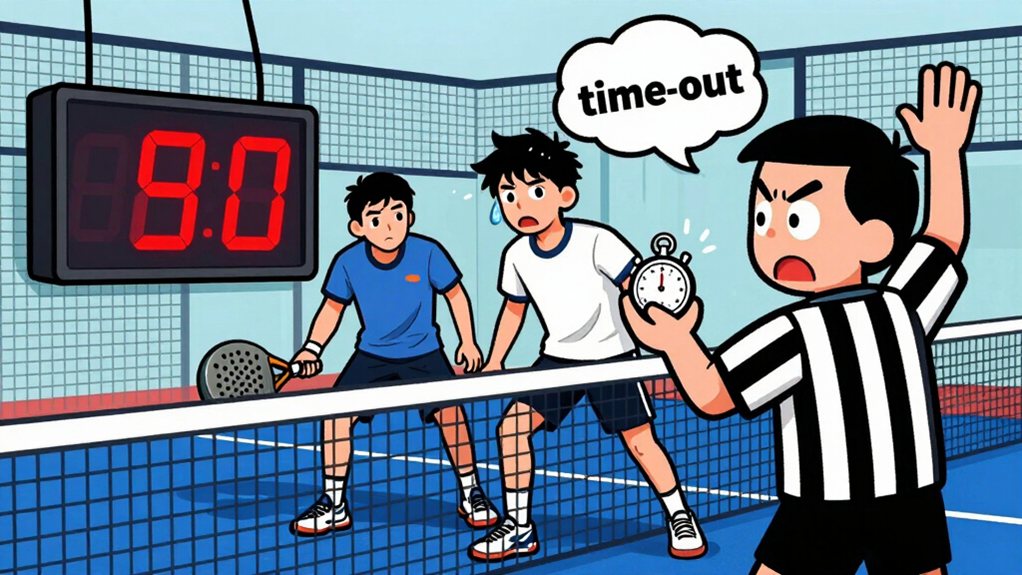
If you exceed the 90-second rest limit, you commit a time violation. The head umpire will issue a penalty after warning you once.
You can’t leave the court area without permission from the umpire, except when changing sides.
Time Violation Penalty
Although the rules allow 90 seconds between games, exceeding this limit results in a time violation penalty. The head umpire issues this penalty when you or your partner delay play without valid reason. We enforce this rule to maintain match pace and fairness.
- You receive a warning for the first offense during a set.
- A second violation costs you one point in the current game.
- Repeated violations lead to game penalties or disqualification.
You can’t leave the court area without umpire permission during rest periods. Exceptions exist only when changing sides.
Show courtesy and respect during all breaks. Keep track of time to avoid penalties.
Umpire Sanction Process
When you go past the 90-second rest limit, the umpire follows a clear sanction process to enforce the rules. First, you receive a verbal warning. Second, the umpire records the violation.
Third, repeated delays result in point penalties. Fourth, excessive violations lead to game forfeiture. The head umpire enforces all penalties. You must stay in the designated area during rests. You need umpire permission to leave. Respect and courtesy are required at all times. The umpire judges each situation.
| Violation | Sanction |
|---|---|
| First overstay | Verbal warning |
| Second overstay | Point deduction |
| Third overstay | Game loss |
| Fourth overstay | Match default |
| Extreme delay | Disqualification |
Leaving Court Restrictions
Building on the umpire sanction process, leaving the court during rest periods has strict limitations.
We’ve a maximum of exactly 90 seconds between games.
You can’t leave the court area without the umpire’s permission.
If you exceed the time limit, the head umpire will apply a penalty.
Follow these three rules:
- Stay in the designated rest zone until the umpire signals you may move.
- Request permission from the umpire if you must change sides or retrieve equipment.
- Exceeding the 90-second limit triggers a warning, then a point penalty, and could lead to disqualification if repeated.
When the 90-second timer ends, you must return to the court immediately or risk a penalty.
The umpire will signal the next game start shortly.
Abuse Penalties: What Behavior Triggers FIP Disciplinary Action?
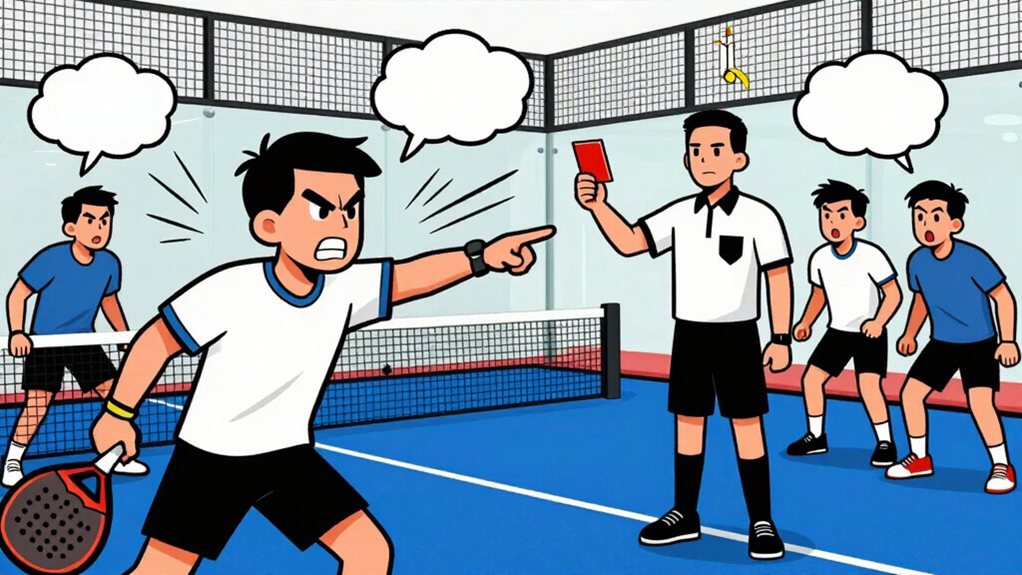
The FIP takes behavioral violations seriously. You must follow the code of conduct or risk penalties. Below are the behaviors that trigger disciplinary action:
- You use audible or visible obscenities.
- You hit the ball violently when it’s not ever in play.
- You throw or strike your racquet.
- You show aggression toward the umpire, opponent, or other players.
- Any incident is reviewed by the FIP Disciplinary Committee.
Penalties range from warnings and point deductions to match defaults or suspensions. You receive a warning for a first offense. A second offense can lead to a point penalty.
Continued or severe aggression may result in a match default or a serious ban from future events. You avoid trouble by staying calm, controlling your equipment, and respecting officials.
Temporary Court Rules: Ball Validity in Net Post Gaps
Understanding the temporary rules for ball validity in net post gaps protects you from losing points unfairly. Some court designs leave gaps between net posts and fencing. The ball is valid only if it travels higher than the net when passing through these gaps.
- Check the gap location before play starts.
- Observe the ball trajectory as it crosses the net.
- Accept the umpire’s decision without argument.
We must remember that this temporary rule applies to specific court configurations. The umpire enforces this rule during matches.
You can’t challenge valid calls based on personal opinion. When the ball travels through these gaps, it must stay above net height to count as valid.
Players should verify court measurements and understand these temporary rules before competing.
Frequently Asked Questions
Is the Ball Out if It Hits the Back Wall First?
If the ball hits the back wall first, it’s not out. The ball stays in play if it doesn’t go over or bounce twice. You can return it after contacting the back wall.
Can a Player Request a Medical Timeout During a Match?
Yes, you can request a medical timeout when injured or ill. The umpire decides if it’s valid. You’re typically allowed one brief timeout per match for legitimate medical issues requiring attention.
What Is the Maximum Warm-Up Time Allowed Before a Match?
Like a warrior sharpening their sword before battle, you’ve got 5 minutes to prepare your body and mind for the match. Use this time wisely to mentally and physically get ready for the competition ahead.
Are Coaches Allowed on the Court During Play?
Coaches cannot enter the court during play. You must remain in the designated coaching area outside the playing zone. Only players and officials are permitted on court while points are in progress.
How Many Points Are Needed to Win a Game in Padel?
Interesting fact: padel games use the same scoring system as tennis. You need 4 points to win a game, and you must win by at least 2 points. Games are played to 6, with a tiebreak at 6-6.
Final Thoughts
So, after all these rules, you now have a crystal-clear guide to padel regulations. We have solved the mysteries of waist-height serves, interference calls, ball changes, rest times, abuse penalties, and temporary court rules. You can step onto the court with complete confidence, knowing exactly when to play, when to pause, and when to protest.
Trust your knowledge, follow the FIP guidelines, and enjoy fair play. The game awaits you.