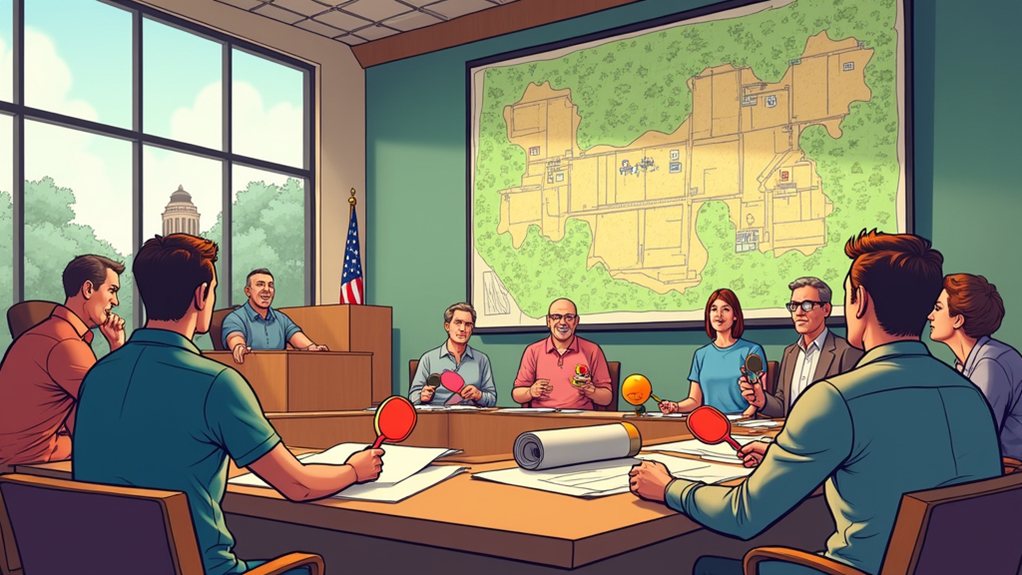
Gather demand data: conduct resident surveys, count existing players at local courts, document wait times, and cite the sport’s 11% annual growth. Recruit advocates from pickleball groups, fitness centers, and senior organizations. Host community meetings two weeks in advance using flyers and social media.
Prepare a council-friendly budget using $20,000,$40,000 per court, $5,000,$15,000 site work, $4,000,$7,200 fencing, and $1,800 lighting. Emphasize low annual maintenance of $500,$2,000 per court and explore grants like State Parks, Land and Water Conservation Fund, and Community Development Block Grants.
Present a proposal with letters of support from local clubs and neighborhood associations. For more details on funding strategies and objection handling, continue exploring the guide.
Why Your Community Needs Pickleball Courts (And How to Prove It)
Why should your community invest in pickleball courts? You should invest because pickleball is the fastest-growing sport in America.
Over 4.8 million Americans play now. This number grows eleven percent each year.
- Health Benefits
- Low-impact exercise suits all ages
- Improves balance, coordination, cardiovascular health
- Reduces healthcare costs for your community
- Social Connection
- Brings neighbors together
- Creates meeting point for all generations
- Builds stronger community bonds
- Economic Value
- Increases property values nearby
- Attracts new residents and businesses
- Courts cost less than many other recreational facilities
- How to Prove It
- Survey residents; include question about demand
- Count existing players at local courts
- Document wait times for court access
- Research similar successful projects in comparable towns

USAPA Approve Pickleball Paddles: The pickleball paddles of 2 are USA pickleball approved & with USAPA approval lable ith high safety and professionalism, and can be used in tournaments

USA Pickleball Approved: BAGAIL pickleball paddles have been approved by the USA Pickleball Association (USAPA) for tournament play, ensuring high safety and professionalism. Each paddle is manufactured strictly according to USAPA standards, and carries a USAPA approval label

【Top-Notch Slip-Resistance】The tread pattern rubber sole of Fitville mens pickleball shoes ensures anti-slip and long-lasting durability.
Building Costs 101: What You’ll Actually Spend
You need to know what you’ll spend, so we break it into three areas: • cost breakdown, • site work, and • additional amenities.
- Cost breakdown includes installation $14,500–$27,800, court surfacing $10,400–$25,600, fencing $4,000–$7,200, net and posts $1,200–$2,600.
- Site work covers clearing and leveling $5,000–$15,000, and 3. additional amenities add lighting $1,800, seating $1,200–$6,000, painting $250–$650.
Cost Breakdown
One major factor that determines your project’s success is understanding exactly where your money goes. Here’s where you can expect to spend:
- Surface installation runs $10,400 to $35,000 depending on asphalt or concrete choice
- Fencing costs range from $4,000 to $7,200 per court for perimeter and wind screens
- Nets and posts average $750 to $2,600 for permanent tournament-grade equipment
- Lighting systems add $1,800 per court for evening play capability
Expect to budget $20,000 to $40,000 for a basic outdoor court in 2026.
Your pitch should include these figures to show financial responsibility. Councils appreciate detailed cost breakdowns.
You demonstrate preparedness when you present specific numbers and clarity.
This builds credibility for your proposal.
Installing a smart energy monitoring system at your courts can help track and reduce ongoing electricity costs, particularly for lighting.
Site Work
Before building, the land must be prepared properly to guarantee a stable, long-lasting court. Site work is often the most overlooked cost in your budget. You’ll need to clear vegetation, remove rocks, and grade the terrain to create a level surface.
Here’s what you should expect:
- Site clearing and grubbing: Remove trees, stumps, and debris. This typically costs $2,000 to $5,000 depending on vegetation density.
- Grading and leveling: Grade the ground to proper elevation and slope for drainage. Grading costs range from $1,500 to $4,000.
- Soil compaction: Compact the subgrade to prevent future settling. This typically costs $1,000 to $2,500.
- Drainage installation: Install proper drainage to prevent water accumulation. Drainage systems cost $2,000 to $5,000.
Total site work typically ranges from $5,000 to $15,000, but costs climb higher if your site has notable slope, poor soil, or requires extensive excavation.
We recommend getting three site work bids from qualified contractors.
Additional Amenities
Once you’ve planned the basic court layout, consider additional amenities that improve playability and user experience. We recommend budgeting for lighting, seating, windscreens, and equipment storage.
Lighting runs roughly $1,800 per court and lets players use the facility after sunset.
Seating for players and spectators costs about $1,200 for on-court benches and $6,000 for tournament bleachers. Windscreens protect the play area from wind and provide visual branding, while equipment racks keep paddles and balls organized.
These additions raise the project cost but greatly boost community satisfaction.
- Lighting: $1,800 per court for LED fixtures.
- Player seating: $1,200 for on-court benches.
- Spectator seating: $6,000 for tournament bleachers.
- Windscreens and storage: $1,500 for screens and racks.
Your plan will meet council expectations fully.
Building Community Support Before You Pitch
- You gather local advocates while we identify key community leaders.
- We host community meetings to collect feedback and show support.
- We develop support materials such as sign‑in sheets, petitions, and cost summaries.
Gather Local Advocates
Building strong community support before you pitch to the council increases your chances of success. You need to gather local advocates who’ll speak on your behalf. These advocates add credibility and demonstrate widespread demand.
Start by identifying passionate pickleball players in your area. Look for people who already play at local parks or recreation centers. Approach them directly and explain your goal. Ask if they’ll support your initiative publicly.
Next, recruit non-players who benefit from community recreation. Fitness enthusiasts, parents with children, and senior citizens often support new recreational facilities. Their diverse perspectives strengthen your case.
- Identify local pickleball players who regularly use public courts
- Approach fitness groups, senior centers, and parent organizations
- Request written statements of support from potential advocates
- Build a contact list of advocates willing to speak at council meetings
Host Community Meetings
After you gather local advocates, host community meetings to build broader support for your pickleball court initiative.
These meetings create opportunities for residents to learn about your plans.
Secure a venue.
Choose a library meeting room, community center, or school gym.
Announce the meeting at least two weeks in advance.
Use flyers, social media, and local newspaper announcements.
Prepare a short presentation.
Explain the benefits of pickleball courts.
Highlight health benefits, property values, and community engagement.
Invite council members to attend.
Collect signatures on a support petition.
Ask attendees to share their contact information.
Record attendance numbers.
These numbers demonstrate community interest to council.
Follow up with thank-you emails.
Keep supporters informed of progress.
Your grassroots effort gains momentum through these meetings.
Develop Support Materials
Gather key documents to present your case to the council. You need a project summary, cost estimates, and community surveys.
Include letters of support from local residents, sports clubs, and health organizations. Your materials must show clear benefits and realistic budgets.
1. Project summary, Write a one-page overview.
Explain the need for courts, the proposed location, and the expected timeline.
2. Cost breakdown, Include site preparation, court surfacing, fencing, lighting, and amenities.
Use the $28,000 to $75,000 outdoor court range.
3. Community support evidence, Collect surveys, signatures, and letters from local organizations.
Show the number of residents who want courts.
4. Funding plan, Identify grants, public funding, and potential sponsorships.
Present multiple options for council consideration.
Making the Financial Case to Your Town Council
You must present clear cost figures and funding options when you ask your town council to approve new pickleball courts. Begin by showing the total price range. Outdoor courts cost between $28,000 and $75,000 per court.
Site preparation adds $5,000 to $15,000. Fencing runs $4,000 to $7,200 per court. Lighting adds $1,800 per court.
List these key expenses:
- Base court construction: $20,000-$40,000
- Site work and grading: $5,000-$15,000
- Fencing and perimeter: $4,000-$7,200
- Lighting systems: $1,800 per court
- Striping and coloring: $250-$650
Show the council how costs decrease with multiple courts. Calculate the total for two or four courts. Compare this to other recreational facilities. Point out the low maintenance costs of pickleball courts.
Emphasize the long-term value for community residents. Explain how user fees can generate revenue. Estimate potential income from programs and events. Demonstrate that the investment pays off over time.
Present all numbers in clear, simple formats. Avoid complex financial jargon. Keep your presentation factual and straightforward.
Winning Grants and Funding for Public Courts
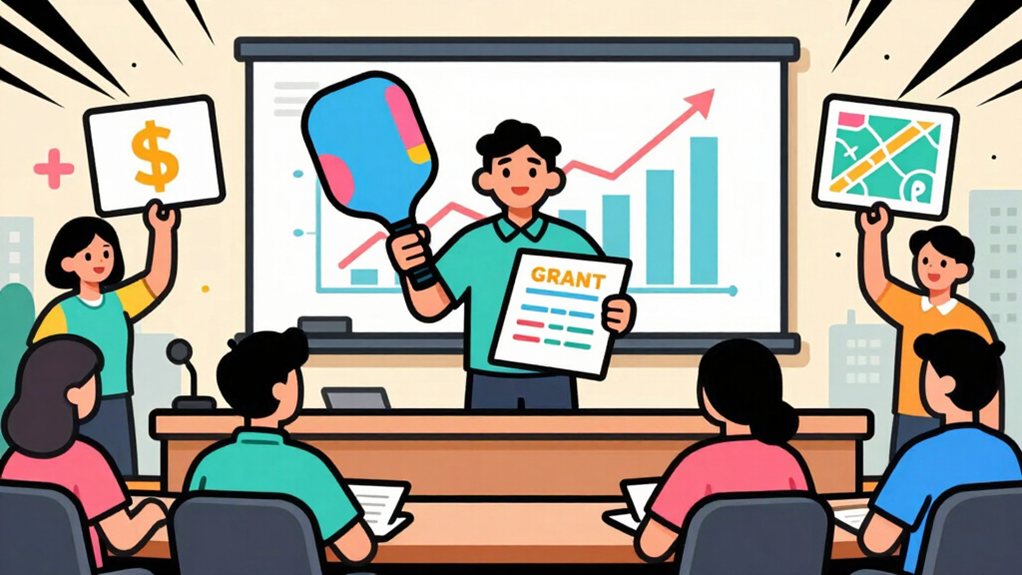
Securing grants and external funding can greatly reduce your town’s upfront costs for pickleball courts. You should research federal, state, and local grant programs that support community recreation projects. Many parks and recreation departments offer funding for public sports facilities.
Here are four funding sources to explore:
- State Parks and Recreation Grants, these often cover 50% or more of construction costs for public courts.
- Land and Water Conservation Fund, this federal program provides grants for outdoor recreational facilities.
- Community Development Block Grants, your town can apply for CDBG funds if the courts serve low-income areas.
- Private Foundations, local and national foundations sometimes fund community health and recreation initiatives.
You will need to submit proposals that demonstrate community need and long-term benefits.
Handling Objections About Maintenance and Costs
When council members raise concerns about maintenance and costs, we must be ready with clear answers and data.
You can counter their objections by presenting facts.
A new outdoor court costs $28,000 to $75,000.
Annual maintenance runs $500 to $2,000 per court.
Budget for monthly cleaning, net replacements, and crack repairs.
Prepare these points:
- Asphalt courts last 10-15 years with proper care.
- Concrete surfaces endure 20+ years.
- Lighting costs $1,800 per court and uses minimal electricity.
- Volunteers often handle routine upkeep.
Highlight community benefits.
Local players maintain courts through organized cleanups.
This reduces council burden.
Show that other municipalities report low maintenance costs.
Your research proves pickleball courts stay affordable year after year.

𝐒𝐭𝐮𝐫𝐝𝐲 𝐍𝐞𝐭: Upgraded and fine material make our net more tear-resistant, no breakage and deformation even though after being used 2 to 3 years. Side sleeves of 4 inches are made of waterproof and UV-resistant 600D polyester fabric, 1.5 inches knoted PE net is durable. And the top of net boasts 420D polyester fabric while the bottom of net has great elastic hem. All of these make our net definitely stable.

EVERYTHING YOU NEED: Our pre-measured pickleball court marking kit includes (2) sidelines, (2) baselines, (2) middle serve lines (2) kitchen lines, and net hash marks, all ready to peel-and-stick. Each kit includes step-by-step illustrated instructions to guarantee a perfectly square, regulation court — even for first-time installers.

PLAYER LEVEL: Designed for the entry level, occasional player. For frequent players, we recommend the Express Light Pickleball Shoe. Advanced players and players playing 6-7 days per week, the Pickleball Supreme Shoe is the recommended style
Presenting a Proposal Council Members Can’t Refuse
Now that you have responses ready for cost concerns, your next step involves creating a proposal that wins council support. You need a document that shows clear benefits, realistic budgets, and community backing. Frame your request around measurable outcomes and local priorities.
Win council support by presenting clear benefits, realistic budgets, and measurable outcomes rooted in community priorities.
- Executive summary with project scope, timeline, and expected usage numbers
- Detailed cost breakdown using current market rates ($20,000-$40,000 per court)
- Letters of support from local clubs, schools, and neighborhood associations
- Funding strategy that includes grants, sponsorships, and municipal allocation options
Present these elements in a clean, organized format.
Council members review many requests. Your proposal must stand out through clarity and completeness.
Use visual charts for cost data.
Keep each section under two pages.
Follow your presentation with a question-and-answer period.
Prepare for detailed questions about maintenance, site selection, and timeline.
Your thorough preparation signals that you have thought through every aspect.
This level of detail convinces council that you’re ready to execute.
Keeping Momentum Alive After Approval
Maintain the energy around your new pickleball courts by establishing clear communication channels and regular community engagement. You need to keep residents informed about construction timelines, court opening dates, and scheduled programming. We recommend creating a dedicated email list, social media group, and monthly newsletter to share updates.
Use this engagement schedule to maintain momentum:
| Month | Action Item | Goal |
|---|---|---|
| 1 | Form a community pickleball committee | Organize volunteers |
| 3 | Host a beginner clinic | Attract 30+ players |
| 6 | Organize a tournament | Build community spirit |
You must follow up with council members quarterly to make certain court maintenance and lighting upgrades proceed as promised. Document all community feedback and share it with local officials. This approach guarantees long-term success for your pickleball facilities.
Frequently Asked Questions
How Long Does the Entire Pickleball Court Project Take From Start to Opening?
You can expect your pickleball court project to take 6 to 12 weeks from start to opening, including planning, permits, site prep, and construction, but your timeline may extend if you encounter zoning or weather delays.
What Permits and Zoning Approvals Are Required to Build a Public Court?
Zoning laws can crush dreams or build them, you’ll need zoning variances, site plan approval, building permits, environmental impact studies, and sometimes conditional use permits. Check local codes; residential zones often reject public facilities while commercial areas welcome them.
How Can We Address Noise Concerns From Nearby Residents During Court Use?
Install noise-dampening fencing and windscreens around the court perimeter. Schedule play during reasonable daytime hours. Host community meetings to address resident concerns and demonstrate your commitment to being good neighbors.
What Insurance and Liability Considerations Should We Include in Our Proposal?
Your proposal must outline general liability coverage requirements, participant waiver protocols, property insurance needs, and risk mitigation measures like proper signage, regular maintenance schedules, and usage guidelines to protect the council from potential legal lawsuits.
How Do We Select the Most Suitable Site for a New Pickleball Court?
Selecting a site is like choosing fertile garden soil, you’ll need level ground, proper drainage, easy access, and room to expand. Analyze terrain, soil conditions, utilities, and zoning carefully before committing your community’s future plans.
Final Thoughts
You present your case with three final actions: 1) Summarize community need and the 35% rise in pickleball participation since 2020. 2) Show cost-benefit analysis, including grant matches and low maintenance fees. 3) Deliver a proposal with a site plan, timeline, and contact list. Follow up within 10 days to confirm council vote.
- We’ll secure endorsement from Parks Director before meeting.
- Provide a budget summary showing $15,000 start-up cost and $2,000 yearly upkeep.

🎾CONTAINS 28 MARKERS: 10 yellow I-shaped and orange I-shaped, 4 yellow L-shaped and orange L-shaped.(After receiving it, please press the court sticker firmly on a flat surface for a few minutes to restore its shape.)
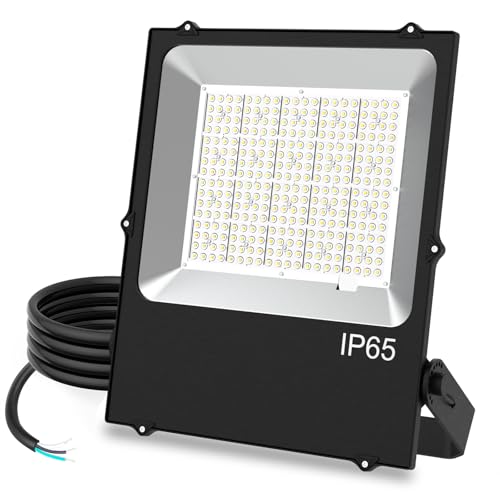
Super Bright & Energy Saving – This 300W LED flood light delivers an impressive 42,000 lumens of crisp 5000K daylight, ideal for large outdoor spaces. Save up to 80% on electricity compared to traditional lighting while enjoying ultra-high brightness and low energy consumption

CREATES A FULL SIZED PICKLEBALL COURT: The Professor Pickleball outdoor pickleball court tape measures 200 feet long and 2 inches wide, providing enough tape to create pickleball lines for an entire outdoor court! Perfect for temporary court setups or quick repairs!