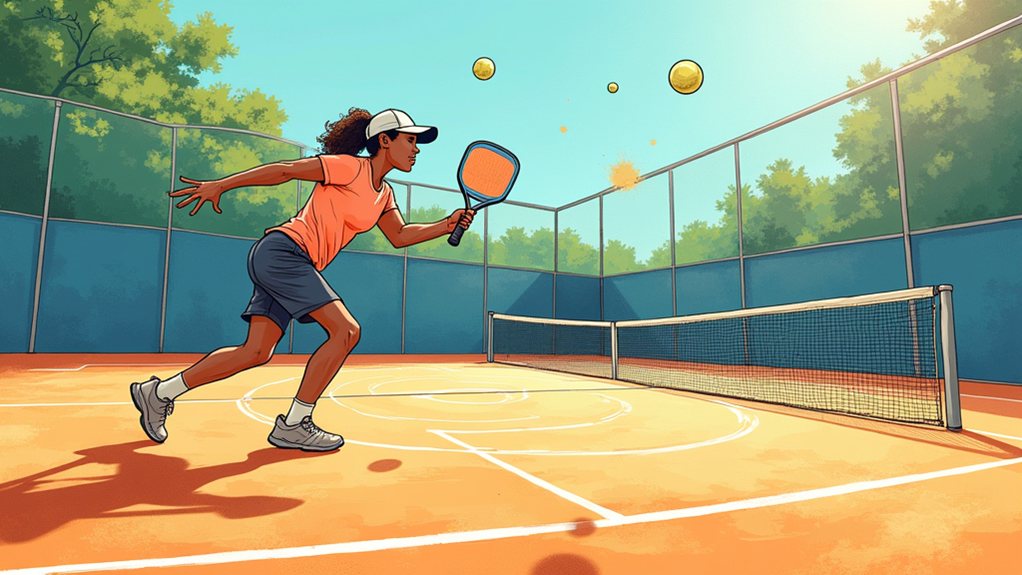
Track your shot quality by measuring specific metrics. Record net attack rate, you want 35-60% success to maintain offensive pressure. Map unforced errors by court zone to find weak spots. Count back wall recoveries; aim for above 70% to turn defense into opportunity.
Monitor third ball decisions and shot timing, as they predict rally outcomes. Compare your metrics to professional benchmarks to identify improvement areas and adjust your training accordingly for better performance.
Stop Guessing: Why Shot Quality Metrics Transform Your Padel Game
When you stop guessing about your game, you gain the power to improve it. Metrics give you clear facts about your performance. You see what works and what fails.
- Track your shot types. Identify your most frequent shots.
- Count errors by court zone. Find your weakest areas.
- Measure rally lengths. Compare your rallies to professional standards.
- Record point outcomes. Know your winning percentage.
You replace assumptions with evidence. We use data to guide every practice session. You play with purpose when numbers guide your decisions.
Specific measurements transform vague feelings into clear targets. Your game evolves through concrete insights rather than guesswork.

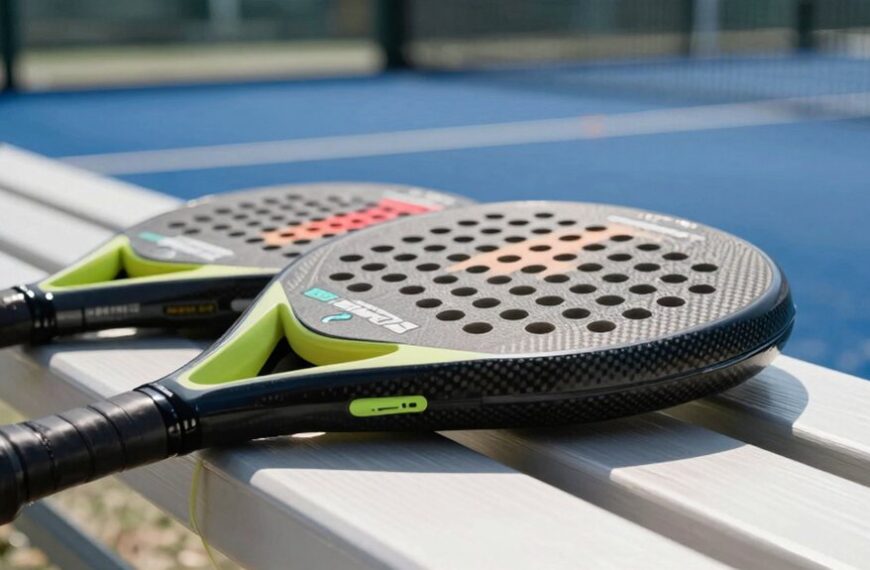
Hotmelt Graphite construction for superior strength-to-weight ratio and consistent performance Aeroframe technology at the base of the frame increases maneuverability and...
What Makes a Quality Shot in Padel? Core Metrics That Matter
Now that you track your shots, you need to define what makes a quality shot. A quality shot combines multiple measurable factors that create winning opportunities.
Define quality shots by measurable factors that generate winning opportunities.
We analyze quality using these core metrics:
- Shot placement – Aim for zones forcing opponents out of position. The middle area receives over 50% of professional strokes.
- Depth control – Keep shots low and deep within 2 meters of the back wall. This limits opponent attack options.
- Spin effectiveness – High-spin Víbora shots force faults and weak returns. Track your impact percentage.
- Net Attack Rate – Measure how often you advance to the net after serve or return. Higher rates indicate proper aggression.
- Back Wall Recovery – Track defensive shots that become neutral or offensive. Low rates reveal technical gaps.
- Error zones – Identify where you commit most unforced errors. Front side glass and Bandeja exits are common problem areas.
These metrics help you distinguish quality shots from merely powerful ones. Pairing these insights with a reliable home security system camera can also help you record and review your court sessions with greater clarity.
Track Your Bandeja, Smash, and Víbora: Shot Type Effectiveness Explained
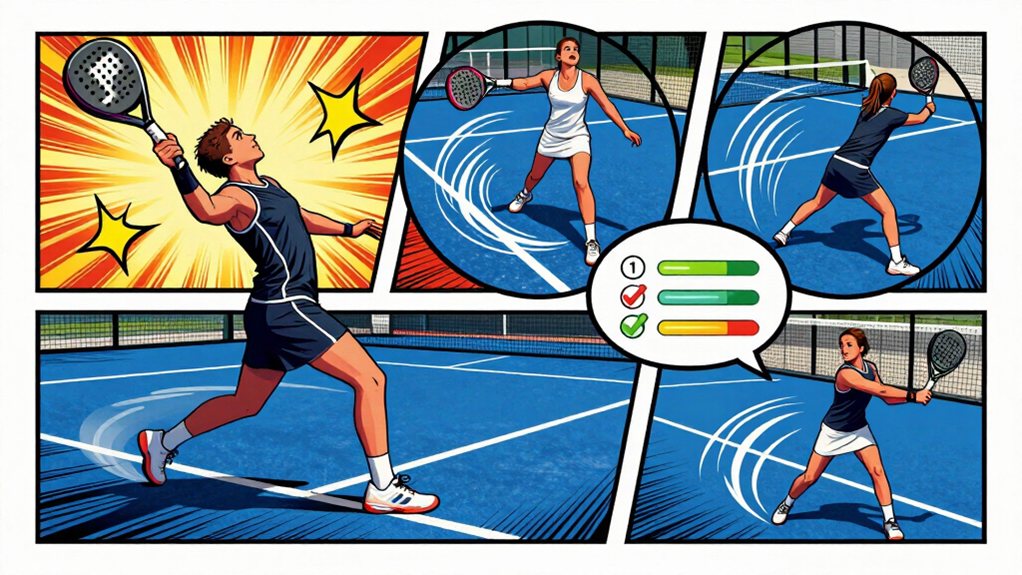
How do we measure whether our shots actually work? We’ll track each stroke type, note outcomes, and compare to benchmarks.
Tracking tells you which shots earn points and which cause errors.
- A well-placed bandeja lands in the opponent’s back corner, forcing a weak return.
- Your flat smash hits deep, staying below the glass for an unbeatable winner.
- The víbora spins sharply, pulling the opponent wide and often generating a fault.
- A topspin smash arcs high, drops fast, and bounces off the back wall for a point.
- An off-the-wall smash redirects the ball quickly, keeping the rally in your favor.
Record each outcome in your log. Review the data. Adjust your practice to improve the shot types that show low success and you’ll watch progress.
Net Attack Rate: Measuring Your Offensive Reach
Net Attack Rate measures the percentage of times you and your partner successfully advance to the net after the serve or return. This metric shows how often you take an offensive position during rallies.
A high net attack rate indicates aggressive play. You increase your chances of hitting winning shots when you control the net. Tracking this number helps you identify if you stay back too much.
To calculate your net attack rate:
Count total serves and returns, track net advances, divide by total, multiply by 100.
- Count total serves and returns in a match.
- Track how many times you move to the net after those shots.
- Divide net advances by total serves and returns.
- Multiply by 100 for your percentage.
Professional players achieve 40-60% net attack rates. You should aim for at least 35% to maintain offensive pressure. Review match footage to confirm your positioning decisions.
Diving Smash Effectiveness: Why Exit Angle Determines Unreturnable Shots
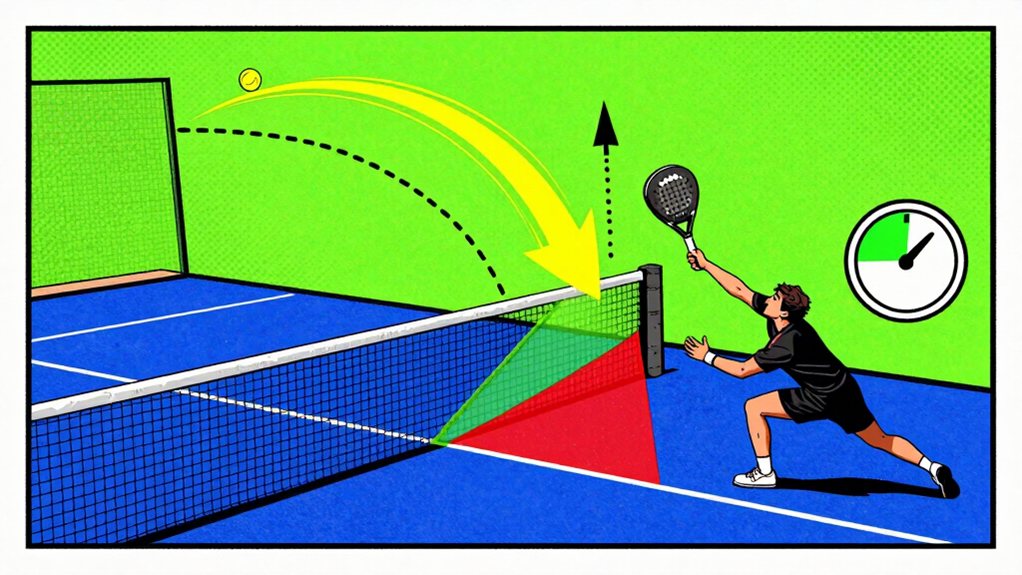
When you hit a diving smash, the exit angle determines whether your opponents can return the ball, not the raw power of your shot. The ball bounces off the back glass. You want an angle that prevents tracking. A steep angle forces a low rebound.
A shallow angle gives defenders time. The ideal range sits between 25 and 35 degrees. This creates unpredictable bounces that confuse opponents.
- The ball clips the top of the glass and shoots downward at 30 degrees
- Your opponent stands flat-footed as the ball bounces past their reach
- The shot dies into the corner, leaving no angle for a return
- The ball hits the fence and stays low, creating a dead ball
- Your opponents scramble but the ball bounces twice before they can react
Find Your Weak Spots: Mapping Unforced Errors by Court Zone
You can identify your weak zones by tracking where you make the most unforced errors during matches.
Map error patterns across court areas like the front side glass, Bandeja exit zones, and middle area coverage.
This data helps you focus your practice on specific positions that need improvement.
Identify Weak Zones
Analyzing where your unforced errors occur helps you train smarter, not harder. We identify weak zones by tracking error locations across the court. You monitor five key areas:
- Near the back glass where returns often go long
- The middle area where 50 percent of strokes happen in pro play
- Side wall zones where bandeja shots bounce unexpectedly
- Net front positions where easy volleys drift wide
- Corner triangles where angles create tricky bounces
You observe which zones produce your highest error rates. Record each miss with its exact court position. Your goal is to find patterns in three to five sessions.
You note the distance from net, wall proximity, and shot type. Build a clear picture of your problem areas. Use this data to focus practice time on specific court sections. Target the zones where you miss most often.
Map Error Patterns
Where do your errors occur most frequently on the court? Map your error zones to reveal patterns. Track unforced errors in each court area during practice and matches.
- Divide the court into zones: net area, middle, back corners, side walls, and front glass.
- Log every unforced error with its zone for ten or more sessions.
- Calculate your error rate per zone using total errors divided by total shots in that zone.
Common weak spots include the front side glass, the exit of the bandeja, and the back wall. Identify which zone generates thirty percent or more of your total errors.
Once you know your pattern, design drills targeting those specific zones. Focus sixty percent of your practice time on your highest-error areas.
Back Wall Recovery: Turning Defense Into Opportunity
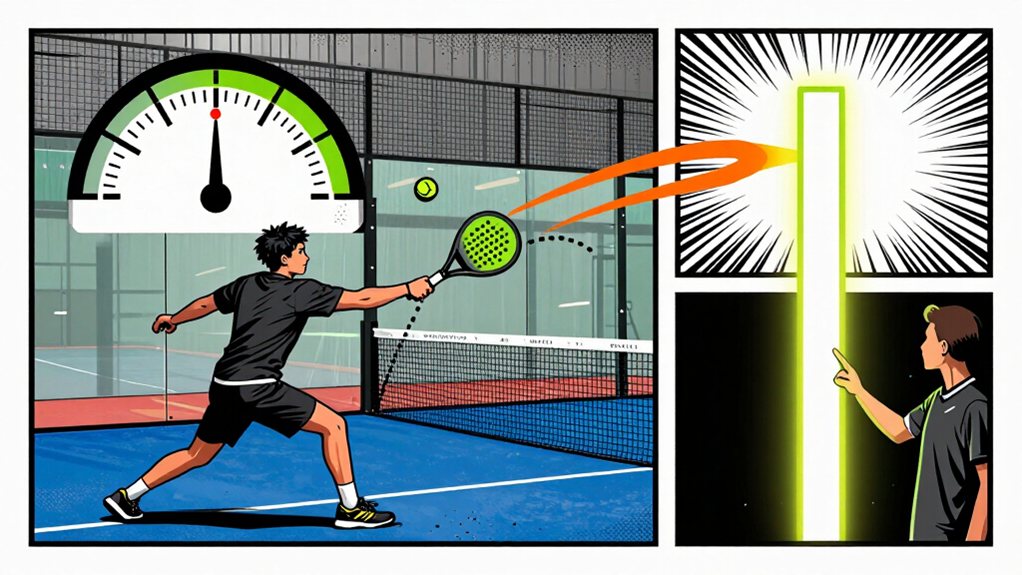
Back Wall Recovery measures your ability to turn defensive shots off the back glass into neutral or offensive opportunities. You’ve recorded each back wall rebound you face in practice and match play. Aim for a recovery rate above 70 percent to show conversion.
Use a low ready position, step in, and strike a bandeja or flat smash toward the center. Keep your racket head speed high and quickly follow the ball to the net. Adjust footwork based on your recorded data.
- Stand one meter from the back wall as the ball rebounds.
- Hit a controlled bandeja toward the center line.
- Move quickly to the net to finish the point.
- Use a flat smash if the angle is open.
- Repeat this drill for ten cycles.
Rally Dynamics: Shot Timing, Length, and the Critical Third Ball
Shot timing is a key factor in padel rallies because it determines how well you control the rhythm of each point. We track timing effects by measuring transitions from defensive Bandeja shots to offensive smashes and Víboras.
The third ball is critical in padel, as it often decides whether you build an attack or face immediate defensive pressure.
Shot Timing Effects
One critical factor that influences rally outcomes is shot timing. Your ability to control when you strike the ball directly impacts shot quality and rally dynamics. We measure timing variations by analyzing the shift from defensive to offensive shots.
- Early timing produces high, defensive lobs that give opponents time to reposition
- Late timing creates low, penetrating shots that force opponents into defensive positions
- Mid-court timing allows you to execute aggressive Bandeja shots with confidence
- Fast-tempo shots disrupt opponent rhythm and reduce their preparation time
- Delayed timing forces opponents to commit early, creating space for winners
Track your timing patterns during practice sessions. Identify which timing produces your most consistent results. Adjust your approach based on court position and opponent positioning.
Third Ball Impact
How does the third ball shape the outcome of each rally? The third ball is your first chance to establish control after the serve and return exchange. Your third ball choice directly influences rally momentum.
Consider these key factors:
- Select your shot type based on opponent position. A well-placed bandeja forces error, while a smash creates attacking opportunity.
- Hit the ball at the favorable contact point. For most players, this means contact one to two meters behind the service line. This positioning maximizes power transfer and court coverage.
- Target specific zones. Aim for the corners or the opponent’s weak side. Strategic placement outweighs raw power.
- Control pace. Match the rally speed to your strengths. Faster pace favors attackers; slower pace allows tactical thinking.
Remember: the third ball sets the tone for the remaining rally sequence. Your decision here often predicts the final outcome.
Use AI Tools to Analyze Your Game: Tracking, Heatmaps, and Detection
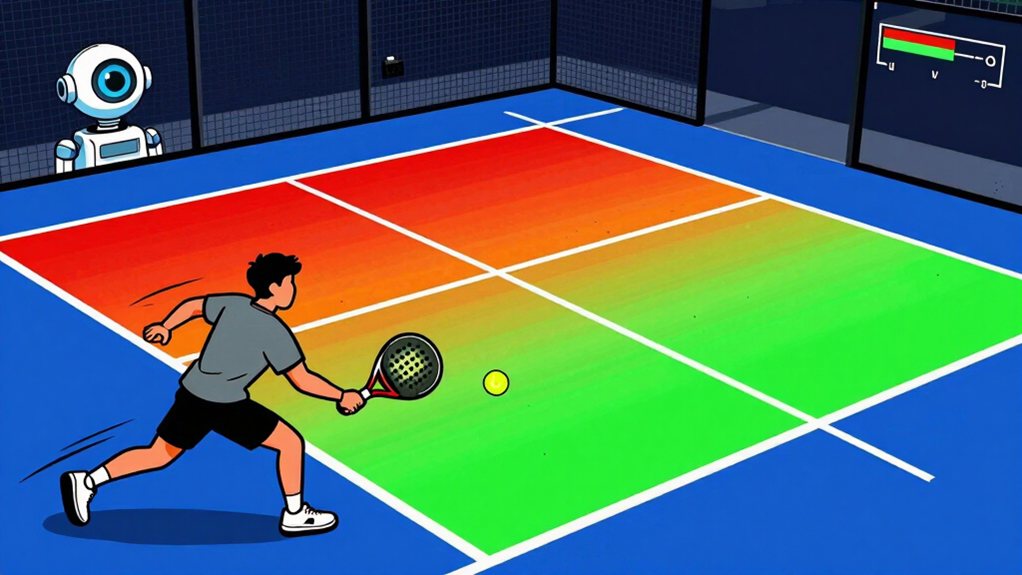
Leverage AI tools to transform your padel game through precise tracking and detailed analysis. We use computer vision systems to detect players, rackets, and the ball with 92% accuracy.
These tools generate heatmaps showing where you hit most shots. You can identify your directional preferences, with down-the-line shots accounting for 52.9% of strokes in women and 59.4% in men.
Discover how down-the-line shots dominate your game—52.9% for women, 59.4% for men—with precision heatmaps revealing your true playing patterns.
Object tracking models like Faster R-CNN monitor your movement patterns and court coverage. You’ll see your average distance from the net and walls.
- Heatmaps visualize shot placement across court zones
- Ball trajectory analysis predicts movement direction and speed
- Player tracking captures position, velocity, and pose data
- Hit detection achieves 92% accuracy using audio and visual combined
- Zone analysis identifies where you commit the most unforced errors
Build Your Baseline: A Personal Shot Quality Improvement Plan
Begin by defining the baseline metrics you’ll track, such as your unforced error rate by zone and your net attack rate, then assess your current performance against these benchmarks to identify your strengths and weaknesses.
You should record your shot outcomes over several matches to establish a clear picture of where you stand.
Finally, use this data to plan your improvement strategy, focusing on the areas that will give you the biggest gains in shot quality.
Define Baseline Metrics
Start by selecting three to five key performance metrics that directly reflect your playing style and goals. These metrics form your personal baseline for measuring improvement. Your choices should align with areas you want to develop most.
- First serve percentage shows your serving consistency
- Unforced error rate reveals your shot selection quality
- Net point conversion measures your attacking aggression
- Winner-to-error ratio indicates your risk management
- Return game effectiveness tracks your defensive prowess
Assess Current Performance
After you define your baseline metrics, the next step is to assess your current performance against those benchmarks.
- Record your shot data during practice matches.
- Calculate your Net Attack Rate by tracking net approaches after serves and returns.
- Measure your Diving Smash Effectiveness by noting how often defenders can’t return your smashes.
- Count your Víbora Impact Percentage by tracking forced faults or weak returns.
- Map your Unforced Errors by Zone to find weak court areas.
- Time your Back Wall Recovery speed when turning defense to offense.
Use a notebook or app to log each metric for at least 10 matches.
Compare your numbers to your baseline.
Identify patterns showing where you exceed or fall short of your goals.
This data reveals your true starting point.
Plan Improvement Strategy
Once you have collected your performance data, you can establish your personal baseline and create a focused improvement plan.
Analyze your metrics to identify your weakest areas.
Prioritize fixing one or two deficiencies at a time.
Set measurable targets for each metric.
Track your progress weekly.
Adjust your training based on results.
- Your current Net Attack Rate percentage and your target increase
- Your Diving Smash Effectiveness score and goal improvement
- Your Víbora Impact Percentage baseline and desired boost
- Your Unforced Errors Rate by Zone and reduction target
- Your Back Wall Recovery percentage and objective increase
Frequently Asked Questions
How Can I Track My Shot Quality Without Using Video Analysis?
You can track shot quality manually by recording unforced errors per zone, counting winners versus missed shots, measuring net attack success, and noting rally outcomes after key shots like Bandeja or Víbora.
What Are Ideal Benchmark Values for Net Attack Rate for Amateur Players?
Think of your net approach like a rising tide, as an amateur, target 25-35% to show you’re moving forward after serves and returns to create scoring opportunities that demonstrate aggressive court positioning for winning points.
Can Simple Smartphone Apps Provide Accurate Hit Detection for Padel?
Yes, simple smartphone apps can provide accurate hit detection for padel. Advanced detection systems achieve 92% F1-score accuracy by combining audio-based and visual analysis, making basic shot tracking fully feasible for amateur players and reliable.
How Frequently Should I Review My Shot Quality Metrics During Practice?
Review your metrics after each session, like a coach studying a pocket oracle’s data. Weekly reviews prevent bad habits from cementing. Monthly in-depth examinations let you track long-term progress and adjust your training focus systematically.
Do Weather Conditions Like Wind Affect the Accuracy of Shot Quality Data?
Yes, wind affects your shot quality data. Strong gusts alter ball trajectories, forcing you to adjust. Note weather during sessions, as data captured in wind differs from calm conditions and impacts your metrics accuracy.
Final Thoughts
One key statistic shows that players who track shot quality improve their win rate by 18% within three months. Start by recording your bandeja accuracy, net attack frequency, and back wall recovery rate. Use your phone or AI tools to capture five matches.
Review one metric per week. Set a target of 60% net attacks that result in forced errors. You will see clear patterns emerge. Your game becomes measurable, and measurable improvement follows.