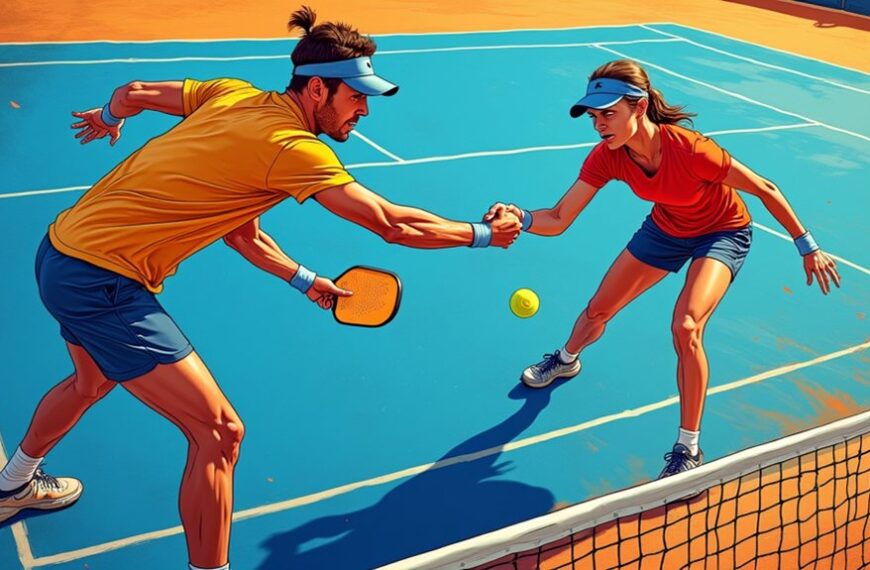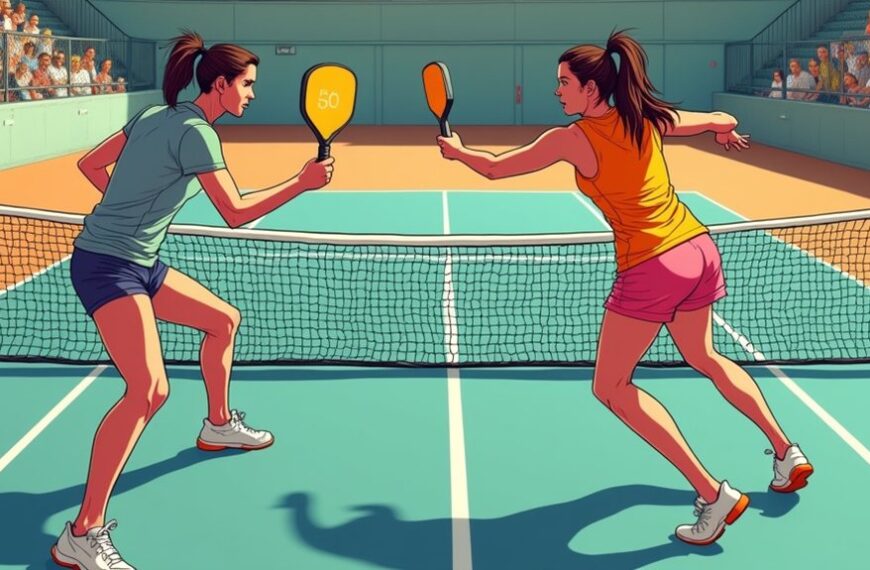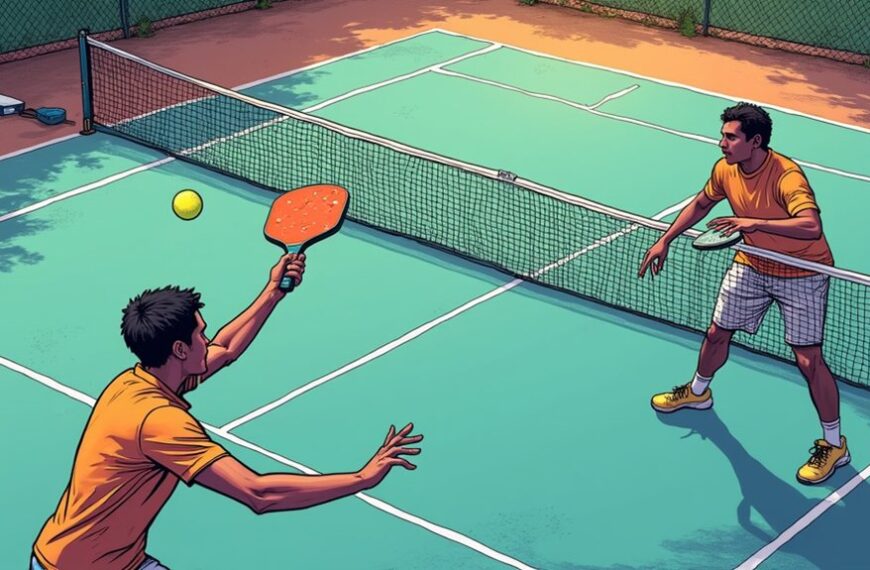
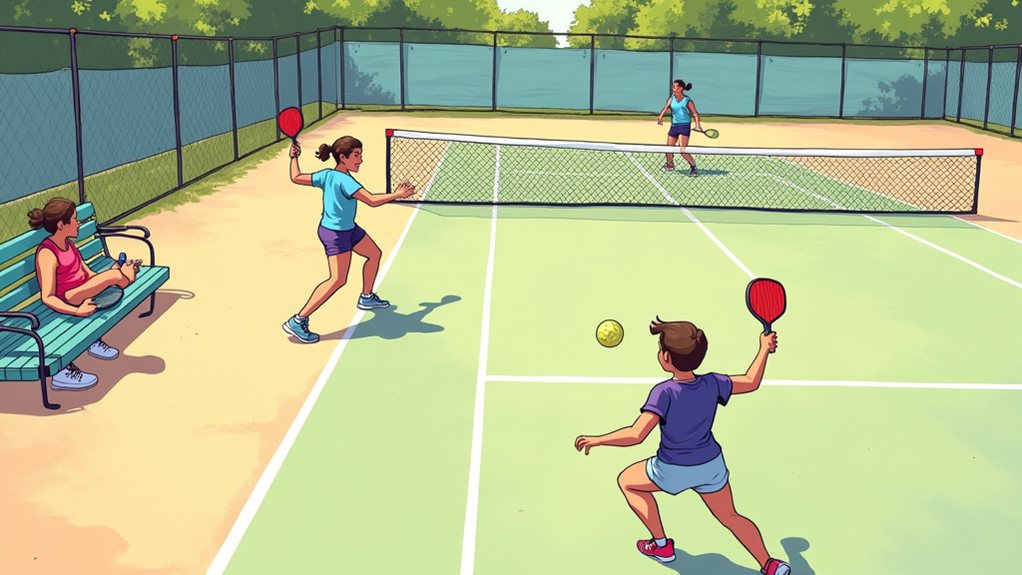
IFP rules: 1) 20 ft by 44 ft court; net 36 in at sidelines, 34 in center. 2) Serve: keep feet behind baseline, sidelines, swing upward, paddle below wrist. 3) Ball bounces once on each side before volleying. 4) NVZ: 7 ft from net; you can’t volley inside unless the ball bounces. 5) Points only for serving side; game to 11 with lead. 6) Call “out” only when sure; any visible gap is “in”. There’s more on faults and disputes.
Pickleball Court Dimensions and Layout
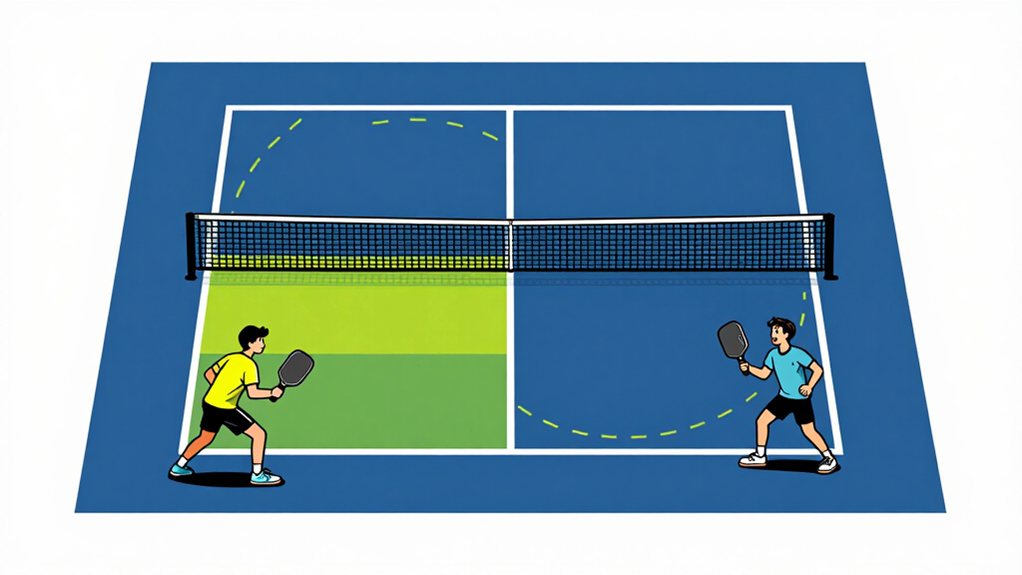
Pickleball is played on a rectangular court with specific dimensions and marked lines that define play areas. The international pickleball federation sets global pickleball rules for court specifications. According to ipf pickleball rules, the court measures 20 feet wide by 44 feet long for both singles and doubles play.
The court is 20 feet wide by 44 feet long, the standard set by the international pickleball federation; both singles and doubles share these dimensions.
Key court features include:
- Baselines run parallel to the net at each end of the court.
- The Non-Volley Zone (NVZ) extends 7 feet from the net on each side.
- Sidelines run perpendicular to the baselines.
- A centerline divides each side into two service courts.
- All lines measure 2 inches wide and must be clearly visible.
The net stretches 36 inches high at the sidelines and 34 inches at the center.
You must stay aware of these dimensions during gameplay. This guarantees proper positioning and fair play for all players.

[Oversized 44x20 Feet Template] Complete pickleball court marking template perfect for backyards, schools, and clubs. Easily create accurate, professional-grade courts for family fun, school sports, or club play, enhancing every pickleball experience with precise and durable court lines.

SLIM 2in1 PICKLEBALL NETS PORTABLE OUTDOOR-On the basis of 4.0 Slim Version pickle ball net, including the addition of an 11FT net, specially designed for individual practice and lightning-fast competitions. And 22FT meets the official pickleball size regulation. NOTE: SLIM 2in1 PICKLEBALL NETS includes 22 FT and Half Court 11 FT nets and one set of base, so you must choose between an 11 FT or 22 FT setup.
How to Serve in Pickleball
When you serve in pickleball, you’ll keep your feet behind the baseline and within the sidelines or centerline extensions. Your paddle must swing in an upward arc at contact, with the head no higher than your wrist; you may forehand or backhand.
Key points: 1) foot behind baseline inside sidelines, 2) upward arc with paddle head no higher than wrist, 3) drop serve’s allowed.
A strong home network with a mesh wifi system extender can ensure your live-streamed pickleball matches and rule updates load without interruption.
Serve Foot Position
As you prepare to serve, keep both feet behind the baseline and within the sideline or centerline extensions. Stay behind the baseline until the ball contacts your paddle.
A foot that crosses or touches the baseline before contact is a foot fault. In doubles, stand on the right side when your score is even and on the left side when it’s odd. Singles follow the same side rule.
Keep your weight balanced and don’t step forward during the swing. These rules apply to every serve.
- Position both feet behind the baseline.
- Align with the correct side based on your score.
- Keep feet behind the line until you hit the ball.
- Keep feet inside the sideline or centerline extensions.
Serve Motion Rules
The serve motion follows specific requirements to guarantee a legal service. You swing your arm in an upward arc at contact, using a forehand or backhand grip. Your paddle head must not rise above your highest wrist point when you strike the ball.
A drop serve removes the upward arc requirement and height restriction, letting you release the ball and hit it after it bounces once.
Key motion rules:
- Arm moves upward at contact
- Paddle stays at or below wrist height
- Drop serve option available for all players
Serve Motion Types:
| Type | Requirement |
|---|---|
| Standard | Upward arm arc, paddle below wrist |
| Drop Serve | Ball drops naturally before contact |
You maintain this motion until you complete each serve. The ball must travel diagonally to your opponent’s court. If you violate these motion rules, you lose the rally. Practice both serve types to keep opponents guessing.
Essential Rules After the Serve
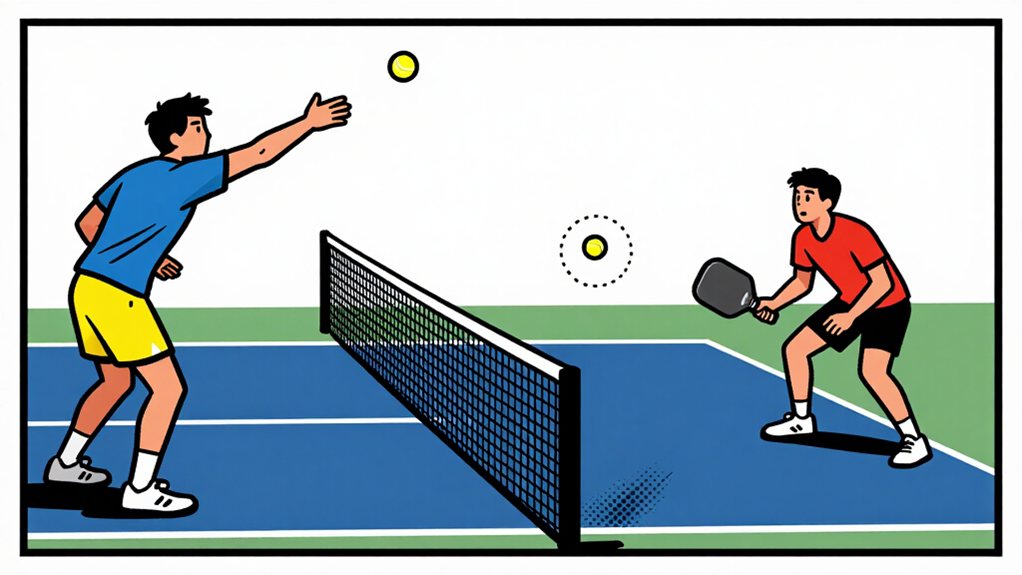
After the serve, you must follow the two-bounce rule, which requires each side to let the ball bounce once before volleying.
You can’t volley the ball while standing inside the 7-foot non-volley zone (NVZ) unless it has first bounced.
Make your line calls promptly and confidently; call the ball “out” only when you’re certain it’s beyond the baseline, sideline, or centerline.
Two-Bounce Rule
When the ball is served, both teams must let it bounce once before volleying. It’s called the two-bounce rule. It guarantees both sides get a fair chance after the serve.
You must let the serve bounce once. Then you must hit the ball after it bounces once on your side. After that, you can really volley the ball in the air.
Your team gets two groundstrokes before volleying officially begins. The receiving team also gets two groundstrokes.
This rule keeps the game fair and preserves traditional pickleball skills. Both teams have equal opportunity to fully control the rally. Failure to follow this rule results in a fault.
| Situation | Action Required |
|---|---|
| Serve lands | Let it bounce once |
| First return | Let it bounce once |
| After two bounces | Volley allowed |
NVZ Faults
If you want to avoid faults near the net, you must understand the Non-Volley Zone rules.
The NVZ is a 7-foot area on each side of the net, and it defines where volleying is restricted.
- No volleying inside the 7-foot NVZ unless the ball has bounced first. That’s a fault.
- You may step into the NVZ after the ball bounces; entering before the bounce is allowed.
- You can volley from outside the NVZ, but you must stay outside after the hit.
- Erne shot: you may jump diagonally over the NVZ on your own side to hit a volley.
- Your partner may be in the NVZ during your volley if they don’t touch the ball.
Follow these rules always.
Line Call Guidelines
Because line calls determine points, you must know the official guidelines.
- Call “out” only when you’re certain the ball lands outside the line. Make your call before the ball bounces twice or before your opponent hits it.
- If you and your partner disagree on whether a ball was “in,” the “in” call wins.
- You can’t ask spectators for input. Base your calls only on what you see.
- Keep clear space between the line and the ball when you call “out.” A ball touching the line counts as “in.”
- Don’t discuss line calls with your partner during play. Focus on your own observations.
The NVZ: Volley Restrictions at the Net
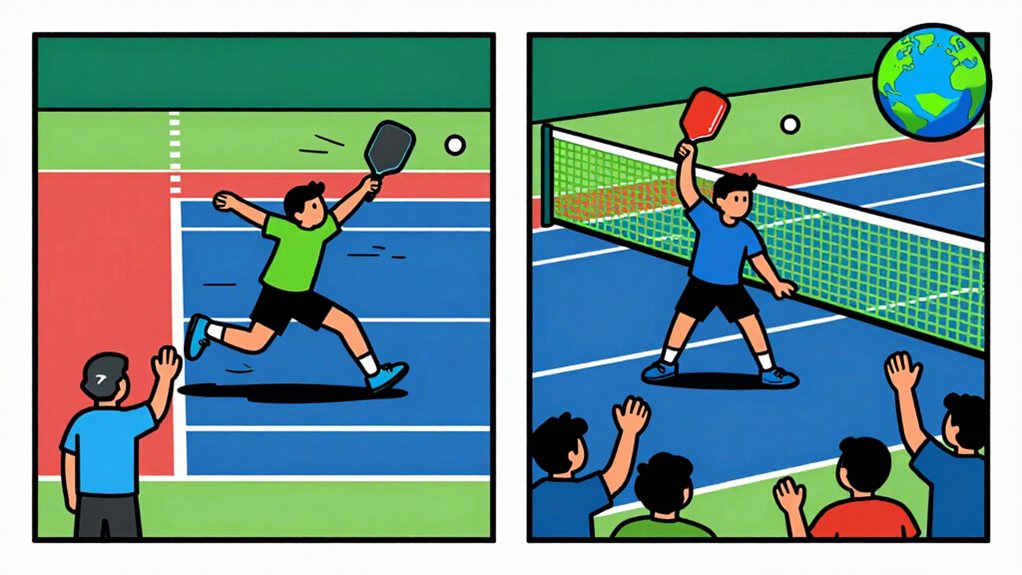
The Non-Volley Zone (NVZ) is the 7-foot area extending from the net on each side of the court. This zone creates specific rules you must follow.
Key Volley Restrictions:
- You can’t volley the ball while standing inside the NVZ.
- Your feet must stay out of the NVZ when volleying.
- You may volley from outside the NVZ but must stay outside after the hit.
- A fault occurs if you touch the NVZ during or after a volley.
- Your paddle can’t enter the NVZ during volley contact.
The Erne Shot Exception:
- You may jump over the NVZ on your own side to execute a volley.
- You must land outside the NVZ after the shot.
- Your partner may be in the NVZ when you volley if they don’t touch the ball.
Pickleball Scoring and Winning
Now let’s examine how points are accumulated and how matches are won. You score a point only when your side serves and you win the rally. If the serving side loses the rally, the serve passes to the opponent and no point is awarded.
Games are played to 11 points; you’ll win by at least two points now. Tournament games may be played to 15 or 21 points, also requiring a two-point margin.
Every rally counts the same, from the first point to the final match point. The server continues serving until a fault occurs, then the other side becomes the server.
The same scoring rules apply in singles and doubles.
- Points only on serve.
- Win rally, you score.
- Reach 11, lead by two.
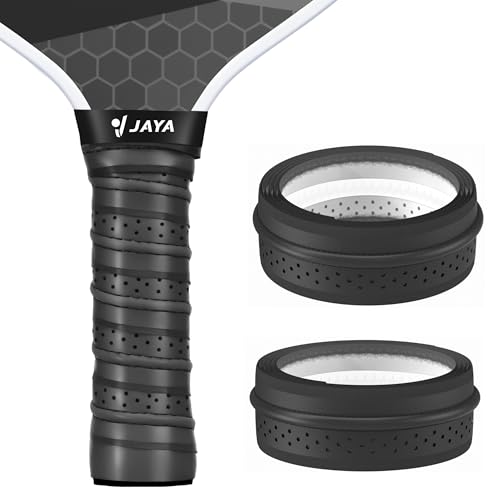
【Enhanced Grip and Stability】The pickleball grip tape features a unique ribbed design with built-in spine cord, providing improved grip strength and stability during intense gameplay

A Specialized Brand for Pickleball - Our professional design team is dedicated to creating top-quality lead tape for the highest level of Pickleball competition. Trust that our lead tape you're getting is the best.

OFFICIAL PADDLE SPONSOR OF WORLD #1 PICKLEBALL PLAYER BEN JOHNS & THE PPA TOUR: An innovator & global leader in table tennis for 70+ years, JOOLA teams up with Ben Johns to create a new line of pickleball equipment that will forever change the game
Line Calls and Resolving Disputes
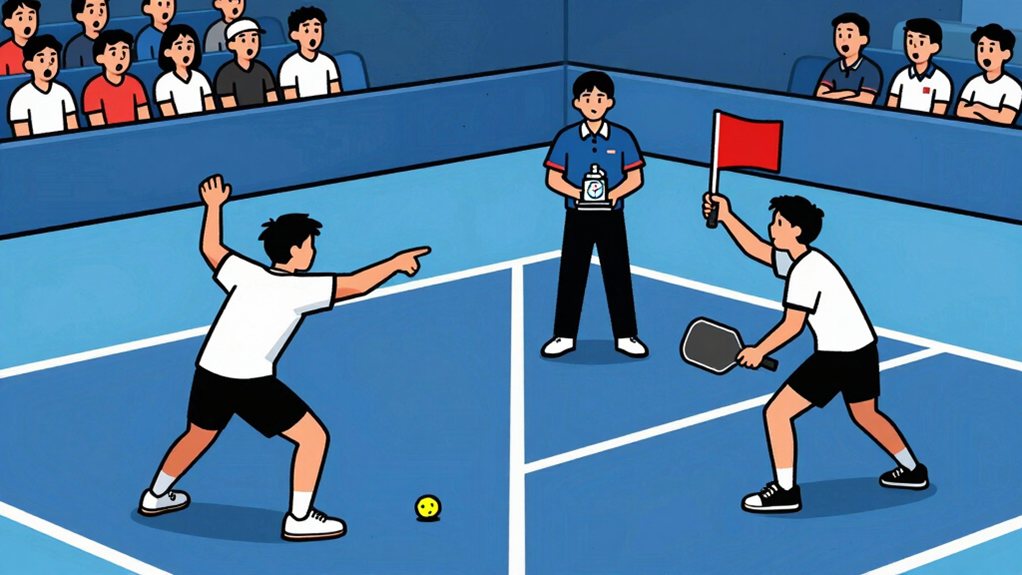
When making line calls, you must rely on your own observation, not your partner’s or spectators’ input. Follow these rules:
- Call “in” if any part of the ball touches the line. The ball is in.
- Call “out” only when you’re certain the ball missed the line completely. Make the call before the opponent hits the ball or before it dies.
- You need clear space between the ball and the line to call “out.” If you see any gap, the ball is in.
- If teammates disagree on an “in” call, the “in” call wins.
- If teammates disagree on an “out” call, the “out” call wins.
- Don’t use your partner’s or spectator’s opinion when making line calls.
- Communicate calmly during disputes. Ask the opponent for clarification if needed.
- If you can’t resolve a dispute, replay the rally. Move on quickly.
Common Pickleball Faults to Avoid
Understanding common faults helps you avoid losing points unnecessarily.
- Foot Faults
- Keep both feet behind the baseline during serves.
- Don’t step into the court before making contact.
- Stay within the sidelines or centerline extensions.
- Non-Volley Zone Violations
- Don’t volley the ball while standing inside the 7-foot NVZ.
- Be sure you hit the ball after it bounces in the NVZ.
- You may volley from outside the NVZ as long as you stay outside after contact.
- Two-Bounce Rule Break
- Allow the ball to bounce once on each side before volleying.
- The serving team and receiving team must each let the ball bounce once.
- Paddle Height Errors
- Keep your paddle head below your highest wrist point at contact.
- The drop serve allows you to bypass this rule.
Frequently Asked Questions
What Are the Official Ball Specifications and Approved Brands for Tournament Play?
The official ball specifications and approved brands for tournament play aren’t detailed in the provided knowledge. You’ll need to consult the International Federation Pickleball’s equipment guidelines for current approved ball standards and manufacturer listings.
Can a Player Request a Timeout During a Match and How Many?
Boldly, you can request one timeout per game recreationally, while tournament play typically allows two timeouts per player. Each timeout lasts sixty seconds, giving you strategic moments to regroup and plan your next moves effectively.
Is There a Minimum Rest Period Required Between Matches in a Tournament?
You’re typically given 5-10 minutes rest between matches in tournaments, though directors may adjust this based on scheduling needs. Always check your specific tournament’s policies for exact rest periods, as they can vary by event.
Are Electronic Scoreboards Allowed for Official Matches, and Who Controls Them?
Electronic scoreboards are permitted during tournament play. The designated scorekeeper, typically a tournament official, controls the display. You confirm the score with your opponent before each serve.
What Is the Process for Appealing a Referee’s Line Call in Tournament Play?
You cannot appeal a referee’s line call in tournament play. You must accept the call as made. Only if teammates disagree on whether a ball was ‘in’ does the ‘in’ call always prevail and stand.
Final Thoughts
Follow these steps to meet Pickleball Federation rules:
- You check the court: 20 ft by 44 ft for doubles, 10 ft width for singles.
- You serve underhand, contact below waist, ball lands in opposite diagonal.
- You stay out of non-volley zone until ball bounces.
- You score when you win a rally, use 11 points, win by two.
- You make clear line calls, resolve disputes.
We’re playing by these rules, compete worldwide, and keep game fair.

NET ONLY! COMPATIBLE WITH WHEELED & WHEEL-FREE FRAMES

14FT NET – Great for backyards! Suitable for 1-on-1 play with adults or kids, offering more room for exciting rallies.

[Adjustable Poles with Height Marks] The adjustable poles with a 35.4"-61" height range and 3 clear height marks (42.1", 47.2", 61") make this net suitable for badminton, teen tennis, beach volleyball, and pickleball