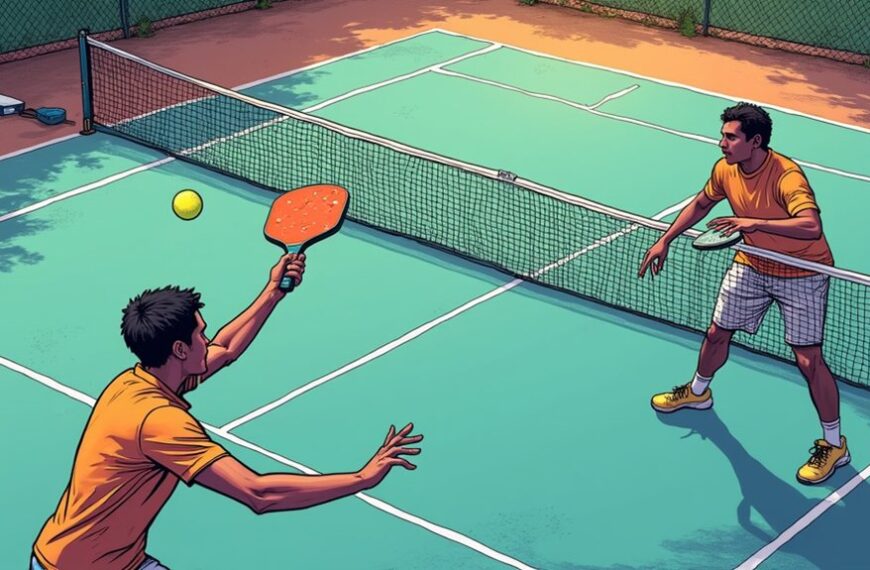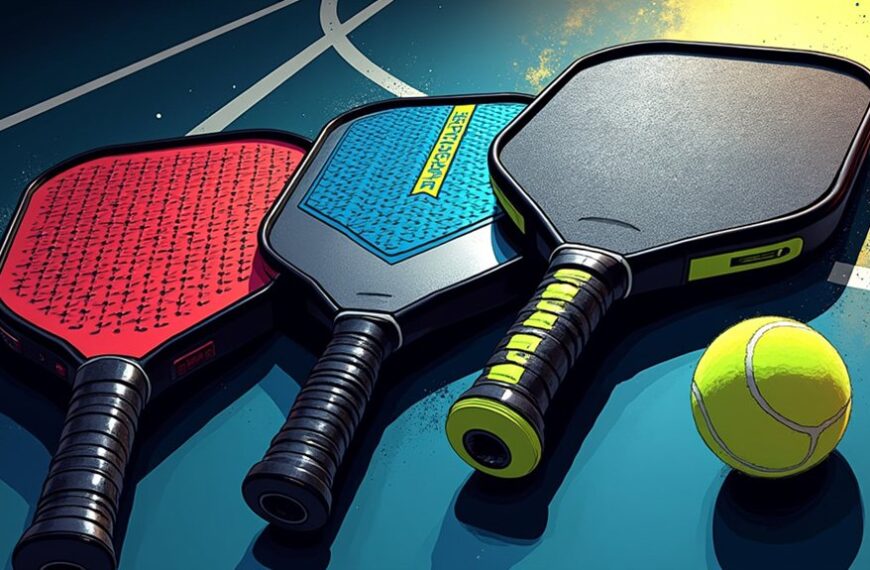
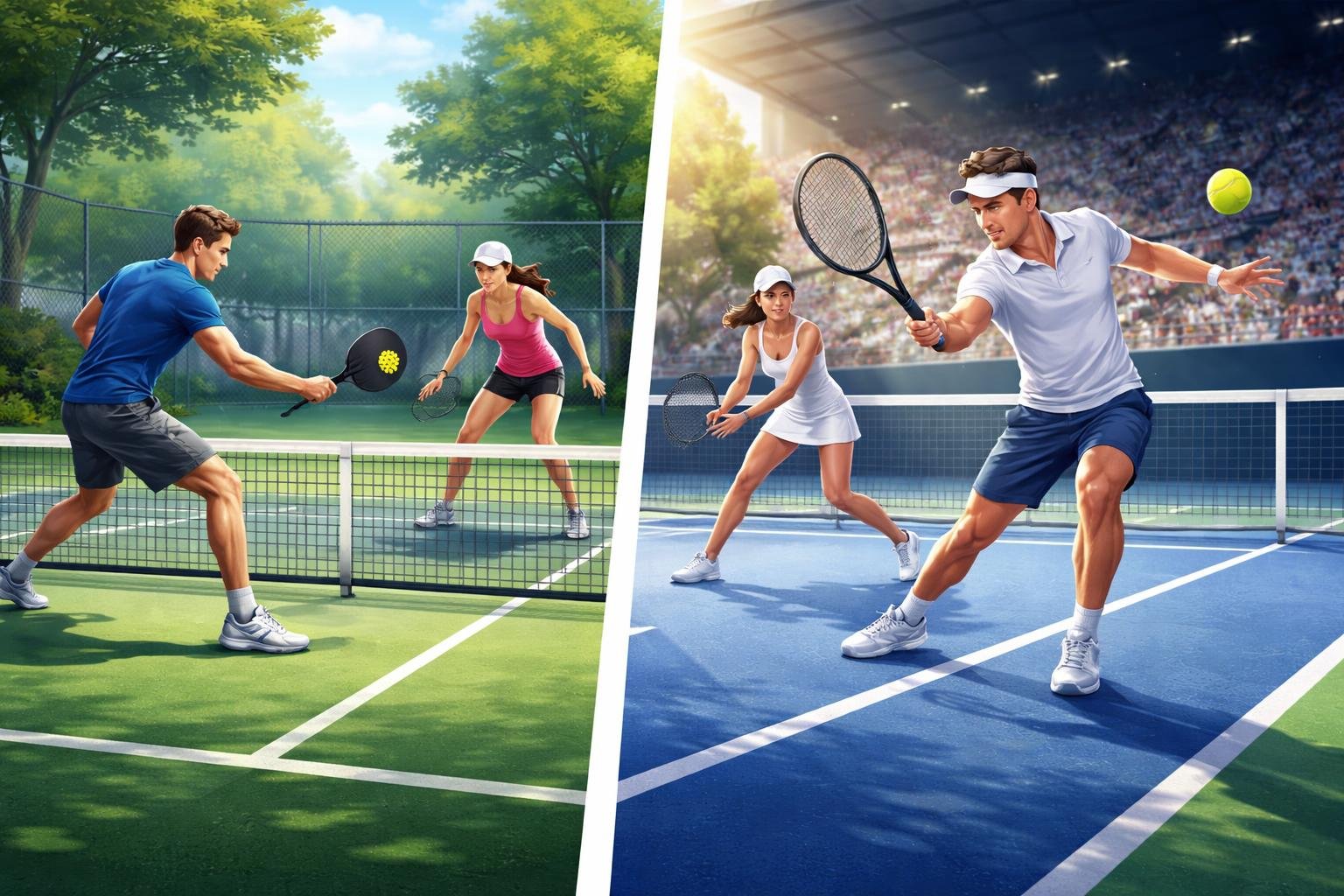
You might love the power and reach of tennis or prefer the quick rallies and social pace of pickleball, and both sports give you great exercise and skill play. Pickleball uses a smaller court, a paddle and a plastic ball with a non-volley zone, while tennis uses a larger court, a strung racket and a different scoring and serve rhythm — making pickleball easier to pick up but tennis richer in long‑court strategy.
If you want faster games, gentler movement and a big social scene, pickleball may suit you. If you enjoy longer rallies, more running and varied shot-making, tennis will challenge you in different ways.
Key Takeaways
- Court size and equipment change how each sport feels and how quickly you learn.
- Rules and scoring shape pace and strategy in both games.
- Accessibility and social aspects drive pickleball’s rapid growth while tennis keeps deep tactical play.
Core Differences Between Pickleball and Tennis
Pickleball and tennis differ most in court size, equipment and rules. These differences change how you move, serve and score in each game.

MULTI-LAYER T700SC CARBON FIBER FACE: TENVINA pickleball paddles are crafted from the lightweight and high-strength material, multi-layer T700SC carbon fiber, which utilizes cutting-edge Dry Jet-Wet Spinning technology. Delivering greater power and easy to control, this pickleball paddle brings you an unprecedented gaming experience.

USAPA Approve Pickleball Paddles: The pickleball paddles of 2 are USA pickleball approved & with USAPA approval lable ith high safety and professionalism, and can be used in tournaments

FAMILY-OWNED: At Selkirk, we are committed to fueling the pickleball obsession found within every player. Through uncompromising quality and a never-satisfied drive for innovation, we serve players around the world from beginners to pros.
What Makes Pickleball Distinct
Pickleball uses a 20×44 ft court and a lower net, so you stay closer to the action. You play with a solid paddle and a plastic ball with holes. Serves must be underarm and contact cannot be above your waist, which reduces raw power and rewards placement and control.
The game features a 7 ft non-volley zone (the “kitchen”) where you cannot volley the ball. This rule forces patience at the net and many short, strategic exchanges. Points are usually played to 11 (win by two), and only the serving team scores.
Pickleball’s smaller court and slower ball make rallies shorter but more frequent at the net. You will cover less ground, which lowers physical demand and often makes the game more social and accessible.
How Tennis Sets Itself Apart
Tennis courts measure 36×78 ft with higher nets and larger racquets strung with strings. You use a pressurised felt ball that bounces higher and travels faster. That means you need more reach, speed and endurance to cover the court.
Serving in tennis is overhead and can be a major weapon; you get two serves per point and can earn points as both server and receiver. Scoring uses games and sets (15-30-40), and matches can last several hours, especially at higher levels.
Tennis doubles include a wider alley area, increasing the space you must defend. The heavier movement, faster ball speeds and longer matches demand greater fitness and often more technical coaching.
Why People Switch Between Sports
You might switch from tennis to pickleball when you want less running but still enjoy racquet skills. Pickleball’s lower impact and smaller court suit players with joint concerns or limited time for long sessions.
Some switch from pickleball to tennis to regain a bigger challenge, more powerful serves, or the endurance aspect. Tennis offers broader shot variety, varied surfaces and global competition pathways.
Many players keep both in their routine. You can use tennis footwork and power while adapting to pickleball’s precision and net tactics. This crossover improves overall court sense and keeps your skills sharp.
Court Dimensions and Layout
You will see how court size, net height and line placement shape play and space needs. The details below give exact measurements and key layout differences so you can judge which court fits your space and play style.
Pickleball Court Features
A regulation pickleball court measures 20 ft (6.1 m) wide by 44 ft (13.41 m) long for both singles and doubles. The net height is 34 inches (86.36 cm) at the centre and slightly higher at the posts. The court has a non-volley zone (the “kitchen”) that extends 7 ft (2.13 m) from the net on both sides. Service boxes are two equal rectangles on each side, divided by a centre line.
Lines are typically 2 inches (5 cm) wide and painted in a contrasting colour for visibility. You can fit four pickleball courts inside the footprint of one tennis court, which makes conversions common. Surface types include asphalt, concrete with acrylic coating, and indoor timber or sport floors.
- Court area: 20 ft × 44 ft
- Kitchen: 7 ft from net each side
- Net: 34 in centre
- Line width: ~2 in
Tennis Court Structure
A standard tennis court for doubles measures 78 ft (23.77 m) long by 36 ft (10.97 m) wide. For singles play the width is 27 ft (8.23 m). The net height at the centre is 36 inches (91.44 cm), slightly higher than in pickleball. The court is marked with baselines, service lines and two service boxes on each side.
Tennis courts include doubles alleys—the extra width used only in doubles—which are 4.5 ft (1.37 m) wide on each side. Line widths are usually 2 inches (5 cm) as well. Surfaces vary from hard acrylic to clay and grass, each affecting bounce and play speed. Space around the court for run-back and side-run is larger than for pickleball.
- Doubles court: 78 ft × 36 ft
- Singles court width: 27 ft
- Net: 36 in centre
- Doubles alleys: 4.5 ft each
Comparing Pickleball Court to Tennis Court
Size difference is the most visible contrast: a pickleball court is roughly 20 × 44 ft, about one quarter the area of a 78 × 36 ft tennis doubles court. That makes pickleball easier to fit into smaller spaces and allows multiple courts inside one tennis court footprint.
Net height and zones change play. Pickleball’s lower net and 7 ft kitchen emphasise soft shots and quick volleys. Tennis’s higher net and larger court support long rallies, wide angles and stronger serves. Doubles alleys on tennis courts create wider target areas that do not exist in pickleball.
If you plan conversions, you can overlay pickleball lines on a tennis court. Use contrasting paint for clarity and leave at least 10–12 ft (3–3.7 m) of run-back space where possible to keep play safe and comfortable.
Equipment and Gear Comparison
You’ll see big differences in size, weight and how equipment changes play. Choice of paddle or racquet, the ball type, and net height shape shot speed, spin and movement on court.
Paddles, Racquets, and Rackets
Pickleball paddles are compact, solid-faced and usually 7–16 ounces. They have no strings and a short handle. That gives you quick wrist action and better control at the net. Materials include composite, graphite and wood; graphite paddles are lighter and more responsive for faster reactions.
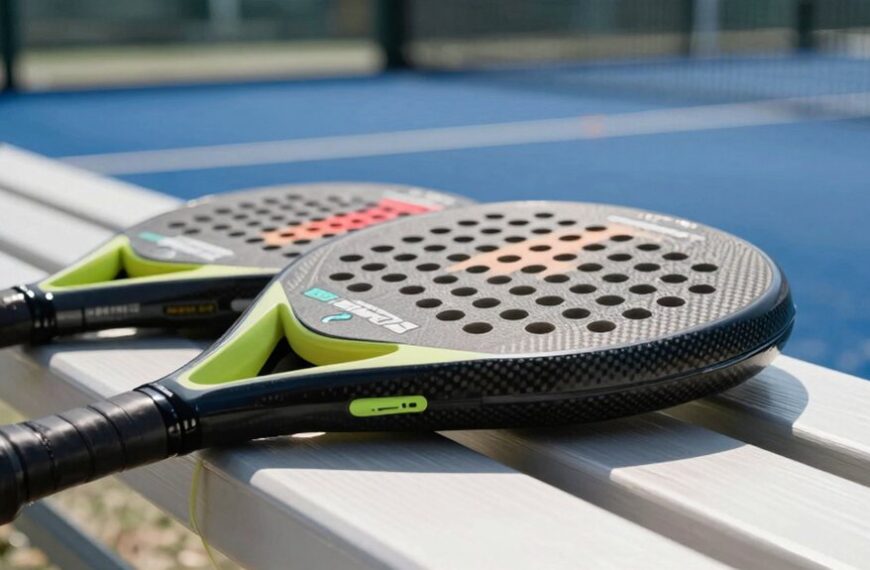
Tennis rackets are larger, framed with stringbeds and longer handles. Typical weights range from about 9–12 ounces (strung). The string tension and head size affect power and spin. You’ll use a full arm swing more often with tennis racquets, which demand reach and follow-through.
If you switch sports, expect different grips and balance. Pickleball gear focuses on manoeuvrability and touch. Tennis equipment prioritises power, spin and court coverage. Choose paddles or racquets based on wrist strength, preferred shot style and court size.
Balls: Wiffle Ball vs Tennis Ball
Pickleball balls are hard plastic with holes — often called wiffle balls — and weigh about 0.78–0.935 ounces. The perforations slow flight and reduce bounce. Indoor balls have larger holes and travel faster; outdoor balls are heavier and more wind-resistant. These traits make pickleball rallies shorter in distance and more about placement.
Tennis balls are pressurised rubber covered in felt and weigh roughly 1.975–2.095 ounces. They bounce higher and retain speed over longer court distances. Felt affects aerodynamics and spin; a worn tennis ball plays slower and grips strings differently.
Your footwear and timing must change with the ball type. Pickleball balls demand softer, precise hits and quick hands. Tennis balls require stronger groundstrokes, more follow-through and more court coverage.
Net Height and Surface Differences
A standard tennis net is 36 inches at the centre and 42 inches at the posts. Tennis courts are 78 feet long and 27–36 feet wide depending on singles or doubles. That larger court forces you to move more, cover angles and use longer swings.
Pickleball nets sit lower: 34 inches at the centre and about 36 inches at the posts, on a court 44 by 20 feet. The smaller court and lower net keep rallies compact and increase net play. Pickleball also has a seven-foot non-volley zone, the “kitchen,” that limits where you may volley.
Surface matters too. Hard courts, clay and grass affect bounce for tennis balls more than for pickleball balls. On hard surfaces you’ll get higher bounce and faster play in both sports, but the relative effects are stronger for tennis. Adjust your gear choices and movement to match net height and court surface.
Rules, Gameplay, and Scoring
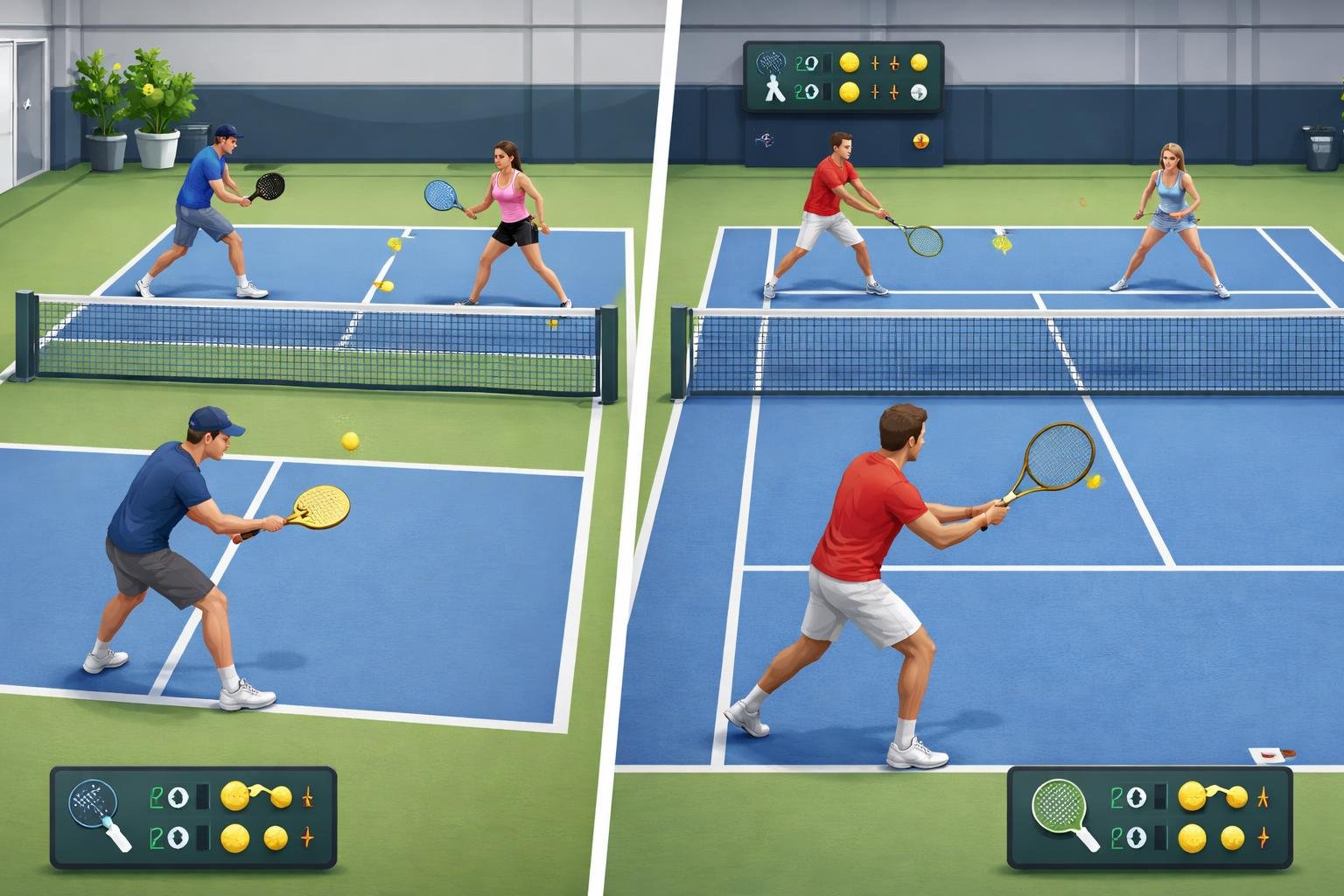
You will find clear differences in how each sport starts a point, how volleys work near the net, and how points are counted. Pickleball centres on short, controlled rallies with specific non-volley rules. Tennis uses a broader set of scoring rules and allows more aggressive net play.
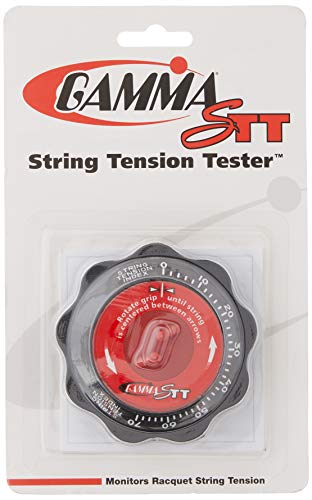
The STT lets you know when it’s time to restring.

HEAD PERFORMANCE: Born out of revolutionizing how we ski and play tennis, HEAD has constantly pushed athletic equipment into the modern era. With decades of experience in all racquet sports; HEAD offers nothing but top tier tennis equipment.

Professional Digital Racquet Tension Tester with high precision microcomputer chip provides accurate string tension measurement for tennis badminton squash rackets ensuring string job every time
Serving Differences
In pickleball you serve underarm and must strike the ball below waist height. Serves must land diagonally into the opponent’s service court and clear the 7-foot non-volley zone line. Only one serve attempt is allowed in casual/recreational play; tournament rules permit one fault then a second serve depending on format.
Tennis serves are overarm or underarm at your choice, tossed into the air and struck with a racquet. You get two serve attempts per point. Serves must land in the correct diagonal service box and may be aced (not returned). Foot-faults happen if your foot touches the baseline before you hit.
Both sports require you to stay behind the baseline when serving. Pickleball serving rules include rotation of serving side in doubles, while tennis alternates servers by game and allows more power and variation.
Non-Volley Zone and Unique Pickleball Rules
Pickleball has a 14-foot non-volley zone (the “kitchen”) that runs 7 feet from either side of the net. You cannot volley while standing inside or touching this zone. Step into it only after the ball bounces; otherwise the point is lost.
Pickleball enforces the two-bounce (double bounce) rule: after the serve, the receiving team must let the return bounce, and the serving team must let the next shot bounce before volleys can begin. This slows play and rewards placement over raw power.
Other unique rules include side-out scoring in some formats, strict service faults (net or wrong court), and line-call conventions that differ from tennis. You must also watch for carry or double-hit faults; pickleball expects a clean paddle strike.
Tennis Rules and Scoring
Tennis uses games, sets and matches. A standard game counts 0 (Love), 15, 30, 40 then game point. If both players reach 40–40 you play deuce and must win by two points. A set usually ends at six games with a two-game lead; many competitions use a tiebreak at 6–6.
Tennis serving rules let you attempt two serves per point and allow a wide range of serves—flat, slice, kick. You can volley anywhere on the court except you must follow normal foot-fault and out-of-bounds rules. Let serves (ball touches the net then lands in the service box) are replayed as a “let” in most play.
Doubles rotation in tennis assigns one server per team per game. Scoring can vary by format (match tiebreaks, no-ad scoring) in recreational and pro play. You must keep track of games won and adhere to umpire or self-call protocols for out and lets.
Game Flow and Rally Style
Pickleball rallies often start slow because of the two-bounce rule and kitchen restrictions. You will see shorter court coverage and quick dink exchanges near the net. Points frequently end with soft placement, errors in the kitchen, or forced volleys after the bounce rule ends.
Tennis rallies can be longer or shorter depending on surface and players. You will encounter heavy serves, baseline rallies, and aggressive net approaches. Court size and racquet power allow wider angles and deeper shots, making movement and stamina more critical.
In both sports, strategy changes with score and opponent. In pickleball you aim to control the kitchen line and force errors. In tennis you mix serve placement, spin and court positioning to create openings.
Player Experience, Accessibility, and Community
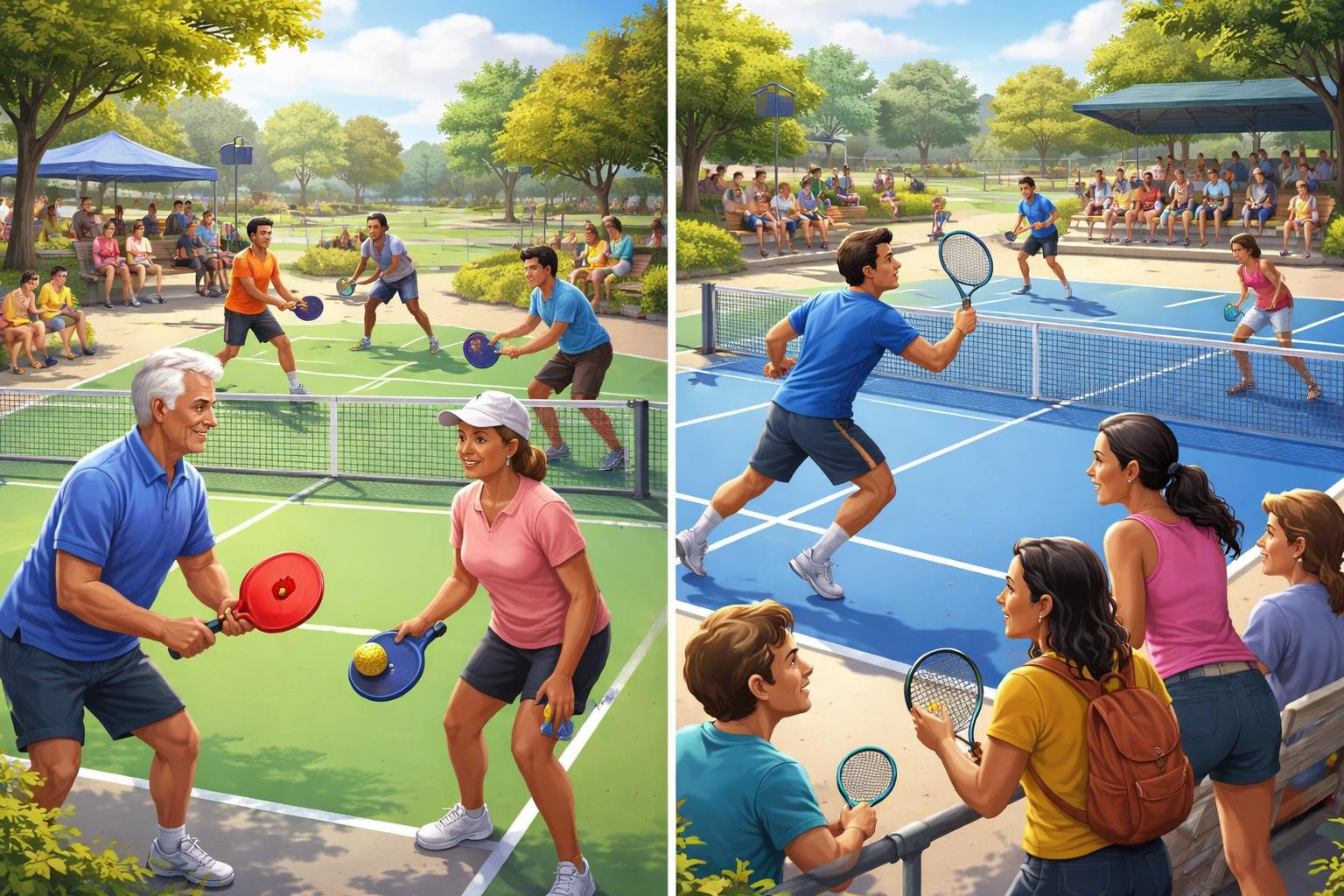
Pickleball and tennis give very different on‑court experiences. One feels slower with less running, the other demands more court coverage and power. Both offer strong communities, but they attract different kinds of players and clubs.
Physical Demands and Learning Curve
Pickleball uses a smaller court (20 × 44 ft) and a slower ball, so you spend less time sprinting and more on quick, short movements. That makes it easier on knees and hips, which helps many older players or those returning from injury. You still need good hand‑eye coordination and footwork, but rallies often end sooner and you recover faster between points.
Tennis requires covering a much larger court and hitting with more power. Serves, long groundstrokes and high‑speed movement take more endurance and shoulder strength. Expect a steeper learning curve for consistent serves and court positioning. If you play singles, your fitness needs rise sharply. For doubles, teamwork and court discipline add complexity that takes practice.
The Social Side of Both Sports
Pickleball courts tend to be social hubs. Games rotate quickly and players of varying skills can join casual sessions. Community centres and converted tennis courts host drop‑in play that helps you meet people fast. Major League Pickleball (MLP) and local leagues add a competitive layer, but grassroots play remains very social.
Tennis clubs have long‑standing social structures — coached clinics, ladder systems and club tournaments run by organisations like the International Tennis Federation influence play standards. Club culture can be more formal, with scheduled sessions and membership rules. Both sports give you social ties, but pickleball often offers faster, more casual integration.
Switching from Tennis to Pickleball
If you switch from tennis to pickleball, many skills transfer: volleys, serve placement and reading opponents. However, you’ll need to adjust your timing because the paddle and ball behave differently. Expect to shorten your swings and focus more on placement than power.
Tennis players often find initial success at the net but must learn the non‑volley zone rules and softer touch shots unique to pickleball. Clubs that host both sports sometimes run crossover clinics to help you adapt. If you aim to compete, MLP and local tournaments provide clear pathways, but casual play remains the easiest route to settle into the game.
Evolution, Growth, and the Future of Both Sports
You will learn how each sport began, how facilities are changing to meet demand, and where professional competitions are heading. The following sections focus on roots, current trends in court use, and the rise of pro leagues worldwide.
Origins and Historical Development
Tennis traces back to jeu de paume, a 12th‑century French handball game. Over centuries, racquets appeared and lawn tennis took shape in the 19th century. The International Tennis Federation (ITF) formed in 1913 to govern rules, tournaments and national bodies.
Pickleball started in 1965 on Bainbridge Island, Washington, when families combined badminton, table tennis and racquet sports. It used a paddle and perforated plastic ball on a smaller court. Growth stayed local for decades before rapid nationwide adoption in the 2010s.
You should note how rules and equipment shaped play. Tennis kept longer court dimensions and higher speeds. Pickleball’s smaller court and slower ball lowered the physical barrier for older or new players. Those design choices still explain who plays each sport today.
Trends and Facility Adaptation
You will see courts repainted, new builds, and mixed‑use sites as demand shifts. Many public parks now divide tennis courts into multiple pickleball courts to raise capacity. A single tennis court can often fit four pickleball courts, letting facilities host more players at once.
Clubs and local councils weigh income against tradition. Private clubs favour more pickleball where demand and revenue rise. Meanwhile, some organisations preserve dedicated tennis courts for coaching, competitions and ITF‑sanctioned events.
You must consider access and safety. Surface wear, net heights and line markings differ between sports, so temporary conversions need clear signage and scheduling. Many venues install portable nets and reserve times for each sport to reduce conflict.
Professional Leagues and Global Expansion
You can follow pro circuits growing fast in both sports. Tennis has a long global structure: ITF events feed into ATP and WTA tours and Grand Slams that span continents. That system supports ranking, prize money and national representation.
Pickleball built pro leagues more recently. Major League Pickleball (MLP) and Major League Pickleball (often abbreviated MLP) events attract former tennis players and celebrities. Tours now offer team formats, televised matches and larger purses, drawing corporate sponsors.
International reach is expanding. Tennis keeps steady global governance via the ITF and national federations. Pickleball bodies are forming in more countries and staging international tournaments. You should watch for more crossovers—players switching sports, shared venues, and joint marketing deals—that will shape how both sports grow.
Frequently Asked Questions
You’ll find clear differences in rules, courts, scoring, gear, and injury risks between pickleball and tennis. The answers below give exact numbers, practical tips, and simple steps you can use to compare the sports.

REGULATION SIZE PICKLE BALL NET - Pickleball net meets official standards with 22ft width, 36" height at the sidelines, and 34" height at the center. The net features velcro strap design at the top of the pickle ball nets portable outdoor help to tighten the net to keep strong shape even under windy day.

22FT or 11 FT Pickleball Net - BAGAIL's latest portable pickleball net features two nets - a full-size (36 "H x 22'W) USAPA regulation net and an 11'W half court practice net. Quickly assemble the frame system into 22FT or 11FT depending on your needs, and play with family or friends anywhere - in your driveway or on the indoor court. Suitable for players of all ages and skill levels. Whether practicing solo sessions or hosting social games, this 2-in-1 pickle ball net has you covered
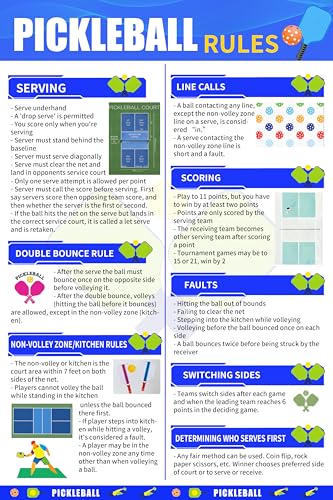
COMPREHENSIVE RULES REFERENCE: Educational pickleball poster displays all essential game rules including serving techniques, scoring system, line calls, and fault guidelines in an easy-to-read format for quick reference during play
What are the main differences in rules between the two sports?
In tennis you may serve overhand and you get two service faults before losing the point. In pickleball the serve must be underhand and you get only one serve attempt.
Pickleball has a non-volley zone (the “kitchen”) 7 feet from the net where you cannot smash the ball while standing inside. Tennis has no equivalent line; volleys can be played anywhere inside the court.
In pickleball only the serving side can score points. In tennis every rally ends in a point for one side or the other. Pickleball also uses a two- or three-word score call (server number, team score, receiver score) in doubles play, which affects positioning and rotation.
How do the court dimensions and net height compare?
A standard tennis court is 78 feet (23.77 m) long and 27 feet (8.23 m) wide for singles. A pickleball court is 44 feet (13.41 m) long and 20 feet (6.10 m) wide.
Tennis nets are 42 inches (106.7 cm) at the posts and 36 inches (91.4 cm) at the centre. Pickleball nets are 36 inches (91.4 cm) at the posts and 34 inches (86.4 cm) at the centre.
You can play pickleball on a tennis court by adjusting net height and marking a smaller court area. Many clubs overlay pickleball lines on tennis courts for dual use.
How does the scoring system work in each sport?
Tennis uses “love, 15, 30, 40” and deuce/advantage for games, then sets and matches. Each rally produces a point, regardless of who served.
Pickleball uses simple numerical scoring: 0, 1, 2, 3, etc. Games are commonly played to 11 points, win by two. Only the serving side can score, and doubles uses a specific server rotation that affects which player serves next.
Tennis sets often require six games to win (with a two-game lead or tie-break), while pickleball matches typically use best-of-three games or timed play.
Which sport is easier for beginners to pick up and why?
Pickleball is generally easier to learn for most beginners. The smaller court and slower, lighter ball make rallies and placement simpler to manage.
Tennis demands more from your serve power, court coverage and heavy topspin skills. Beginners may need more time to develop endurance and stroke mechanics in tennis.
Your prior experience with racquet sports speeds up learning in both games. If you play tennis already, an elongated pickleball paddle helps with the transition.
What equipment differences matter most, including rackets and balls?
Tennis uses a strung racquet and pressurised felt ball. Pickleball uses a solid paddle and a perforated plastic ball.
Tennis racquets are longer and have a handle and head designed for string tension and spin. Pickleball paddles are smaller and stiffer; elongated paddles are available to give more reach for tennis players.
Shoes matter: tennis-specific shoes support lateral movement on larger courts. Pickleball may be played in similar court shoes, but check sole patterns and ankle support for frequent direction changes.
What are the most common injuries in each sport, and how can they be prevented?
In tennis common injuries include shoulder and elbow problems (like tennis elbow), knee strain, and ankle sprains from fast pivots. Prevention: strengthen rotator cuff and forearm muscles, use proper technique, warm up, and wear supportive shoes.
In pickleball common issues are knee pain, Achilles or calf strain, and wrist injuries from quick hand motions. Prevention: build leg and calf strength, work on short compact swings, use a paddle with appropriate grip size, and wear shoes with good court traction.
In both sports, you should warm up, stretch, hydrate, and increase intensity gradually to reduce injury risk. Regular conditioning and rest days help you stay healthy.