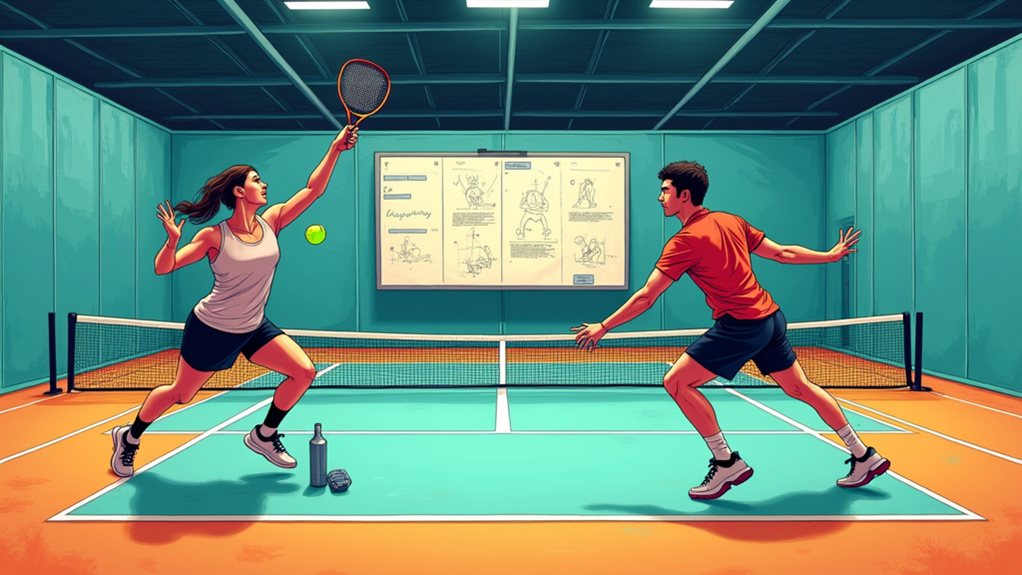
Start with a self-assessment: rate your cardiovascular endurance, strength, flexibility, and agility from 1–5, then add the scores. If your total is below 12, build general fitness first; 12–16 means a 3-day week works, and above 16 supports a 5-day schedule. Choose 3 sessions for 6–8 hours weekly or 5 sessions for 10–14 hours weekly.
Block your training days on a calendar and include at least one full rest day and one active recovery day. Keep intense sessions at RPE 6–7 and recovery at RPE 3–4, and always wait 48 hours between high-intensity sessions to help your muscles recover. For more details on structuring each session and avoiding common planning mistakes, continue exploring the full guide.
How Fit Are You? Start With a Self-Assessment
How well do you know your current fitness level? Before you start padel training, assess your baseline fitness. This helps us set realistic goals and prevent injuries.
Check these areas:
- Cardiovascular endurance: Can you run continuously for 20 minutes?
- Strength: Can you perform 10 squats and 10 lunges without stopping?
- Flexibility: Can you touch your toes and rotate your hips comfortably?
- Agility: Can you change direction quickly while running?
Rate each area from 1 (poor) to 5 (excellent). Add your scores.
A total below 12 means you need more general fitness before intense padel work.
A score of 12-16 indicates moderate fitness, suitable for a 3-day training week.
A score above 16 shows you can handle a 5-day schedule.
Tracking your recovery environment is equally important, and a smart indoor air quality monitor can help you maintain optimal breathing conditions during rest days at home.

UNLEASH YOUR POTENTIAL | Lay the best foundation for your tennis future by learning the correct grip from the start. Don’t waste time learning it incorrectly and create bad habits that actually inhibits your learning. So ensure the correct grip from the start with GripFixer and enhance your learning and potential.

UNLEASH YOUR POTENTIAL | Lay the best foundation for your tennis future by learning the correct grip from the start. Don’t waste time learning it incorrectly and create bad habits that actually inhibits your learning. So ensure the correct grip from the start with GripFixer and enhance your learning and potential.
Pick Your Training Frequency: 3 Days vs. 5 Days
- List how many hours you can train each week: three 90‑minute sessions or five 60‑minute sessions.
- Schedule at least one full rest day and one active‑recovery day to let your body recover between hard sessions.
When you balance time and recovery, you stay fresh, reduce injury risk, and we progress faster on the court.
Assess Time Availability
Before you commit to a training plan, honestly evaluate your weekly schedule. You need to know how many hours you can realistically dedicate to padel training. Consider your work commitments, family time, and other obligations.
Block out specific days and times in your calendar. Do not overestimate your available hours.
| Option | Weekly Time Commitment |
|---|---|
| 3 sessions | 6-8 hours |
| 5 sessions | 10-14 hours |
You must account for travel time to and from the court. Factor in 30-60 minutes per session for warm-up and cool-down. Weekend sessions often require longer blocks.
Write down your available windows. Protect these times from other commitments. Check your calendar for the next four weeks. Identify recurring open slots.
Be realistic about energy levels after work. Morning sessions work better for some. Evening sessions suit others. Your training plan must fit your life, not conflict with it.
Consider Recovery Needs
Recovery determines how your body adapts and grows stronger between sessions. Your training frequency depends on how well you recover. Choose three days per week if you need more rest between intense sessions. Choose five days per week if you can handle active recovery sessions.
- Three-day plan: Monday technical court, Thursday physical + mobility, weekend match play. You get two full rest days between sessions.
- Five-day plan: Monday net transitions, Tuesday strength, Wednesday active recovery, Thursday serve practice, weekend match play. Wednesday serves as your recovery day.
- Add mobility work, stretching, or foam rolling on rest days. Monitor your RPE (Rate of Perceived Exertion). Keep it at 6-7 for hard sessions, 3-4 for recovery days.
Plan Your Weekly Padel Training Schedule
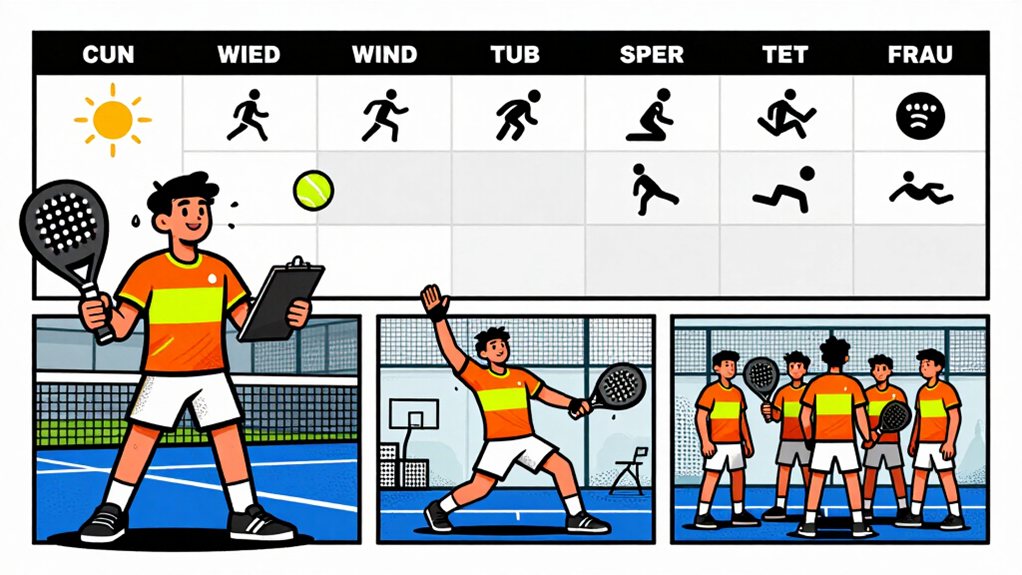
When you’re building your first padel training week, you need to choose a session frequency that matches your current fitness level and time availability.
1. Beginners choose 3 sessions per week. Monday or Tuesday focuses on technique (RPE 6-7).
Thursday adds physical and mobility work (RPE 6-7).
Weekend includes match play (RPE 7-8).
2. Intermediate players select 4-5 sessions per week. Monday targets net play and transitions.
Tuesday builds strength.
Wednesday provides active recovery (RPE 3-4).
Thursday works on serves and returns.
Saturday adds tactical match play.
We spread sessions across separate days. This prevents overtraining and supports recovery.
Avoid scheduling back-to-back intense sessions.
Your first week should match your schedule. Add sessions gradually as fitness improves.
Build Each Session: Warm-Up, Drills, and Match Play
A well-structured padel session follows a proven pattern that prepares your body, sharpens your skills, and simulates real match conditions.
1. Warm-up, five to seven minutes: light jog, arm swings, then twenty easy volleys.
2. Technical drills, fifteen to twenty minutes:
Net routine: three sets of twelve bandeja volleys, aim at side glass.
Glass defense: two sets of eight deep lobs, recover to net.
Serve-return: four points with plan A, four points with plan B, focus on placement.
3. Tactical play, ten to twelve minutes: half-court game, forbid net zone, first to fifteen points wins.
4. Match simulation, twenty to twenty-five minutes: we’re playing two to three games to twenty-five points, rotate positions, discuss decisions after each game.
Add Strength, Agility, and Flexibility Work
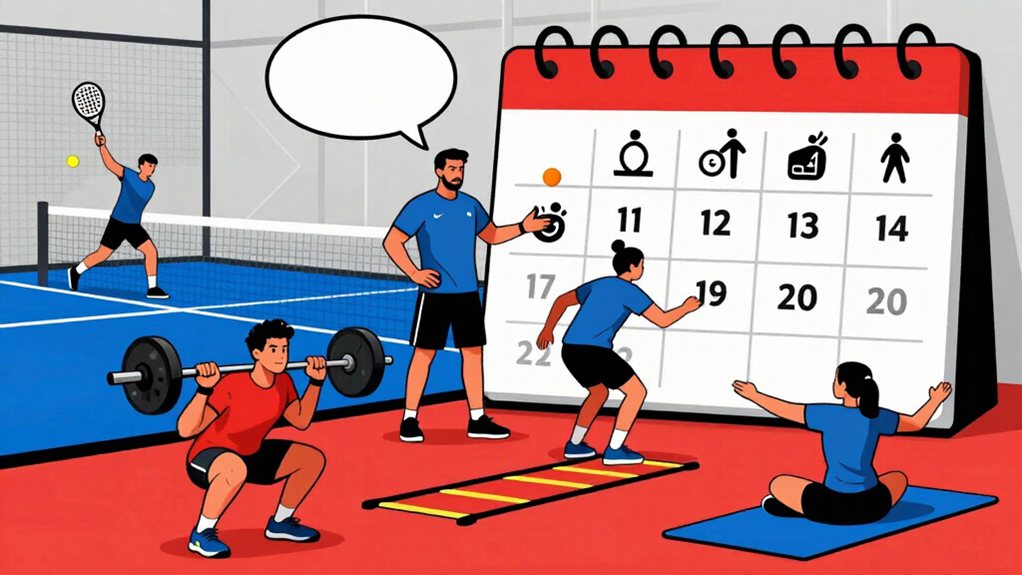
Add strength training to your plan: we’ll include 1) squats, 2) lunges, 3) core work, and 4) posterior chain.
Include agility drills: you’ll add 1) ladder footwork, 2) cone direction changes, and 3) jump sequences.
Finish with flexibility and mobility work: you’ll do 1) dynamic stretching, 2) joint mobility, and 3) foam rolling.
Strength Training Essentials
Building a strong physical foundation requires dedicated strength, agility, and flexibility work beyond court time. You need strength training sessions that target key muscle groups used in padel.
We recommend scheduling strength work on Tuesday for a 5-session plan, or Thursday for a 3-session week. You’ll perform 3-4 sets of 8-12 reps for each exercise.
- Squats and lunges build lower body power. These movements improve your explosive pushes toward the ball.
- Core exercises include planks, anti-rotation holds, and weighted rotations. A strong core stabilizes your swings and protects your back.
- Posterior chain work involves Romanian deadlifts and glute bridges. You develop hip drive for efficient movement and injury prevention.
Perform strength sessions at RPE 7/10. Rest 48 hours before your next technical session to allow recovery.
Include 5-10 minutes of dynamic stretching both before and after strength work. This routine develops the power and durability needed for intensive padel play.
Agility Drills For Padel
When you combine agility training with your padel preparation, you develop the quick direction changes and reactive movements the sport demands. Include these drills in your physical sessions twice per week.
- Ladder drills: Perform three sets of six forward lateral steps. Focus on quick foot contacts with the ground.
- Cone shuffles: Set four cones in a square. Shuffle around the perimeter for 20 seconds. Rest for 10 seconds. Repeat five times.
- Direction change sprints: Place three cones eight meters apart. Sprint to the first cone, side-shuffle to the second, then backpedal to the start. Complete eight repetitions.
You build the reactive base needed for rapid net transitions and defensive recoveries. Consistent practice sharpens your court movement.
Flexibility And Mobility
Key areas to target include your hip flexors, shoulders, and ankles. These areas improve your reach and swing power. You should dedicate at least 10 minutes daily to mobility work.
- Hip circles and leg swings loosen your lower body for quick direction changes during rallies.
- Arm circles and shoulder rotations prepare your hitting arm for volleys and smashes.
- Ankle rotations and calf stretches prevent twists when you move to the ball.
You must hold each stretch for 20-30 seconds. Never bounce while stretching. Perform mobility work before and after padel sessions.
Include foam rolling on rest days to release muscle tension. Your flexibility routine should last 15-20 minutes total. Consistent practice improves your court movement.
Schedule Recovery Days to Stay Fresh
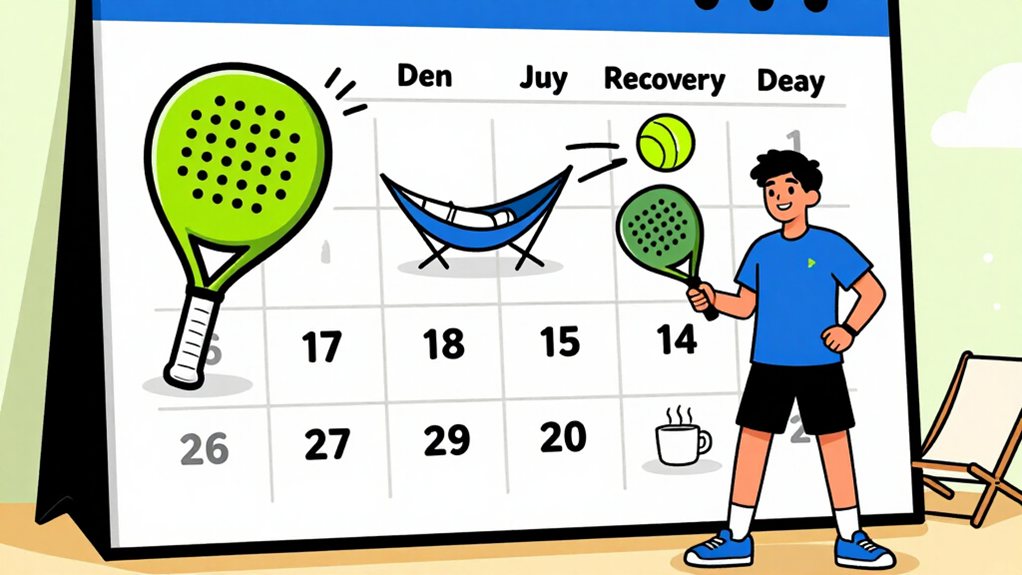
Recovery days keep your body fresh and prevent injuries. You need at least one recovery day per week when you train 5 sessions. Use active recovery with light movement rather than complete rest. Your body adapts and grows stronger during rest periods.
Schedule your recovery on Wednesday for a 5-session week. Do light activities like walking, swimming, or mobility work. Keep intensity between RPE 3-4/10. This maintains blood flow without adding stress.
Include these recovery methods:
- Stretching
- Foam rolling
- Light swimming
- Walking
| Recovery Day | Activity |
|---|---|
| Wednesday | Light cardio/mobility |
| Sunday | Complete rest |
| Post-session | Stretching/rolling |
Recovery prevents plateaus. It refreshes your mind and body. You train harder when you rest properly.

Know your air – An Alexa air quality monitor that makes it easy to understand what’s in your indoor air.

【16-in-1 Air Quality Monitor Indoor】Experience the ultimate indoor air quality monitoring with our 16-in-1 Air Quality Monitor, offering real-time detection of 9 key parameters including CO2, PM2.5, PM1.0, PM10, HCHO, TVOC, Temperature, Humidity, AQI, and Time. With 7 distinct AQI alert buzzers, this air quality tester ensures your family breathes with ease. (*Note: "16-in-1" refers to the combination of 9 key detectable parameters and 7 types of AQI alert buzzers.)
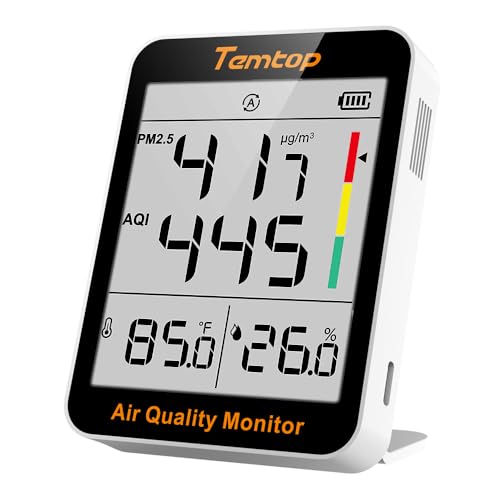
Improve Your Comfort & Health: Air Quality Monitor + Indoor Thermometer This smart air quality monitor continuously tracks PM2.5 and AQI, while also serving as a precise indoor thermometer and thermo-hygrometer for temperature and humidity. Understand whether your environment is both healthy and comfortable.
Scale Volume and Intensity to Your Experience Level
After scheduling your recovery days, you must adjust your training volume based on your experience level. Beginners start with three sessions weekly, mixing court and physical work.
Each session lasts about 60 minutes, RPE 6-7. Add fourth session focusing tactical play.
We schedule five sessions for advanced players, including block at RPE 3-4. Use this numeric list to guide your weekly structure:
- Three sessions for beginners: two court (RPE 6,7) and one physical block (RPE 6,7).
- Four sessions for intermediate players: two court, one tactical, one physical (all RPE 6,7).
- Five sessions for advanced players: court, physical, tactical, match play, and active recovery (RPE 3,4). Monitor fatigue, record RPE after each session, and tweak volume when soreness appears promptly, don’t slack.
Don’t Make These Training Planning Mistakes
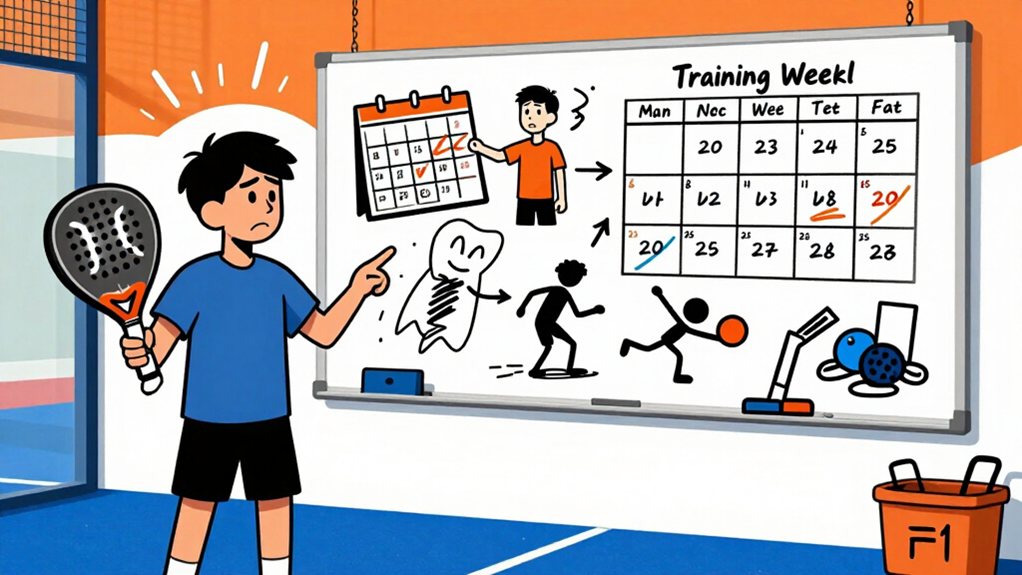
One of the biggest mistakes new padel players make is jumping into too many sessions before your body adapts. You risk injury and burnout when you skip recovery days. Start with three sessions per week. Add more only when you feel fully recovered after each session.
- Don’t ignore rest days between training. Your muscles need 48 hours to repair.
- Avoid scheduling back-to-back high-intensity sessions. Mix technical work with active recovery.
- Never skip warm-ups. Five to ten minutes of dynamic movement prevents strains.
- Don’t copy advanced player schedules. Beginners need lower volume and intensity.
- Track your fatigue using a simple 1-10 scale. Stop when you reach level 7 consistently.
Frequently Asked Questions
What Padel Shoes and Gear Do I Need for Training?
You need dedicated padel shoes with proper grip and lateral support, a quality padel racket suited to your level, comfortable sportswear, grip tape, extra balls, and a racket bag. Consider moisture-wicking clothing and court-specific socks.
How Should I Fuel My Body Before and After Sessions?
Carbohydrates before play, proteins after recovery, that’s your fueling rhythm. Pre-session: oatmeal, banana, or toast with honey 1-2 hours before. Post-session: lean proteins, rehydration, and muscle-repairing foods within 30 minutes.
What Mental Strategies Help Stay Focused During Intense Weeks?
Set clear micro-goals before each session, visualize executing perfect shots, control your breathing during fatigue, use positive self-talk, celebrate incremental progress, review daily improvements, stay present, and trust your training to sustain mental focus.
How Do I Find a Compatible Training Partner or Group?
Join local padel clubs, attend social sessions, and use club matchmaking to find partners matching your skill level. Communicate your goals clearly, train consistently, and observe who complements your playing style during mixed-level practice sessions.
Should I Track My Progress With Metrics, and How?
Studies show players who track metrics improve 40% faster. You should log technique hours, match results, RPE scores, and recovery weekly. Use a spreadsheet or app to quantify progress and prevent overtraining.
Final Thoughts
1. Use the plan you built this week and you’ll apply it. 2. Begin each session with a 5-minute warm-up, follow the drills, then play a match. 3. Add two strength sessions, one agility session, and one flexibility session. 4. Schedule two recovery days. 5. Track your progress.
Players who train three days a week increase rally length by 20% in eight weeks. Stay focused, stay consistent, and we’ll see improvement in your game today.