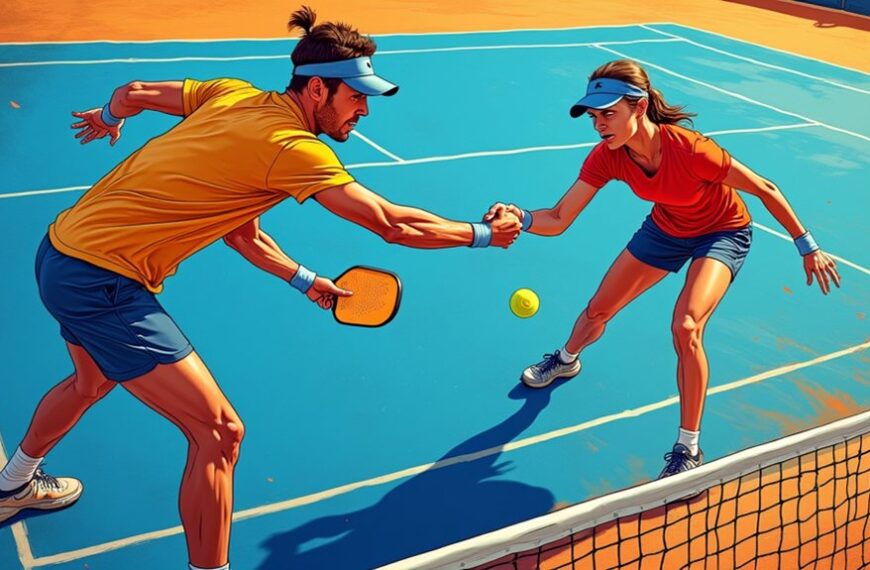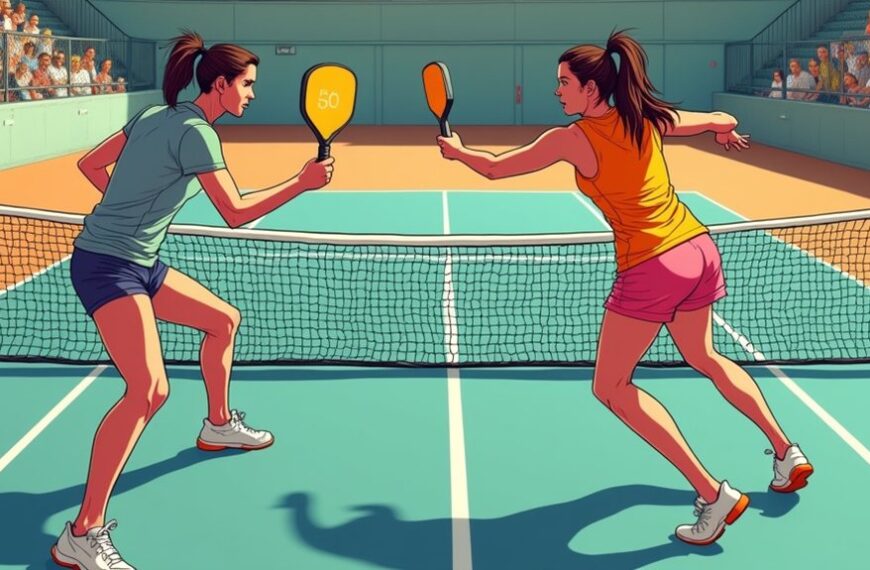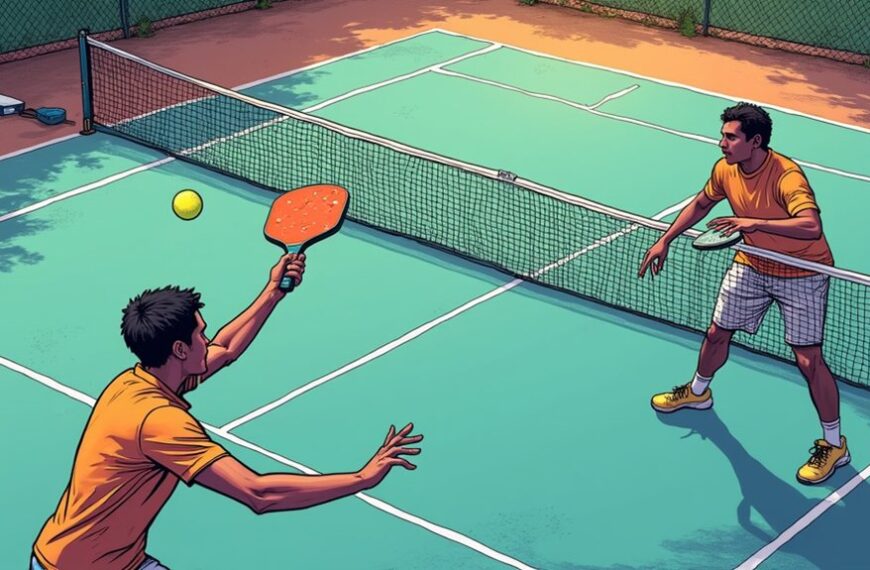
1) Scoring: singles uses two numbers, doubles uses three numbers. 2) Serving: singles serve, changes odd; doubles partner serves once. 3) Side-out: singles to opponent; doubles serve, both partners serve. 4) Court: singles cover 20-foot width; doubles cover ten feet. 5) Non-volley: singles defend line; doubles one forward, one back. 6) Shots: singles groundstrokes, doubles dink and volley to opponent. 7) Physical: singles high stamina, movement; doubles moderate stamina, teamwork. You’ll learn more after this.
Pickleball Scoring Explained: Singles vs Doubles Formats
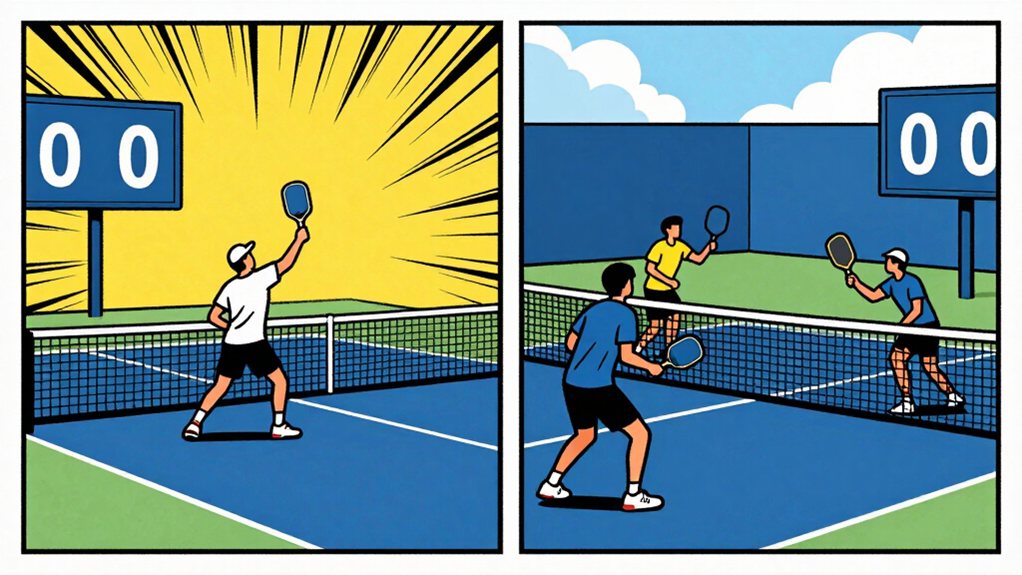
Pickleball uses different scoring formats for singles and doubles play. You need to understand these pickleball scoring differences to play correctly.
Pickleball scoring varies: two numbers in singles, three in doubles. Understand these differences to play correctly.
Singles Scoring (two numbers):
- Format shows your score first, then opponent’s score (e.g., 5-3)
- Server switches sides when your score is odd
- One serve per turn
Doubles Scoring (three numbers):
- Format shows your team score-opponent’s score-server number (e.g., 7-5-2)
- Server number indicates which partner serves (1 or 2)
- Each partner serves once before side-out
- First serve exception at 0-0-2 allows only one serve
Remember these pickleball singles rules and pickleball doubles rules to track scoring properly. Watch the third number in doubles to know who’s serving.
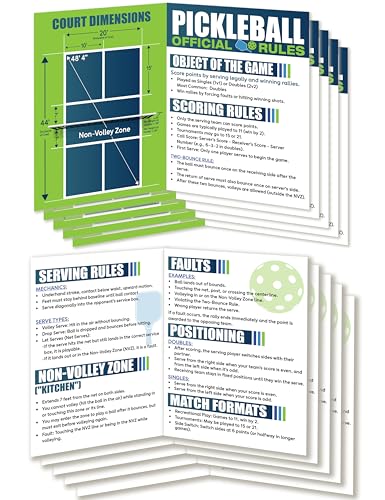
Pickleball rules card – Say goodbye to confusion on the court with this easy-to-follow bi-fold rules reference. Side 1 and Side 2 feature official pickleball rules, including serving rules, scoring, the kitchen rule explained, and more. A great pickleball quick guide for players of all levels.

Serving Rules: How Rotation and Faults Work in Each Format
When you serve in pickleball, understanding the rotation and fault rules keeps the game flowing properly. In singles vs doubles pickleball, you follow different serving patterns.
- Singles serving:
- You serve from one side of the court
- You get one serve attempt per turn
- If you fault, your opponent receives the serve
- You switch sides when your score becomes odd
- Doubles serving:
- Your team receives two consecutive serves
- You and your partner each serve once before side-out
- First server starts on the right when your score is even
- First server moves to the left when your score becomes odd
- Second server follows the same position pattern
Common faults in both formats include:
- Hitting the ball out of bounds
- Failing to land the serve in the diagonal service court
- Not keeping both feet behind the baseline during the serve
Side-Out Procedures: When and How Serve Changes
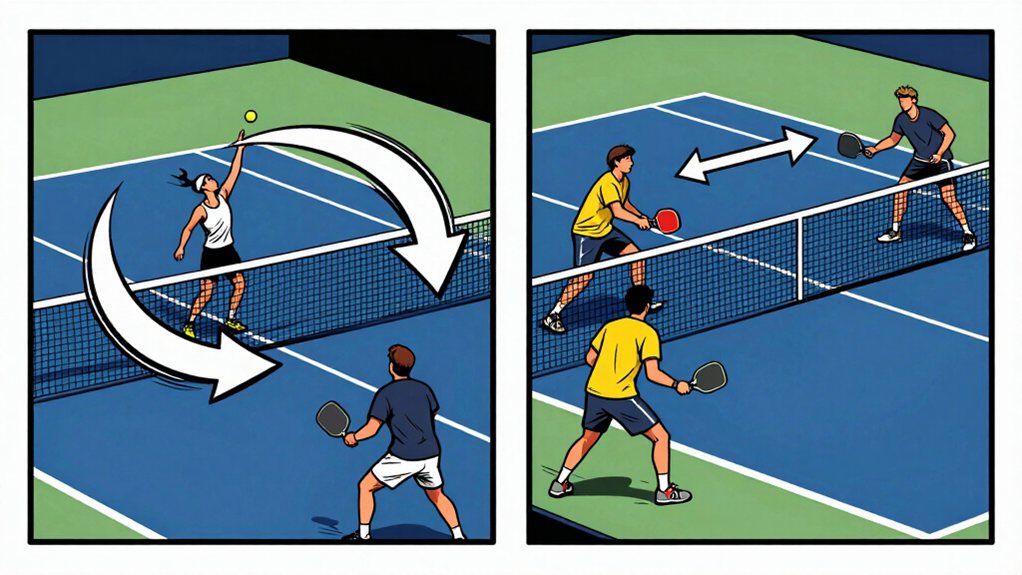
Now that you know how to serve in singles and doubles, you need to understand what happens when the serving team loses a point. This is called a side-out. In singles, the serve transfers to your opponent immediately when you lose a point. You then become the receiver, and you start from the right side if your score is even.
In doubles, side-out procedures differ. When the serving team loses a point, the receiving team gets the serve. That team’s first server steps up. After both partners on the serving team have completed their serves, the side-out completes. The receiving team then serves until they lose a point.
Score format changes during side-out. Singles shows two numbers: serving score-receiving score. Doubles shows three numbers: serving team score-receiving score-server number. When you understand side-outs, you track the ball accurately.
Court Coverage Differences: Why Singles Demands More Endurance
Because you cover the entire 20-foot court width alone in singles, the physical demands far exceed those of doubles.
You must cover the full 20-foot width on every point; a partner doesn’t share the sideline.
In doubles each player guards about 10 feet, giving you a break while your partner moves.
You’ll sprint from the baseline to the non-volley zone repeatedly; doubles rely on short net exchanges.
- Start each rally from the baseline.
- Move laterally to the opposite sideline.
- Sprint forward for a shot at the kitchen line.
We need greater stamina, faster lateral cuts, and longer recovery bursts.
Our heart rate stays higher because you never get a break.
Practice daily distance drills, agility ladders, and court-sprints to match the solo load.
Non-Volley Zone Strategy: Positioning for Singles vs Doubles
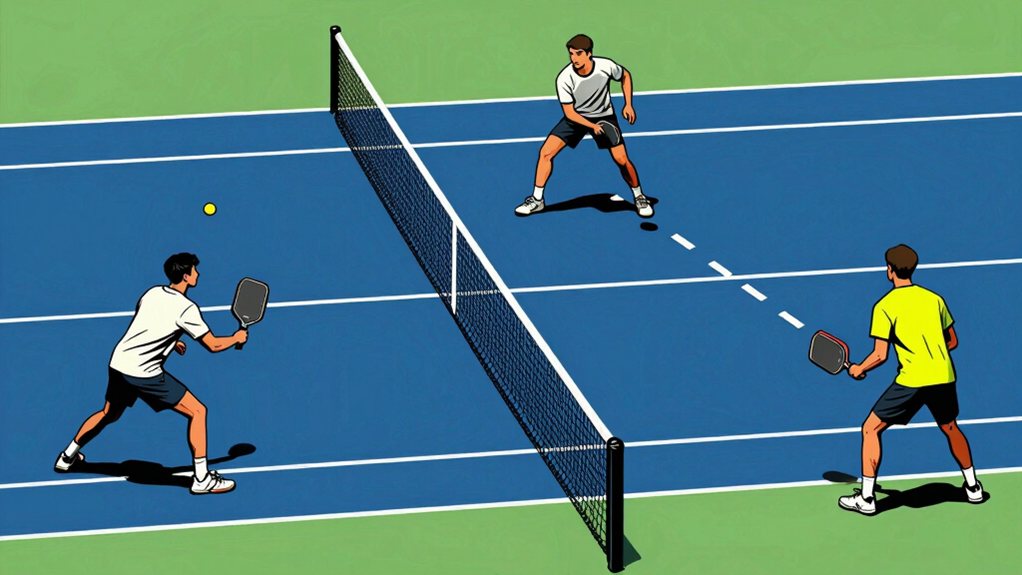
Since the non-volley zone plays differently in singles and doubles, your positioning strategy must adapt accordingly.
In singles, you defend the line alone. You stay back near the baseline when receiving. You move forward only when your opponent hits a weak return. You hold your ground at the non-volley zone only after you earn the advantage with a deep shot.
Your goal is to force errors by pinning opponents behind the baseline.
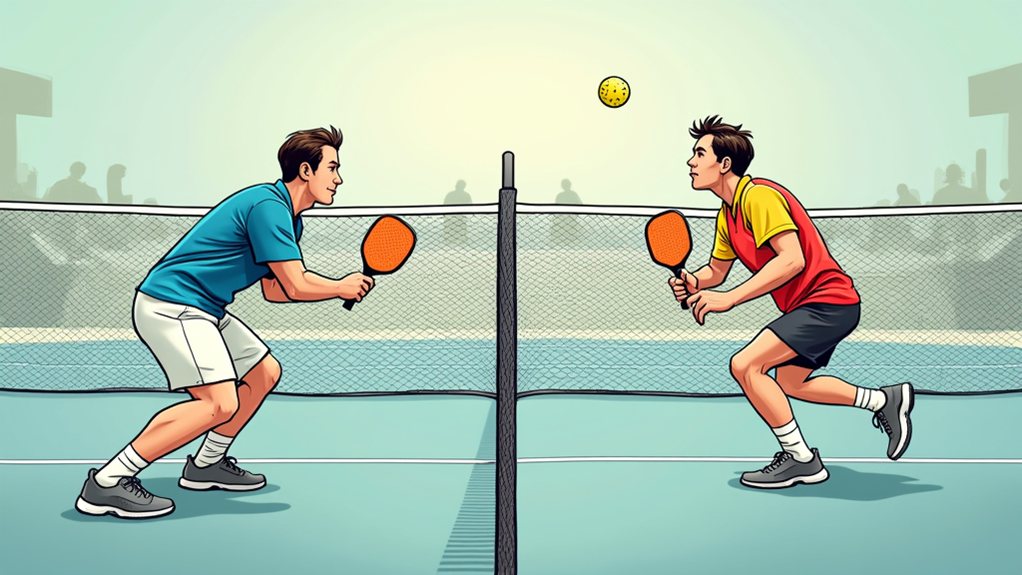
In doubles, both you and your partner control the non-volley zone together. One player moves forward, the other stays back. You split coverage at the line.
You communicate constantly about who takes the next volley. Your partner backs you up on every dink.
Key positioning rules:
- In doubles, the player at the non-volley zone should angle slightly toward the middle.
- In singles, you must cover the full width between the baselines.
- In doubles, your partner covers behind you when you move in.
- In singles, return of serve lands 3 feet behind the baseline.
Just as a smart thermostat heating system lets you control your home environment with precision, controlling your court position with precision gives you a competitive edge in both singles and doubles play.
Shot Selection: Groundstrokes for Singles, Net Play for Doubles
While singles and doubles require different shot selections, your strategy must match the format you play. In singles, groundstrokes become your primary weapon. You construct rallies from the baseline. You aim for depth first. You add topspin for safety. You angle shots to move opponents laterally.
You look for opportunities to attack short balls. In doubles, you shift to the net quickly. Your first priority is volley placement. You use dinks to force opponent errors. You aim at the opponent’s feet. You avoid lifting the ball high. You communicate with your partner constantly.
| Singles | Doubles |
|---|---|
| Groundstrokes dominate | Net play dominates |
| Baseline positioning | Non-volley zone priority |
| Target deep corners | Target opponent feet |
| Use angles and pace | Use dinks and volleys |

DURABLE AND FUNCTIONAL - This pickleball machine offers external oscillation, ball speed up to 30 mph, and an elevation from 0 to 70 degrees, while its small, lightweight removable Lithium battery is easy to charge and can operate 4+ hours.
Serve Up Pickleball Snacks – Shaped like a pickleball paddle with an engraved pickleball center, this charcuterie board with lid brings court-inspired fun to appetizers, cheese, crackers, fruit, and snack spreads
Physical Demands: Speed and Stamina in Each Format
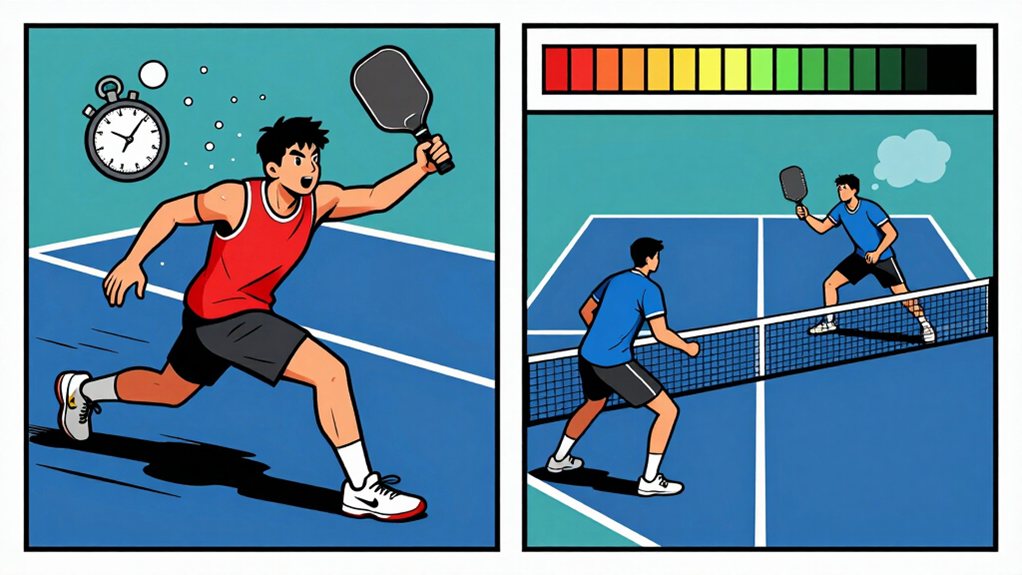
In singles pickleball, you cover the entire 20-foot width alone, requiring superior speed and quick lateral movement. In doubles, your partner shares the 10-foot coverage area, reducing stamina demands and shifting focus to reflexes.
Your endurance needs differ greatly, with singles being highly cardio-intensive while doubles emphasizes moderate physicality and net-focused action.
Singles Speed Focus
Because you cover the entire 20-foot court alone, singles pickleball demands exceptional speed and stamina. You become the sole defender of every inch.
Key speed requirements in singles:
- Full-court sprinting on every shot
- Lateral movement across the entire 20-foot width
- Quick direction changes after each hit
- Fast recovery to the center after attacking
Your conditioning must support continuous play. Build endurance through:
- Interval training
- Lateral agility drills
- Sprint intervals
You must anticipate every shot alone. Your footwork determines your success.
Without a partner’s support, your speed and stamina directly win or lose matches.
Doubles Stamina Contrast
Although you share the court with a partner in doubles, the physical demands differ from singles. You save energy because your partner covers half the court, which reduces your overall running distance. Singles pushes your cardiovascular system to its limit with full-court movement.
Doubles allows you to focus on quick reactions at the net rather than endless sprinting across the court. Your endurance needs drop substantially when you share court coverage with a partner. The pace feels more measured compared to the nonstop movement of singles play. You can sustain higher intensity for longer periods because your partner shares the court coverage burden.
- You experience reduced cardiovascular strain during doubles matches
- Your body recovers faster between points due to less running
- Reflex and agility become more valuable than raw stamina
Court Coverage Impact
When you play singles, you cover the entire 20-foot width of the court alone. This means you run more, pivot constantly, and sprint from baseline to non-volley zone. Your legs burn faster because no partner fills gaps. You must anticipate every shot angle.
In doubles, you split the court with a partner. You cover about 10 feet of width. You move less but communicate more. Teamwork replaces individual endurance.
| Format | Court Width | Physical Demand |
|---|---|---|
| Singles | 20 feet | High stamina required |
| Doubles | 10 feet per player | Moderate, teamwork focus |
| Both | 44 feet length | Tests speed and agility |
You develop different fitness in each format. Singles builds cardiovascular power. Doubles sharpens reflexes and positioning. Choose based on your physical goals.
Partner Coordination: Teamwork Tactics for Doubles Success
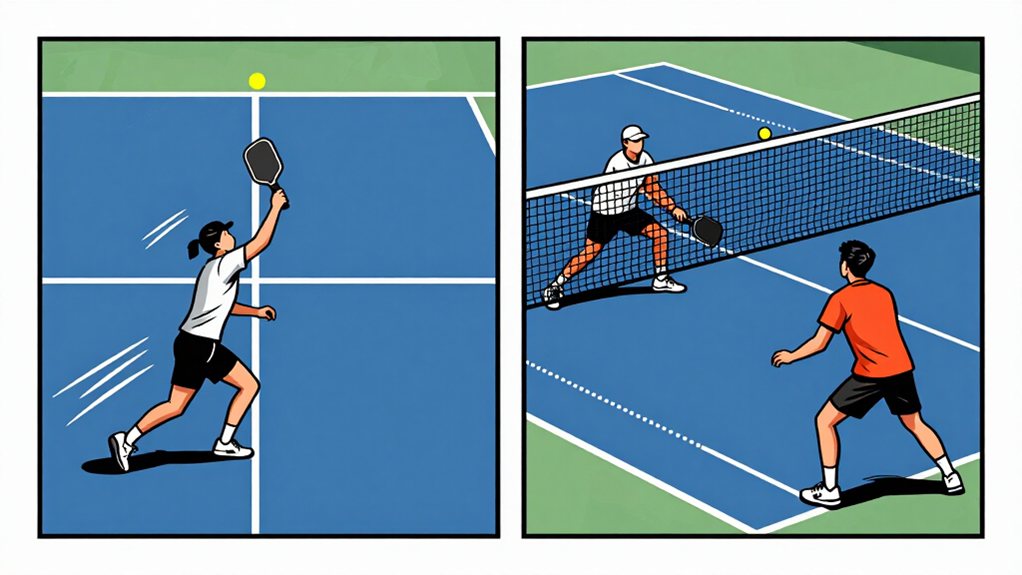
Effective doubles play requires you and your partner to function as a unified unit on the court. You must communicate constantly during rallies to avoid confusion and overlap. Call out shots, signal intentions, and confirm coverage before each stroke.
Positioning determines success; one player controls the net while the other holds the baseline. Switch positions strategically when opponents target the middle of the court. Practice synchronized movements until they become automatic reflexes. Trust your partner to cover assigned zones without hesitation.
Develop clear signals for dink exchanges and volley attempts. Work as one mind and two bodies to dominate the court.
- Maintain verbal communication before, during, and after each shot
- Designate net and baseline roles clearly before each point begins
- Use consistent hand signals for coverages and intended shot types
Which Format Should You Play? Matching Your Style to the Game
Now that you understand doubles teamwork, consider whether singles or doubles matches your abilities.
Now that you understand doubles teamwork, decide if singles or doubles aligns with your abilities.
Your fitness level matters most. Singles demands constant movement across the full 20-foot width. You run more and rely only on yourself. Doubles lets you share the court with a partner. Each player covers about 10 feet.
- Choose singles if you have great endurance and speed.
- Choose doubles if you prefer net play and teamwork.
Test both formats. Play three games of each. Note which feels more comfortable. Your skill set determines your best format.
Frequently Asked Questions
What Are the Best Warm-Up Drills for Singles Versus Doubles Match Preparation?
For singles, practice lateral shuffles, full-court sprints, and deep rally drives to build endurance. For doubles, focus on dinking sequences, partner communication drills, and net volley exchanges to build teamwork. Mix in dynamic stretching.
How Does Mixed Doubles Scoring Differ From Regular Doubles?
You use the same three-number scoring as regular doubles: serving team score, receiving score, server number. The only difference is each team fields one male and one female, but it’s actually the same scoring format.
What Common Injuries Should Players Watch for in Singles and Doubles?
Stop thinking pickleball injuries won’t happen to you. Watch for tennis elbow, rotator cuff tears, Achilles tendinitis, and knee injuries. Singles creates more running injuries while doubles causes more shoulder and wrist issues from volleying.
Do the Same Ball Speed Regulations Apply in Both Singles and Doubles?
You play with the same ball speed regulations in both formats. The ball must travel at the same maximum speed regardless of whether you’re playing singles or doubles, but your rallies will feel faster in singles due to more aggressive shot pace.
Are Paddle or Ball Weight Recommendations Different for Singles and Doubles?
Picture this, you’ll wield the same paddle and ball whether you play solo or partner up. Equipment specifications stay uniform across singles and doubles formats, ensuring consistent performance and exciting play dynamics in every match.
Final Thoughts
Pickleball offers two paths. Choose singles if you want full control, faster rallies, and solo endurance testing. Choose doubles if you prefer shared responsibility, strategic net play, and team communication building. Master both formats by practicing these key elements:
- Singles: Serve from the right on even scores, left on odd scores.
- Doubles: Use side-out scoring, maintain proper non-volley zone positioning.
- Both: Keep serves low, return deep, and move your opponent side to side.
Play the format that matches your goals.

PLAYER LEVEL: Designed for the entry level, occasional player. For frequent players, we recommend the Express Light Pickleball Shoe. Advanced players and players playing 6-7 days per week, the Pickleball Supreme Shoe is the recommended style

AOSTA 7.0 RUBBER COMPOUND: High-density outsole provides unsurpassed durability from heel-to-toe

FIT: The pickleball shoe is designed as a stability shoe for the short lateral and front/back movement required by the game; It may take some time to adjust to the fit if you have been playing in a sneaker or neutral athletic shoe