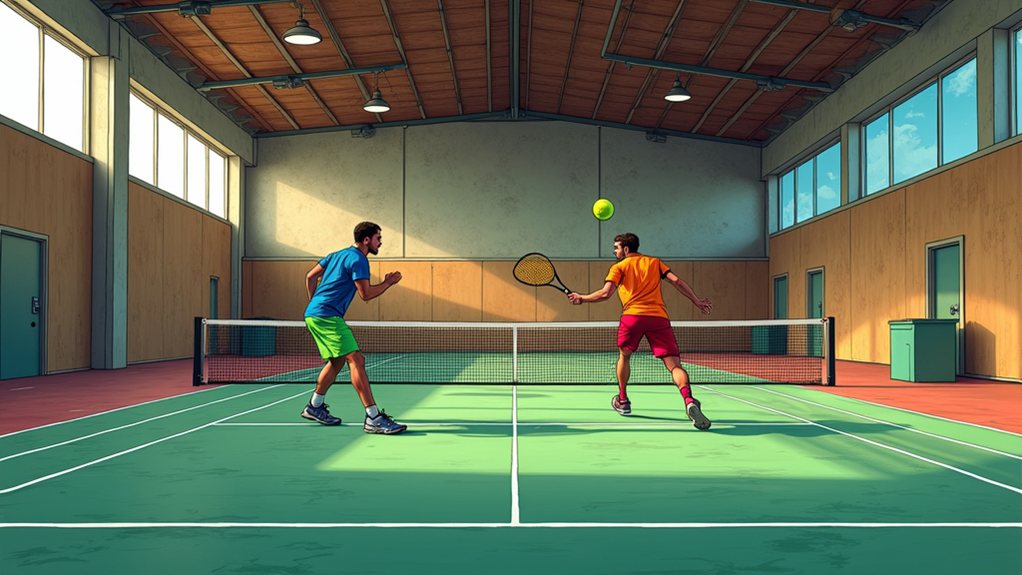
The Impact of Low Ceilings on Your Padel Game
Low ceilings impact your padel game by restricting overhead shots and limiting tactical options. FIP and KNLTB require at least 7 meters of clear height for indoor courts; courts below this are disqualified from official matches. You lose the ability to play effective lobs and overhead smashes when the roof is under 7 meters.
Professional tournaments demand 8 meters or more at net center for full tactical play. Shadows and glare become problems with inadequate lighting positioned below 6 meters. Choose clubs with 8-meter minimum heights and 300 lux uniform lighting for proper play. Continuing further will provide you with more detailed guidance on court selection and technique adjustments.
Minimum Court Height Standards: What FIP and KNLTB Require
If you want your padel court to meet official standards, you need to understand what FIP and KNLTB require. These organizations set clear height regulations for different court types.
Key Requirements:
- Indoor courts: minimum 7 meters clear height
- Outdoor courts: minimum 6 meters
- Professional tournaments: 8 meters or more at net center
- Canopy courts: minimum 7 meters to avoid play restrictions
Heights below 7 meters disqualify courts from official matches. FIP and KNLTB won’t certify courts that fall short of these standards. For facilities that rely on wireless systems to manage court bookings and operations, using a low latency wifi mesh router ensures consistent connectivity across multiple courts without signal degradation.
You must meet these requirements if you plan to host league games or tournaments. Check your ceiling height at the highest point above the playing surface before you build or certify your court.

END SAGGING NETS: Achieve professional-level tension in seconds with our heavy-duty tennis net center strap

HEAVY-DUTY CONSTRUCTION WITH GALVANIZED HARDWARE: Built to withstand year-round outdoor conditions, this center strap uses corrosion-resistant galvanized components to ensure long-lasting performance on any court.
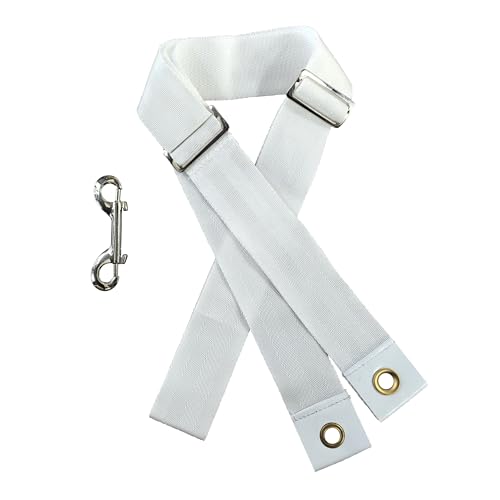
SECURE NET TENSION: This heavy-duty tennis net center strap keeps your net tightly secured and at the regulation height, ensuring fair and consistent play for every match.
How Low Ceilings Limit Your Shot Options
Because low ceilings restrict your overhead space, they directly limit the shots you can play. When roof height drops below 7 meters, you lose the ability to hit effective high lobs. The ball crashes into the ceiling constantly, forcing you to alter your shots.
Low ceilings restrict overhead space, eliminating effective high lobs and forcing flatter, predictable shots.
- Your overhead smash becomes risky and unreliable.
- Deep lobs often hit the roof before landing.
- You must play flatter trajectories.
- Defensive lobs lose their effectiveness.
You find yourself adapting to a more defensive game. You can’t use the full height of the court. Your opponents gain an advantage when you can’t execute proper lobs.
The reduced shot variety limits your tactical options and makes rallies predictable. You lose the element of surprise in your strategy.
Court Height Impact at Different Skill Levels
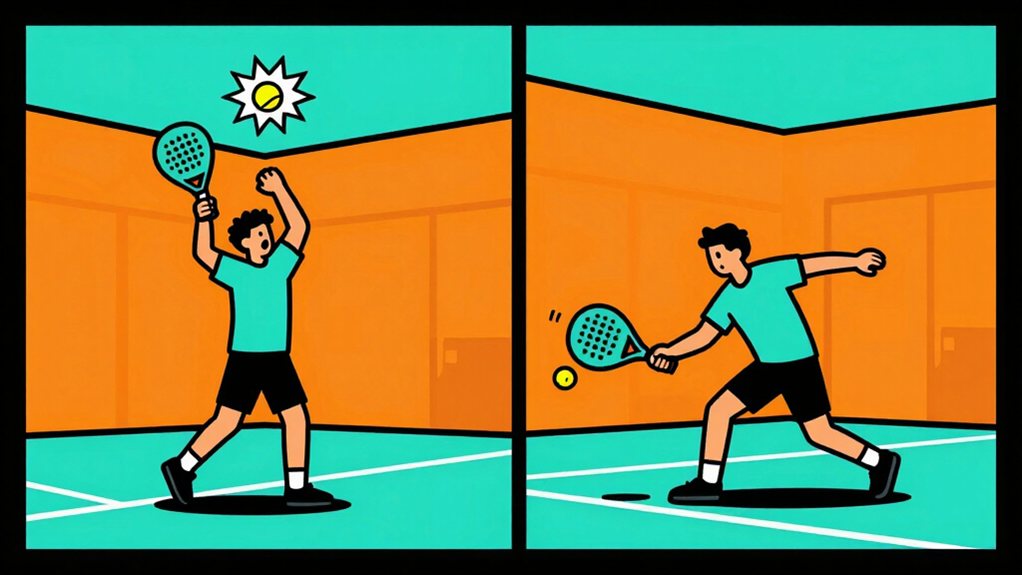
The height of a padel court directly influences how we’ll and you’ll play at different skill levels. Use this guide:
1) Novice – under 7 m limits high lobs;
2) Amateur – 7‑8 m lets you adjust;
3) Pro – 8+ m enables full tactical play.
Check the court’s posted height before you book so you match your skill level needs.
Novice Height Constraints
Understanding how ceiling height affects your game helps you choose the right court. As a novice, you face unique challenges on low-ceiling courts. You lack the skills to handle restricted ball flight. You can’t compensate for limited lobs with advanced shot placement.
Low ceilings punish every misjudged lift shot. Balls bounce off the roof during basic rallies. You develop bad habits when you adapt to restricted heights. You learn to hit flat shots instead of proper lobs.
You struggle more on higher ceilings later. Choose courts with at least 7 meters for fair learning conditions. Avoid courts below 7 meters if you’re new to padel. Seek clubs with 8 meters or more for proper skill development. Proper court height supports your long-term improvement.
Amateur Players Adjust
As you advance beyond the beginner level, ceiling height affects your game differently than it does novices. You notice restrictions that beginners overlook. Here’s how amateur players adjust:
- You modify your lob height. In courts under 7 meters, you reduce lob height by 20-30% to avoid ceiling contact.
- You change shot selection. You favor flat drives and volleys over high arcs.
- You adapt positioning. You stand closer to the net to shorten reaction time.
- You practice ceiling awareness. You track ball trajectory constantly to prevent losses.
At 6.8 meter heights, expect ball contact every 8-10 rallies. You develop compensatory skills that help in tighter spaces.
Pro Player Requirements
When you play at a professional level, you must have a ceiling height of at least 8 meters at the net center. This standard applies to all FIP-sanctioned tournaments.
Lower ceilings restrict your lob options and limit tactical play.
Your club must meet these requirements:
- Minimum 8 meters at net center
- Minimum 7 meters at court ends
- Uniform lighting at 300 lux
- Proper ventilation systems
Professional venues failing height standards can’t host official matches.
You lose competitive options with inadequate ceilings.
Choose clubs that meet the 8-meter minimum.
Your game improves with proper height access.
Lighting and Visibility Problems in Low-Ceiling Courts
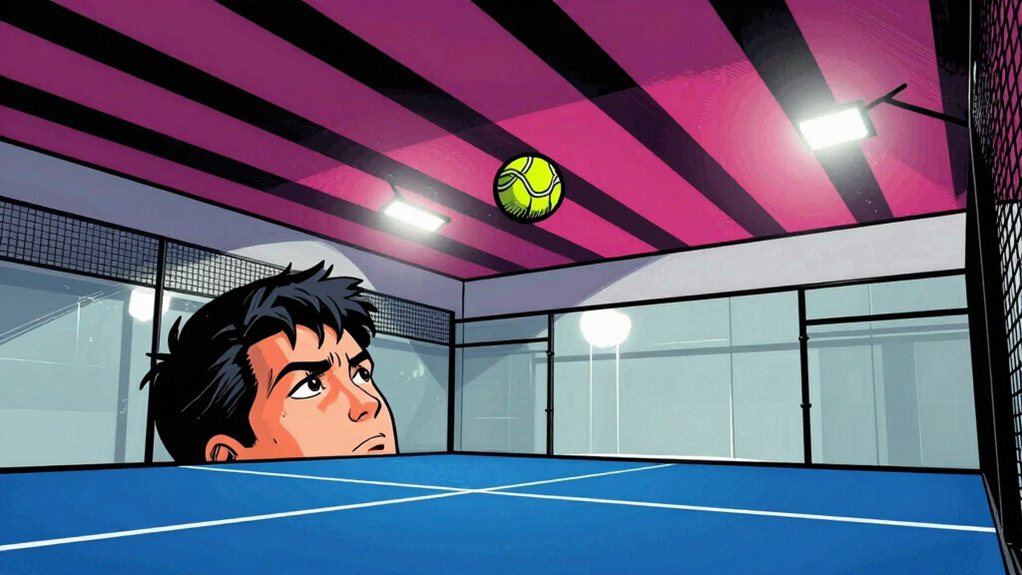
Lighting and visibility problems arise when low ceilings interfere with proper light placement in padel courts. Low roofs block ideal light angles, creating shadows across the playing surface. You notice dark zones near the walls and uneven brightness across the court. The ceiling reflects and diffuses light incorrectly, causing glare in some areas and dim spots in others.
Consider these common lighting issues in low-ceiling courts:
| Issue | Effect on Play |
|---|---|
| Shadow zones | You misjudge ball depth |
| Glare spots | You lose track of the ball |
| Uneven brightness | Your depth perception suffers |
Your night games suffer most when the roof traps humidity and heat. We recommend LED fixtures mounted high on side walls for best results.
Position lights at least 6 meters above the court floor. Avoid placing lights directly under low ceilings. Check that your court provides uniform 300 lux brightness throughout the playing area.
Who Suffers Most From Low Ceiling Courts
If you’re an advanced player or tournament competitor, low ceiling courts severely limit your game.
Your high-speed lobs hit the roof repeatedly.
You lose the tactical edge that players with 8-meter ceilings enjoy.

High quality tennis net strap crafted with heavy duty polyester webbing

Regulation tennis court net center strap.
Advanced Players
Advanced players feel the greatest impact from low ceiling courts. You notice the ceiling limits your tactical options first.
Your high lob shots crash down constantly. We recommend you seek courts with 8+ meter heights for full game development.
You lose your ability to play raised defensive lobs. Your overhead smashes lose effectiveness.
You adapt your serve placement to avoid high returns. Your footwork patterns change to lower positions.
You can’t practice professional-level shots in ceilings below 7 meters. Your game stagnates without proper height clearance.
You experience reduced shot variety. Your competitive edge diminishes in low-ceiling environments.
You must choose higher venues for serious training. You sacrifice winning opportunities at restricted courts.
Tournament Players
Tournament players experience the harshest consequences from low ceiling courts. You face constant ball-roof contact when you compete at venues below 7 meters.
The International Padel Federation requires at least 7-8 meters for official tournament status. We recommend targeting 8 meters minimum at net center for professional play.
Lower ceilings force you to abandon tactical lobs, reducing your competitive edge. Your performance suffers when you can’t execute full-height shots at the standard 22-foot ceiling limit.
- You can’t host FIP-sanctioned events below 7 meters
- Your team misses ranking points at non-compliant venues
- Players abandon ambitious lobs, limiting tactical options
- Ball speed increases, changing rally dynamics unexpectedly
- You lose competitive advantage to higher-ceiling opponents
Choosing a Padel Club: Ceiling Height Checklist
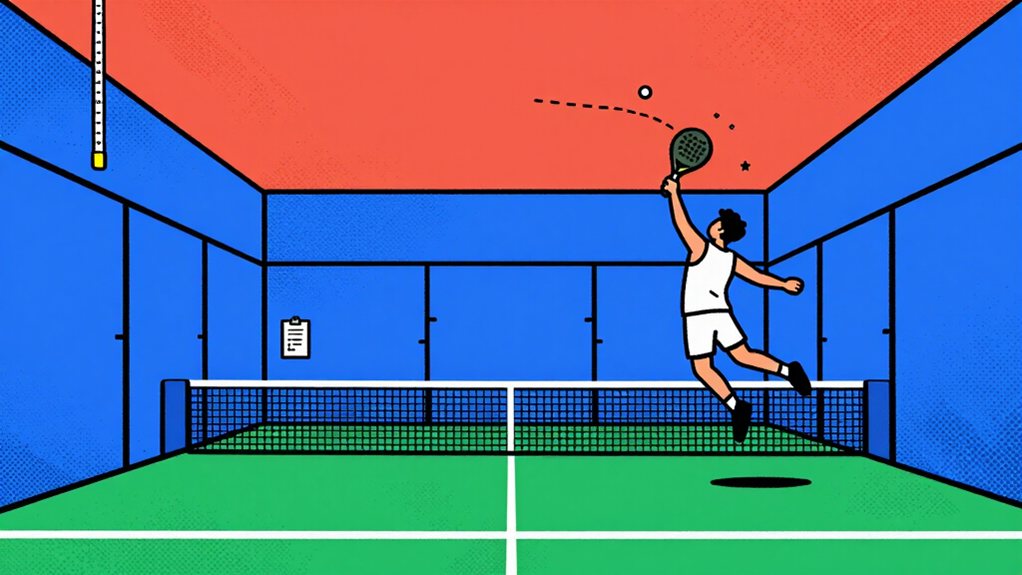
Evaluate ceiling height when you select a padel club to make certain the facility meets your playing needs. Use this checklist to make the right choice:
- Measure clear height at court center. You need at least 7 meters for proper play.
- Identify any beams or fixtures that reduce usable height.
- Confirm court type. Indoor courts require 7 meters minimum; outdoor courts need 6 meters.
- Check lighting integration. Lights should hang well above the ceiling line to avoid interference.
- Look for ventilation in enclosed spaces. Poor airflow affects comfort during games.
- Test the space yourself. Play a few rallies and note how the ball behaves near the ceiling.
We recommend visiting at different times of day. You’ll notice if shadows create dark zones or if heat builds up in the space.
Higher ceilings give you freedom to use lobs and overhead shots effectively.
Recommended Court Height for Serious and Professional Play
When you aim for serious and professional padel play, the court height you choose directly impacts your ability to execute advanced shots. Select a ceiling that meets the official federation threshold. We recommend 8 meters at the net centre for tournament play. Heights below 7 meters limit your lob options and reduce shot variety.
- 7 meters minimum for indoor competition, meeting FIP and KNLTB standards.
- 8 meters at net centre, ideal for professional tournaments and unrestricted lobs.
- 8.5 meters or more provides full lob clearance for top-level players.
- 6.8 meters (22 ft) is acceptable for club-level amateur play only.
- Heights below 7 meters disqualify courts from official matches and federation events.
Choose a venue with at least 8 meters to guarantee full competitive potential.
Frequently Asked Questions
Does a Low Ceiling Increase the Risk of Injury?
Yes, low ceilings increase your injury risk. They trap heat, fatigue you faster, and create visibility problems from blocked light angles. Limited space restricts your movement and increases collision chances with walls or other players.
Can Low Ceilings Affect How Long Padel Balls Last?
Think of your padel balls as tiny sponges, low ceilings crush their lifespan. Each hard smash against a low roof dulls the felt, and repeated impacts force you to buy new balls far sooner than you’d expect.
Do Low Ceilings Impact Spectator Comfort and Acoustics?
Low ceilings crowd your space, trap heat, and amplify crowd noise until it strains your ears. The enclosed design creates an overwhelming atmosphere that diminishes your enjoyment and creates uncomfortable viewing conditions.
Are Low Ceilings More Suitable for Hot or Humid Climates?
No, low ceilings trap heat and worsen humidity without proper ventilation. You’ll struggle with poor air circulation in hot climates, making enclosed designs uncomfortable. Ventilation becomes critical, yet you still face temperature and moisture challenges during gameplay.
Does Low Ceiling Limit the Types of Drills Coaches Can Run?
You might think you can adapt all drills to low ceilings, but you’ll find your overhead shots, high lobs, and tactical scenarios stay severely limited without proper ceiling height needed to develop full competitive game.
Final Thoughts
In summary, low ceilings directly affect your padel game. The bottom line is that court height matters greatly.
Key recommendations:
- Choose courts with minimum 6-meter ceiling height
- Avoid low-ceiling facilities for tournament play
- Adjust your lob technique when ceiling height is limited
- Test visibility before committing to club membership
FIP requires 6 meters minimum; KNLTB recommends 6.5 meters for competitive play. You must prioritize ceiling height in your club selection criteria.

Adjustable 2” Wide Nylon Heavy Duty Snap Model Number: 21510 Country of Origin:China