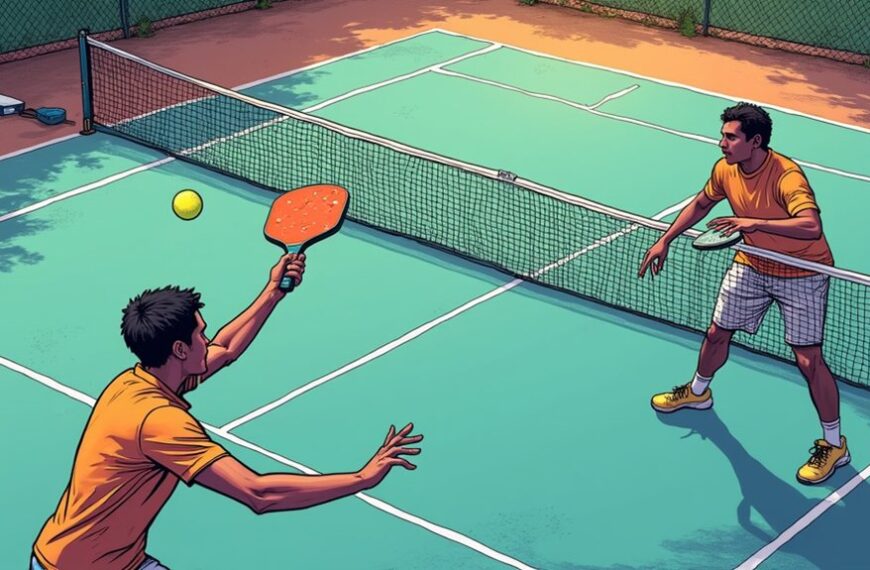
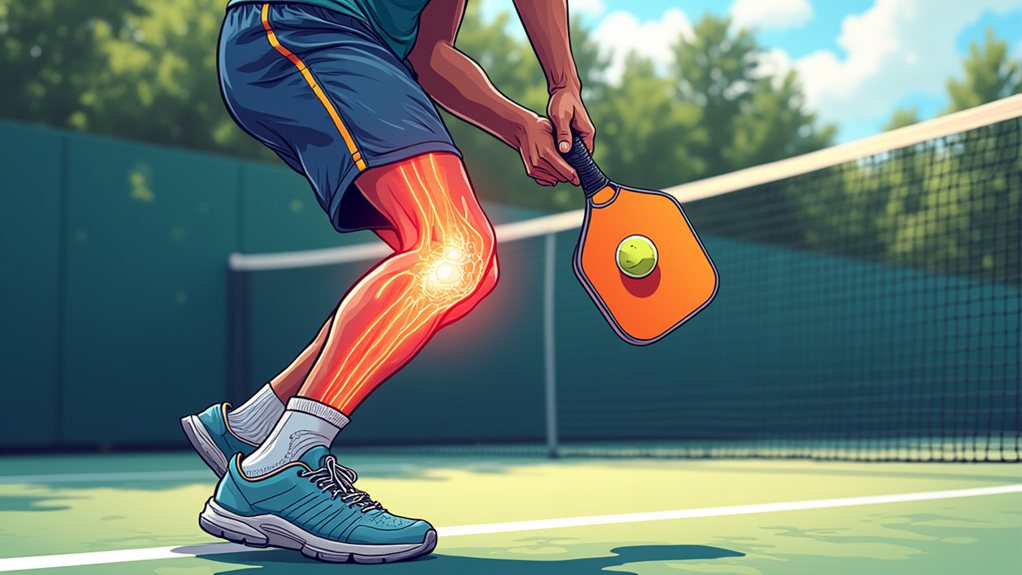
You overload your knees when you sprint laterally, stop suddenly, and squat repeatedly during pickleball. These motions stress ligaments, cartilage, and tendons, especially after age 50, when 90 % of ER injuries occur. Wear proper court shoes with lateral support, replace them every 6 months, and can’t ignore lunge technique.
Apply ice within 48 hours for 15 minutes every 20–30 minutes, raise the leg above heart level, and strengthen quadriceps and hamstrings three times weekly regularly. More guidance follows.
Why Does Pickleball Cause Knee Pain?
1. Repetitive movements create strain
Quick lateral moves, sudden stops, and frequent squatting overload your knee joints.
Each direction change stresses your ligaments.
Over time, this repetition wears on joint structures.
2. Aging increases vulnerability
Players over 50 face higher risk.
Research shows 90% of ER pickleball injuries occur in people aged 50 and older.
Your knees lose flexibility as you age, making them less able to handle sudden movements.
3. Pre-existing conditions compound the problem
Osteoarthritis affects many veteran players.
This joint degeneration creates pain during normal play.
Muscle weakness and imbalance also contribute to knee stress.
Consider these prevention steps:
- Strengthen quadriceps and hamstrings
- Use proper footwear on hard surfaces
- Warm up before playing
- Take regular breaks during matches
Your knees work hard during pickleball.
Protect them by understanding what causes pain and how to prevent injury.

Growth-Stage Foot Orthotic Support: insoles for men women are meticulously designed using advanced ergonomic principles. Insoles conform to leg contours, adjusting foot posture and alignment to maintain proper angles in knees, hips, and lower limbs.

PROFESSIONAL-GRADE COMFORT: Podiatrist-certified arch support system developed with 20 years of data and 120,000 foot scans ensures optimal comfort for running shoes for women

Lightweight Stability for Pickleball - Built for pickleball players, Ultrashot Light supports explosive lateral movement, quick cuts, and controlled stops with a lighter, more stable feel on court.
How Do Pickleball Movements Stress Your Knees?
Pickleball movements stress your knees through specific mechanical demands.
Your knees handle intense pressure during quick direction changes.
When you lunge sideways, your medial collateral ligaments stretch to stabilize your body.
Each sudden stop forces your anterior cruciate ligament to absorb impact.
Frequent squatting compresses your kneecaps against joint surfaces.
Your quadriceps work overtime to extend your legs after each low volley.
The repeated start-and-stop motion overloads your knee joints.
Hard court surfaces amplify this stress.
Your body relies on strong hamstrings to balance quadriceps forces.
Poor muscle balance increases strain on delicate ligaments.
Proper footwear helps distribute forces evenly across your joints.
What Are the Most Common Knee Injuries in Pickleball?
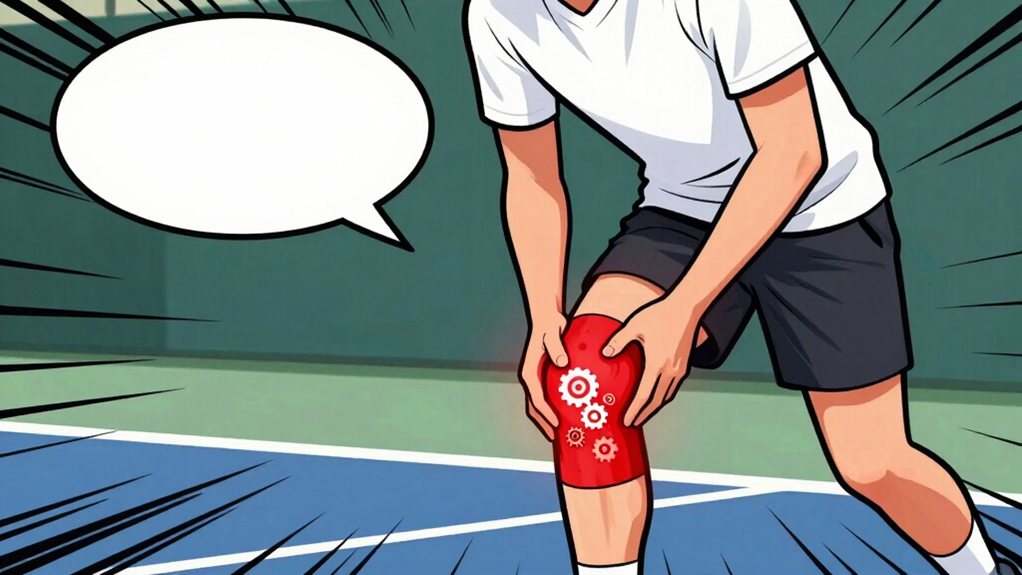
The most common knee injuries in pickleball include sprains, strains, and arthritis-related conditions. You face several injury types during play.
- Knee sprains occur when ligaments stretch or tear from sudden twists and directional changes.
- Strains affect muscles and tendons surrounding your knee joint from repetitive movements.
- Meniscus tears happen when you pivot quickly and the cartilage cushion between bones gets damaged.
- Patellar tendinitis develops from overuse, causing inflammation in the tendon connecting your kneecap to your shinbone.
You should seek medical evaluation for persistent knee pain. Early diagnosis helps prevent minor issues from becoming serious problems.
Proper treatment speeds your return to the court.
How Do Age and Playing Surfaces Worsen Knee Pain?
As you age, your knees lose flexibility and the joint cartilage wears down, making you more susceptible to pain during play. This happens gradually and accelerates after age 50, when joint repair slows.
Hard court surfaces compound the problem. Concrete and asphalt transfer impact forces directly into your knee joints. Each lateral move and sudden stop sends shock through the cartilage. Indoor wood floors offer slightly more give but still stress knees.
Playing on outdoor concrete courts in direct sunlight adds heat to joints, increasing inflammation. Wet courts create slip hazards that force compensatory movements. The combination of aging knees and hard surfaces creates a perfect storm for pain.
We see the highest injury rates in players over 50 who use hard courts regularly.
What Footwear and Technique Changes Protect Your Knees?
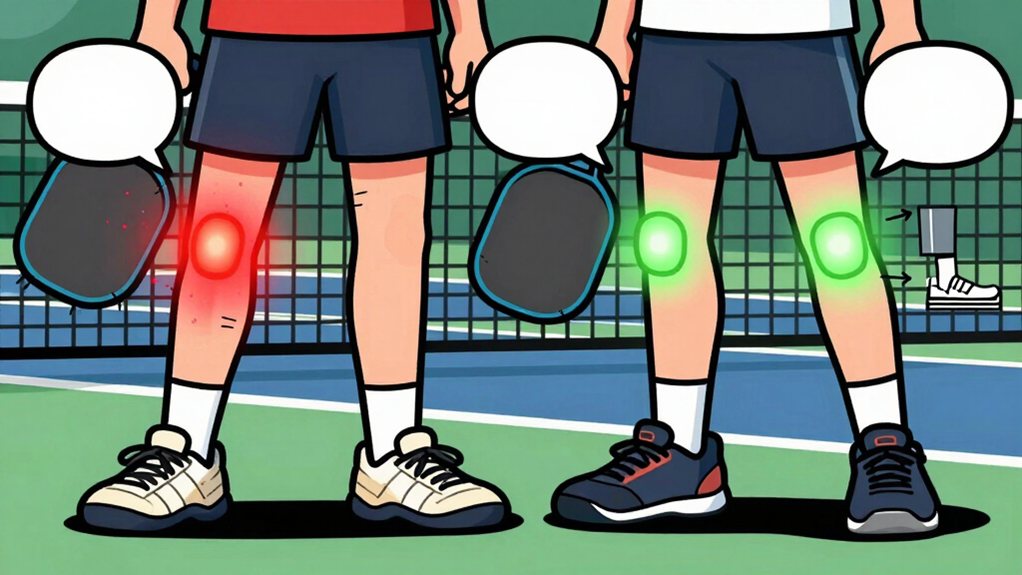
With the right shoes and proper form, you protect your knees from the stress of quick movements and sudden stops. You need court shoes with lateral support and non-marking soles. Replace shoes every 6 months of regular play.
Change your technique to reduce knee strain:
- Bend your knees when you lunge for low balls instead of hyperextending.
- Land with bent knees when you jump to absorb impact.
- Avoid pivoting on a planted foot; pivot with your hips and shoulders.
- Stay low during lateral shuffles to maintain knee alignment.
For whole-home coverage during your recovery and training research, a mesh wifi system extender ensures you stay connected in every room without signal drops.
What Exercises Strengthen Knees for Pickleball Stability?
You can protect your knees during pickleball by strengthening your quadriceps with simple exercises. We recommend straight leg raises, seated leg extensions, and mini squats to build quad strength.
You should also practice balance and stability training with single-leg stands and heel-to-toe walks to improve joint control.

This is an ideal knee brace for women and men, it comes as 1 unit only and can be worn on the left and right knee. Not suitable for children. Must be hand-washed and air-dried only. Helps reduce strain and provides extra stabilization, engineered for stability and lasting pain relief — making it ideal for rodilleras para dolor de rodillas

✅ END THE PAIN! - You know what happens when your knee buckles? It hurts. A lot! Sparthos Hinged Knee Brace alleviates pain from knee injuries like ACL, MCL & meniscus tears, strains and sprains and others. Get through your day without pain and discomfort.

ADJUSTABLE STRAP can make adjustment according personal knee’s curves to supply better protection of patella; It is fully adjustable, fit 13 to 18 inches (Knee Circumference).
Quad Strengthening Drills
Strong quadriceps provide crucial support for your knees during pickleball movements. These four quad exercises target the muscles that stabilize your knees during play.
- Wall Sit: Press your back against a wall, lower into a sitting position until thighs are parallel to the floor. Hold for 30 seconds. Repeat 3 times.
- Straight Leg Raise: Lie on your back with one leg bent. Lift the straight leg 12 inches off the ground. Perform 15 repetitions on each side.
- Step-Up: Step onto a sturdy platform with one foot. Rise up, then lower back down. Complete 12 reps per leg.
- Squat to Chair: Lower yourself onto a chair from standing. Rise immediately. Do 10 squats with controlled movement.
These exercises build knee support. Perform them three times weekly for best results.
Start with one set and add more as your strength improves.
Balance And Stability Training
How do balance and stability training protect your knees during pickleball? They strengthen the small muscles around your knee, improve your proprioception, and help you keep proper alignment during side-to-side movements.
- Single-leg stand: stand on one foot, hold 30 seconds, switch legs, repeat 2 times each side.
- Heel-to-toe walk: step forward with heel touching toe, walk 20 steps, keep eyes forward.
- Bosu squat: place flat side down, stand on dome, lower into a squat until thighs are parallel, rise slowly, perform 10 reps.
- Lateral step-up: step onto a low platform sideways, push through heel to stand, step down, repeat 12 reps each leg.
These drills train your ankles, hips, and knees to react fast, it’s reducing strain and injury risk.
What First-Aid Steps Help After Knee Pain Starts?
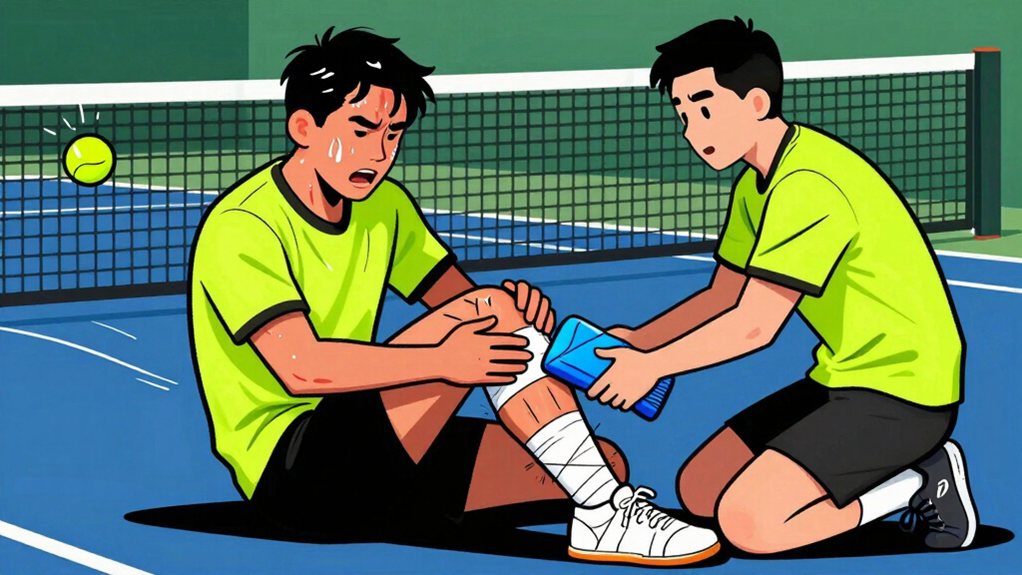
When knee pain starts after playing pickleball, use the R-I-C-E method immediately. Rest the knee and stop all activity, then ice the joint for 15-20 minutes every 2-3 hours.
Finally, raise the leg above heart level while sitting or lying down.
Rest The Knee
If you feel knee pain during pickleball, stop playing immediately and begin first-aid care. Rest is your primary priority. Avoid putting weight on the injured knee for at least 24 to 48 hours.
Lift your leg above heart level when sitting or lying down. Use crutches if you can’t bear weight without pain.
- Stop all activity that causes knee discomfort.
- Avoid walking or standing for extended periods.
- Keep your knee elevated using pillows.
- Limit movement to vital tasks only.
Rest allows your knee to begin healing. Don’t return to pickleball until pain subsides completely.
Your body needs time to recover. Rushing back leads to further injury. Consult a doctor if pain persists beyond a few days.
Ice The Joint
Once you’ve rested your knee, apply ice to lift swelling and manage pain.
Place a cold pack or bag of frozen peas directly on the skin for 15-20 minutes. Remove the ice, wait 20-30 minutes, then reapply.
Repeat this cycle 3-4 times daily for the first 2-3 days. Stop icing when swelling decreases and pain subsides.
Wrap ice in a thin towel to prevent frostbite. Never apply ice for more than 20 minutes at a time. Keep your knee lifted above heart level while icing.
Key steps:
- Apply ice within 48 hours of injury
- Use 15-minute intervals
- Wait 20-30 minutes between applications
- Check skin every 5 minutes for redness
- Stop when swelling decreases
Elevate The Leg
Following rest and ice, raise your leg to reduce swelling and promote healing. Raise your leg above heart level for best results. Use pillows to prop your leg comfortably. Keep your knee straight while elevated.
- Sit or lie down with your leg supported
- Place pillows under your calf, not behind your knee
- Maintain elevation for 15-20 minutes, several times daily
- Continue elevation for 2-3 days as swelling decreases
This position uses gravity to drain excess fluid from your knee joint. We recommend elevation especially after activity when inflammation increases.
Consistent elevation helps speed your recovery. Your knee will benefit from this support as it heals.
When Can You Return to Pickleball After Knee Pain?
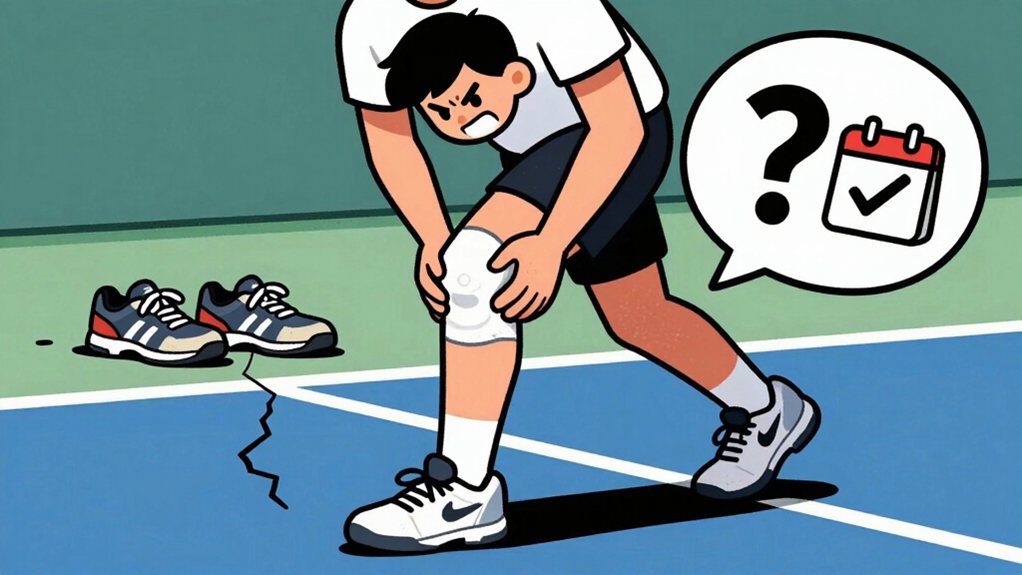
Returning to pickleball after knee pain requires careful observation of your symptoms and a gradual progression back to play.
- Wait until pain subsides completely. This usually takes 7-10 days for mild strain.
- Start with low-impact activities first. Walk, swim, or cycle for 3-4 days before playing.
- Test your knee with light drills. Practice shadow swings and short serves.
- Monitor swelling. Stop immediately if swelling returns or pain increases.
- Increase play time slowly. Begin with 20-30 minutes, then add 10 minutes daily as your knee strengthens.
- Use proper footwear and warm up for 5-10 minutes before matches.
- Stop play if you feel sharp pain. Consult a doctor for persistent discomfort.
- Do strengthening exercises. Perform quadriceps and hamstring work 2-3 times weekly.
Frequently Asked Questions
Should I Wear a Knee Brace While Playing Pickleball?
90% of ER pickleball injuries occur in people 50+. If you’ve had previous knee injuries or experience instability, wear a supportive brace for extra protection. It prevents strain during quick lateral movements and sudden stops.
What Stretches Help Prevent Knee Pain Before a Pickleball Game?
Start with dynamic stretches like leg swings and walking lunges. Perform quad stretches holding each leg for 30 seconds. Include hamstring stretches and calf raises to warm up supporting muscles. Finish with gentle knee circles.
How Do I Know if My Knee Pain Needs Medical Attention?
If your knee swells like a balloon, locks up, makes popping sounds, or buckles when you walk, you need professional help. Sharp pain during movement or inability to bear weight signals urgent medical care.
Can Continuing to Play With Mild Knee Pain Cause Permanent Damage?
You risk worsening joint damage by playing through mild knee pain. Repeated stress on injured tissue leads to chronic inflammation, accelerated arthritis, and potential ligament or meniscus tears. Stop immediately if pain increases or returns.
Are There Supplements or Vitamins That Support Joint Health for Pickleball?
Thinking vitamins are your knee’s superhero cape? Hate to break it to you, glucosamine, chondroitin, omega-3s, and vitamin D might support joint health, but they won’t grant you invincibility on the pickleball court ever during gameplay.
Final Thoughts
- First, warm up for 5 minutes.
- Next, strengthen your thigh muscles with 3 sets of 10 straight leg lifts.
- Then, wear shoes with proper ankle support.
Keep your knees bent at about 20° when you pivot. The ball is in your court: apply these rules now.
We’ll recommend a gradual return to play, starting with 10 minute sessions and monitor pain regularly through daily checks. You should also stretch after each session for 2 minutes daily regularly.
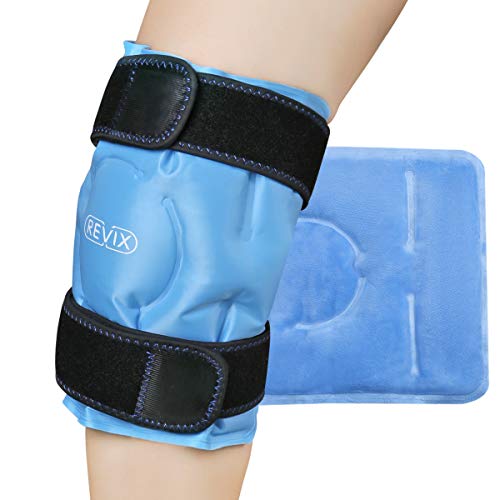
Gel Ice Pack Wrap for Knees: This knee gel ice pack is newly designed with soft plush cover that is much better than a towel wrapping. The plush cover can avoid condensed water dripping after frozen. This cold wrap relieves for Swelling, Sprains, Inflammation, and speeds up healing time, helps muscles recover after strenuous activity, injury, and muscles recovery after the gym

Gel Ice Pack Wrap for Knees:This knee gel ice pack with soft plush cover that avoid condensed water dripping after frozen. This cold wrap relieves for Swelling, Sprains, Inflammation, and speeds up healing time, helps muscles recover after strenuous activity, injury, or surgical procedure and muscles recovery after the gym.

Plus Size Knee Ice Wrap: Measures 19"X10.6" with 24.8" elastic straps, large ice wraps for knee ensures a full coverage for your knees, which is available for knee circumference up to 19". Two adjustable straps make gel ice pack more fit your knee and add compression, securing in place to free your hands.