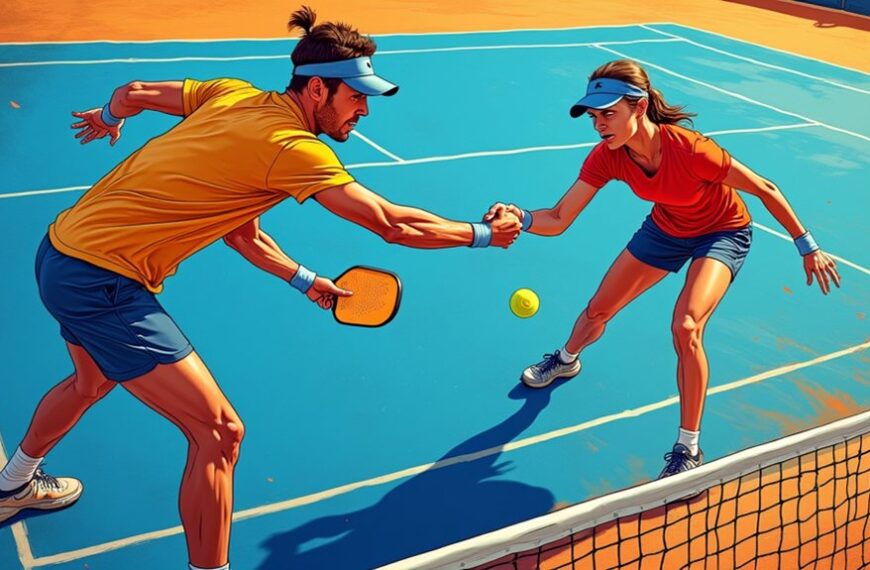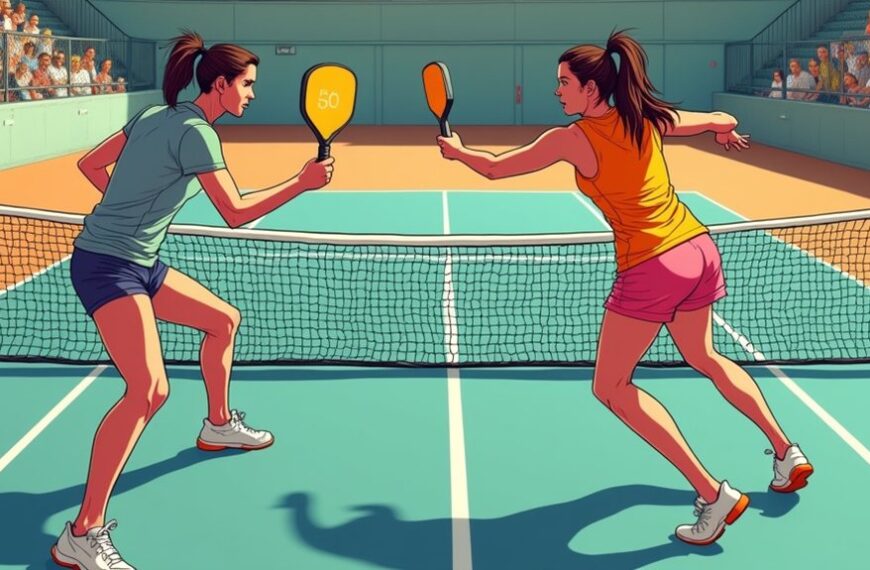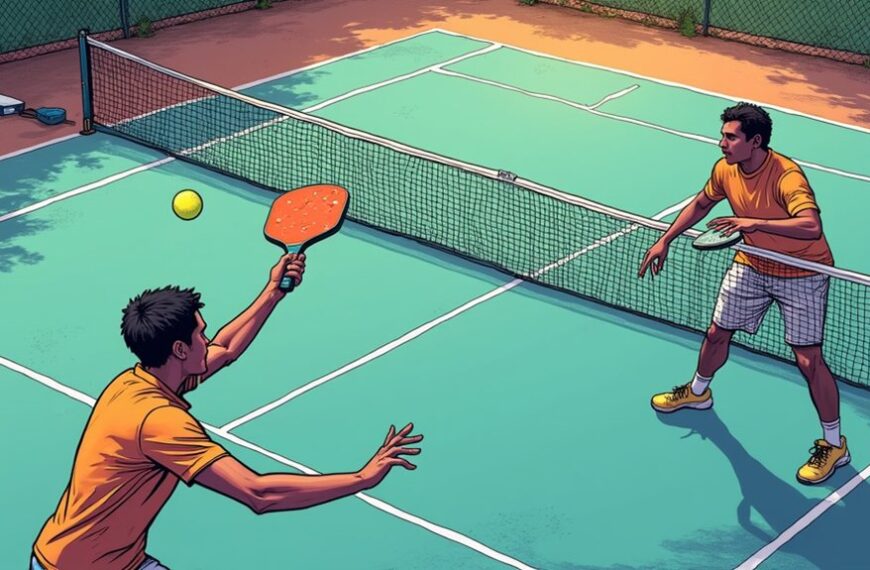
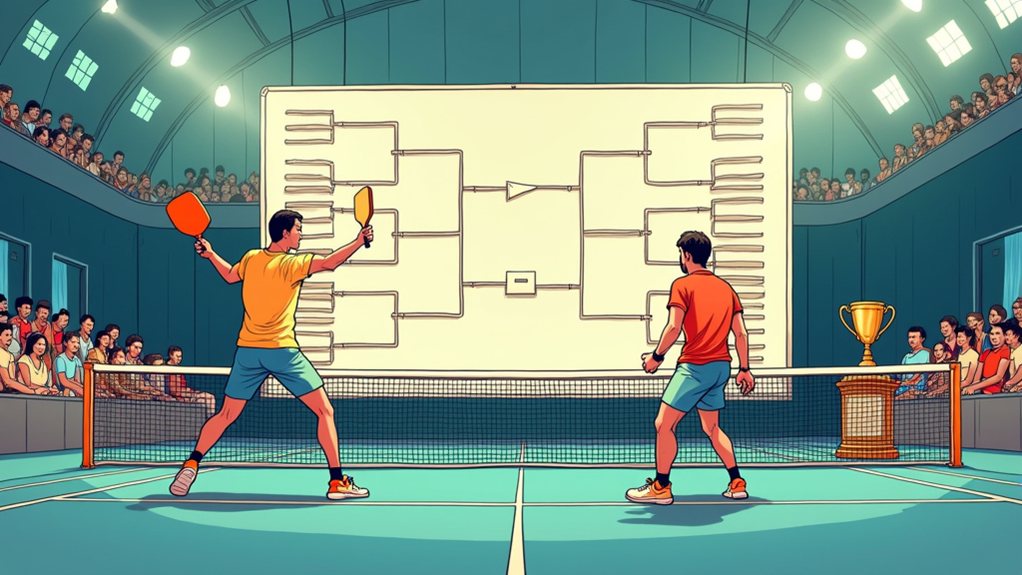
Pickleball tournament formats determine how teams advance, secure teams after a loss, or get eliminated. Single elimination removes teams after one loss. Double elimination gives you a second chance after your first loss. Round robin ensures every team plays every opponent.
Most tournaments use 11-point games with win-by-two rules; some use 15 or 21 points. You get two one-minute timeouts per game in 11-point matches. Each court measures 30 by 60 feet with nets at 36 inches at center. Knowing these rules helps you pick the right format for your event.
Pickleball Tournament Formats Explained: Finding the Right Structure for Your Event
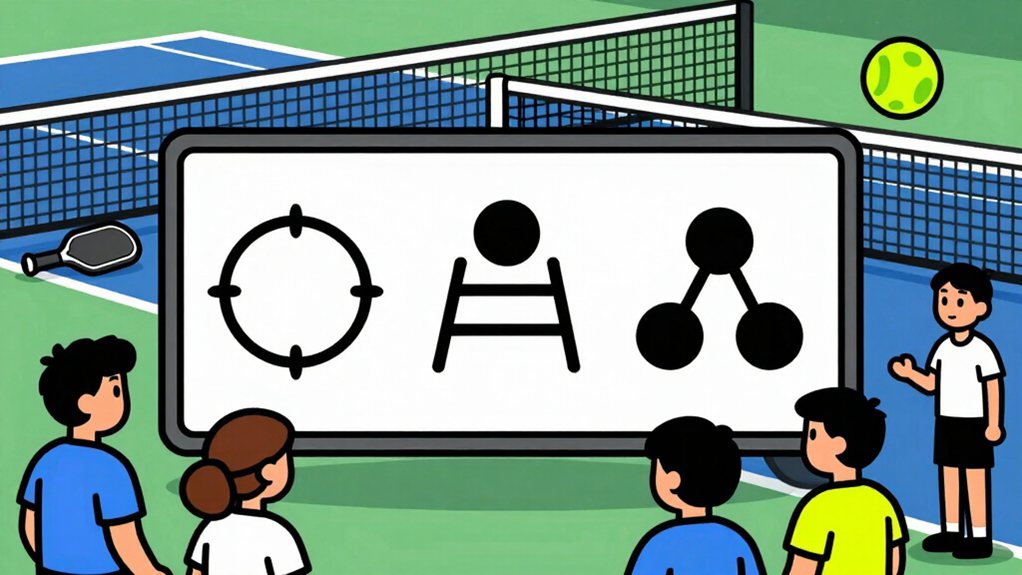
When planning a pickleball tournament, you must choose a format that fits your number of courts, entrant count, and competitive goals. The most common pickleball tournament formats are round robin and double elimination pickleball structures.
Round robin pickleball rules guarantee every team plays multiple matches. All teams play each other once. You determine rankings by win-loss records. Use this format when you have limited courts or want maximum playing time for all entrants.
Double elimination pickleball gives teams a second chance after one loss. Teams lose once in the winners bracket, then move to the losers bracket. A second loss eliminates them from the tournament. This format provides competitive balance and more games per team.
Consider these factors when choosing:
- Number of available courts
- Total entrant count
- Time constraints
- Skill level of participants
Choose round robin for 1-2 courts and small fields. Choose double elimination pickleball for larger fields with enough time and courts.

Pickleball Tournament design. King of the Pickleball Court. Pickleball doubles matching tournament shirt.

Tournament Bracket Chart - 22x34 inches. Reusable laminated with Dry Erasable Pen for Multiple Uses. Pen is sent in multiple different colors at random
Single Elimination Brackets: How Winners Advance and Losers Are Eliminated
Single elimination pickleball brackets operate differently from round robin or double elimination formats. In this format, you play until you lose. Once you lose a match, you’re eliminated from the bracket.
Here’s how it works:
- Teams are seeded based on skill or random draw
- Winners advance to the next round
- Losers are out of the bracket
- The tournament continues until one team remains undefeated
The final two teams in the winner’s bracket compete for gold and silver medals. Teams that lose early may drop to a consolation bracket for third-place matches.
This format works well for large fields because it eliminates teams quickly, keeping the schedule on track. Each team gets a minimum of two matches. Tournament organizers managing large events sometimes use a Home Assistant smart hub to automate court lighting, scoreboards, and facility announcements throughout the day.
Double Elimination: Giving Teams a Second Chance
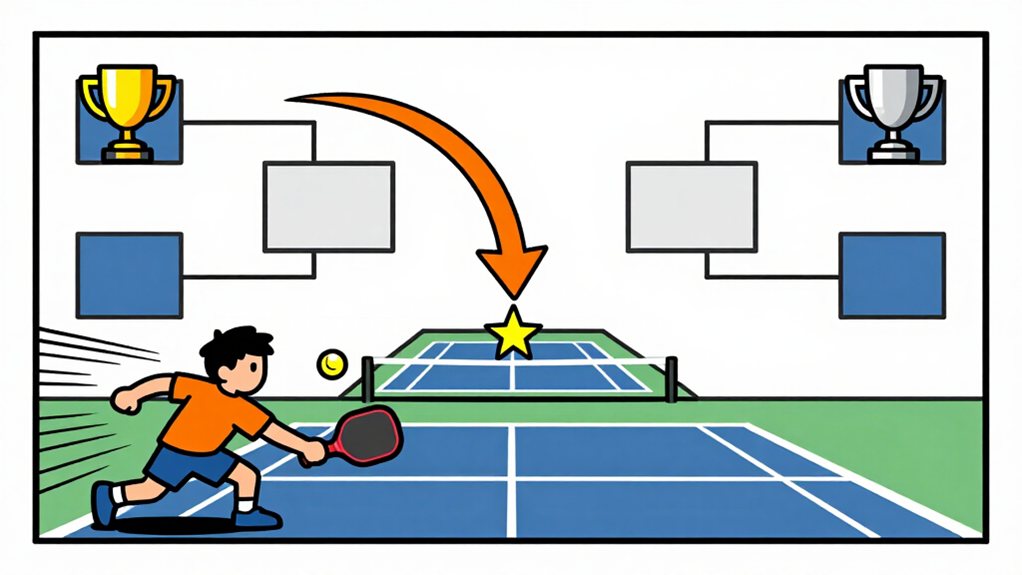
Double elimination gives teams a second chance to stay in the tournament. You play until you collect two losses.
When you lose your first match, you drop to the losers bracket. You stay in the tournament until you lose a second match.
This format guarantees you at least two games.
The winner’s bracket final and the losers bracket final feed into the championship. Consolation bracket teams can still win gold or silver.
Here are the key rules:
- One loss sends you to the losers bracket.
- Two losses remove you from the tournament.
- You need to beat the winner’s bracket champion twice for the title.
We use this format for competitive balance.
It gives your team more playing time.
It reduces the impact of one bad game.
You face different opponents as you move through the brackets.
Round Robin Play: Ensuring Every Team Faces Every Opponent
Since every match counts in round robin play, you’ll face every other team in your group. You play one game to 11 points, win by two, unless the event uses 15 or 21 points.
Wins are recorded as 1,0, losses as 0,1, and the team with the most wins claims first place.
If two or more teams tie, we break the tie using head,to,head results first, then point differential.
- Count total wins for each team.
- If two teams tie, compare their head,to,head game.
- If three or more teams tie, use point differential (points scored minus points allowed) to rank them.
We post the standings after each round, and the top team receives the gold medal. Each team plays one match against every other team in the group.
Pool Play Structure: Group Stages That Seed Into Elimination Rounds
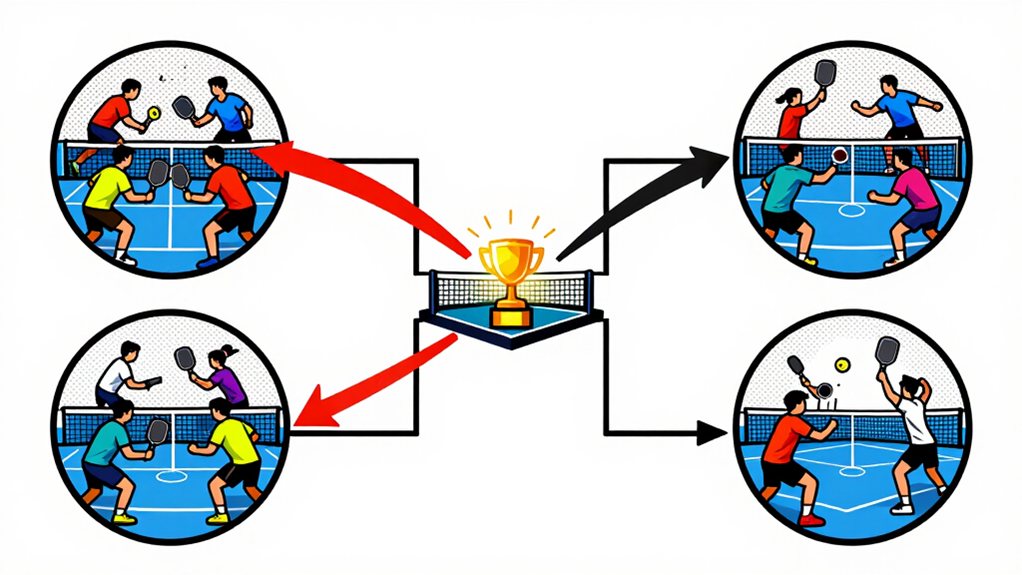
Pool play divides teams into groups where each team plays every other team in their pool. This format lets you face varied opponents before seeding into elimination rounds.
Pool play groups teams, giving each opponent variety before seeding into elimination brackets.
- Create 4-6 team pools based on seed rankings.
- Play round robin within each pool.
- Rank teams by wins, then point differential.
- Select top 2-4 teams from each pool.
- Seed those teams into single or double elimination brackets.
Pools keep matches competitive. You avoid early mismatches against much stronger or weaker opponents.
Seeding then balances the elimination bracket. Expect 3-4 pool matches per team before playoffs begin.
Use this structure for tournaments with 16+ teams.
How Pickleball Scoring Works: Points, Games, and Win-by-Two Rules
Once pool play concludes and you seed teams into elimination brackets, the actual matches follow specific scoring rules.
- Games are played to 11 points.
- You must win by two points.
- If the score reaches 10-10, play continues until one team leads by two.
- Most tournaments use best of three games.
- Some events use 15 or 21 points instead.
- The same two-point margin applies to those formats.
- Round robin pools often use one game to 11 points when six or more teams compete.
- The two-point win requirement remains constant across all scoring formats.

👍 MODERN AND VINTAGE SIGNS :Our signs are made to look bright and vibrant. This high-quality wall art allows you decorate in your own unique style! Your family and friends will love the look of our signs.
USEFUL FOR MANY BUSINESSES AND INDUSTRIES

PICKLEBALL RULES TAGS - No more guessing or arguing on the court about the rules. Our tags are simplified for easy understanding. Includes diagrams, covers the basics and more including serving, two bounce rule, scoring, serving rotation, the kitchen rules, terms & more. Takes the confusion out of the rules of pickleball. Quick start guide to playing pickleball.
Tournament Regulations: Timeouts, Match Limits, and Fair Play Standards
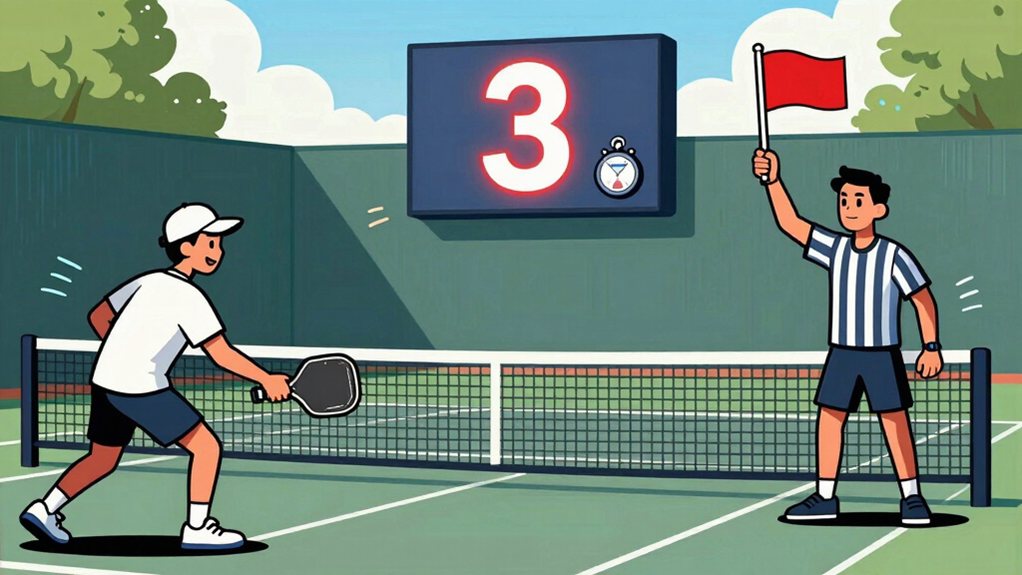
You must follow specific timeout rules, match limit guidelines, and fair play standards during tournaments. Each 11-point or 15-point game allows you two one-minute timeouts, and matches typically consist of best-of-three games. We enforce fair play by requiring sportsmanlike conduct, proper equipment, and adherence to all official pickleball rules.
Timeout Rules Explained
Timeouts give you important strategic breaks during match play. You receive two timeouts per game. Each timeout lasts 60 seconds. Use them to rest, receive coaching, or adjust your strategy.
Scoring systems determine timeout rules. Games to 11 or 15 points allow two timeouts per team. Games to 21 points allow three timeouts per team.
You can’t call a timeout when the score reaches 11-0 in an 11-point game. Coaches can’t enter the court during timeouts. Unused timeouts don’t carry over to the next game. Players must request timeouts from the referee.
- Wait for a natural break in play.
- Raise your hand to signal the referee.
- State “timeout” clearly.
- Proceed to your sideline.
- Return within 60 seconds.
Match Limit Guidelines
In tournament play, match limits protect your safety and secure fair competition for all participants. Tournaments set maximum match counts to prevent exhaustion and secure fair scheduling across all skill divisions. Most events cap players at 3-5 matches per day.
Single elimination guarantees two matches minimum. Double elimination provides two to four matches. Round robin formats may include 4-6 matches depending on pool size. This structure helps organizers manage time and court availability effectively.
- Your tournament will announce match limits during registration.
- Officials track your daily match count carefully.
- You receive rest periods between scheduled matches.
- Event organizers adjust brackets if limits approach capacity.
These guidelines protect your physical condition while maintaining competitive integrity throughout the tournament day and sessions.
Fair Play Standards
Follow fair play standards to guarantee respectful and orderly competition. You must conduct yourself with integrity and respect for officials, opponents, and teammates. We expect all participants to know and follow tournament rules.
Key fair play guidelines include:
- Arrive on time for all matches.
- Call lines honestly and fairly.
- Control your temper and language.
- Accept official decisions without argument.
- Shake hands before and after matches.
| Behavior | Expected Action | Penalty Warning |
|---|---|---|
| Late arrival | Report 10 min early | Default loss |
| Unsportsmanlike conduct | Verbal warning | Disqualification |
| Equipment violation | Correct before play | Point deduction |
| Line call dispute | Request referee | Delay penalty |
| Code of conduct breach | Stop immediately | Tournament ban |
Use your timeouts strategically. You receive two one-minute timeouts per 11-point or 15-point game. Call timeouts before serving. We recommend using timeouts to regroup during close matches.
Choosing a Tournament Format Based on Court Count and Entry Numbers
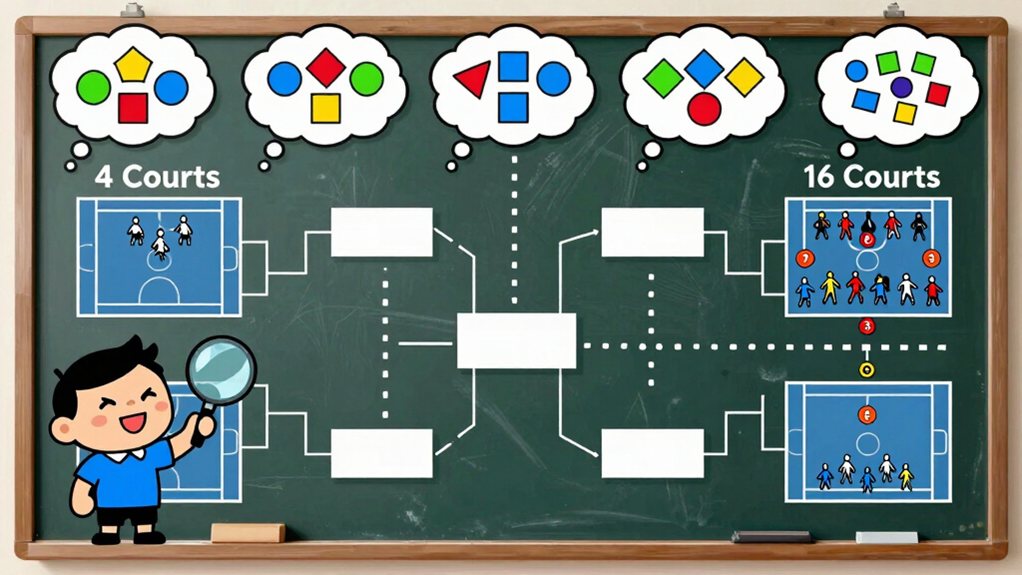
When selecting a tournament format, you must consider your court count and the number of entrants.
- For 1-2 courts with 4-8 teams, use round robin. This gives each team maximum playing time.
- For 2-4 courts with 8-16 teams, choose single elimination. It moves quickly and keeps events on schedule.
- For 4+ courts with 16+ teams, pool play works best. Split teams into groups of 4-5. Top teams advance to elimination rounds.
Court availability determines daily match capacity. Plan for 8-10 matches per court per day.
Account for 10-15 minutes between matches for warm-ups and scoring.
Calculate entry numbers before choosing format.
Too many teams for few courts creates long delays.
Too few teams for large format leaves courts empty.
Step-by-Step Guide to Organizing a Smooth Pickleball Competition
You must define tournament structure, arrange court layouts, and coordinate volunteers to run an effortless competition.
Select your format based on entrant numbers and court count.
Then assign volunteers to key roles like scorekeepers, registration, and court management.
Define Tournament Structure
Defining your tournament structure is the first critical step in planning a successful event. You must choose a format that matches your entrant count and goals.
- Single elimination works best for large fields. Winners advance, losers exit. You guarantee two matches per player.
- Double elimination gives teams a second chance. A team needs two losses to leave the event. This format creates a losers’ bracket.
- Round robin suits small groups. All teams play each other. You determine winners by win-loss records.
- Pool play divides large groups into smaller clusters. Top teams from each pool advance to playoffs.
Choose single elimination for eight or more courts. Use round robin for two or fewer courts. You should align format with your expected entrant count.
Arrange Court Layouts
Selecting your tournament format leads directly to setting up your competition space. Follow these steps to arrange court layouts effectively.
- Measure your playing area. Each pickleball court requires 30 feet by 60 feet of playable space.
- Position courts side by side. Leave 10 feet between adjacent courts for player movement.
- Mark boundaries clearly. Use tape or paint for baseline, sidelines, and service lines.
- Set up nets at 36 inches at center, 34 inches at posts.
- Provide clear spectator pathways. Designate areas for warm-ups away from active play.
- Provide sufficient lighting. Minimum 30 foot-candles for indoor tournaments.
- Place scoreboards near each court. Post match schedules and bracket information visibly.
Consider court surface type. Outdoor courts use concrete or asphalt. Indoor courts use wood or synthetic materials. Check surface conditions before competition begins.
Coordinate Volunteers
Before recruiting volunteers, confirm your event’s staffing needs. Calculate one volunteer per court plus additional support staff. Typical needs include scorekeepers, court monitors, registration helpers, and food service coordinators.
- Identify key positions first. You’ll need a volunteer coordinator to manage the team.
- Reach out to local pickleball clubs, community centers, and sports organizations.
- Provide clear role descriptions. Scorekeepers track points, announce scores, and make sure rules are followed.
- Schedule volunteers in shifts. Plan for four-hour minimum shifts with overlap coverage.
- Conduct a brief orientation. Review tournament schedule, emergency procedures, and basic court etiquette.
- Equip volunteers with bright shirts. Provide name tags and position-specific badges for easy identification.
Have backup volunteers available. Unexpected absences will disrupt your tournament flow.
Frequently Asked Questions
How Are Players Seeded Into Brackets?
Seed your brackets using player rankings, pool play results, or round robin records. Top performers from preliminary rounds receive higher seeds, ensuring the strongest teams avoid each other until later rounds and creating competitive matchups.
What Happens if a Match Is Interrupted by Weather?
Clear skies suddenly darken with storm clouds, compelling you to pause your match. You wait for officials to determine resumption, and if darkness or unsafe conditions persist, you finish tomorrow. Your match score gets recorded, guaranteeing fair continuation.
Can Teams Request a Rest Period Between Matches?
You can request rest periods between matches, but it depends on tournament director approval and schedule. Most events allow brief breaks, especially in hot weather or when matches are closely scheduled.
How Are Disputes Over Line Calls Resolved?
Line calls are resolved by the receiving team. If you disagree, request a referee. Without one, players must accept the call and play continues. For disputed facts, the benefit always goes to the caller’s team.
Are There Age or Skill Divisions for Tournaments?
Yes, most tournaments offer both age divisions and skill divisions. You compete in age brackets like 19-and-under, 30+, 50+, or 65+, and skill levels from 2.0 to 5.0, allowing you to find your appropriate competitive tier.
Final Thoughts
Study your bracket each morning. Know your match time, court number, and opponent. Arrive 15 minutes early. Warm up for 5 minutes.
Communicate with your partner before each game. Adjust your strategy after each loss and win. Stay present in the moment. Trust your preparation.
You control your effort. We reward focused play with advancement. Execute your plan. Play your game.
Win or lose, you improve. Celebrate progress, not victories. Every match builds your skill.

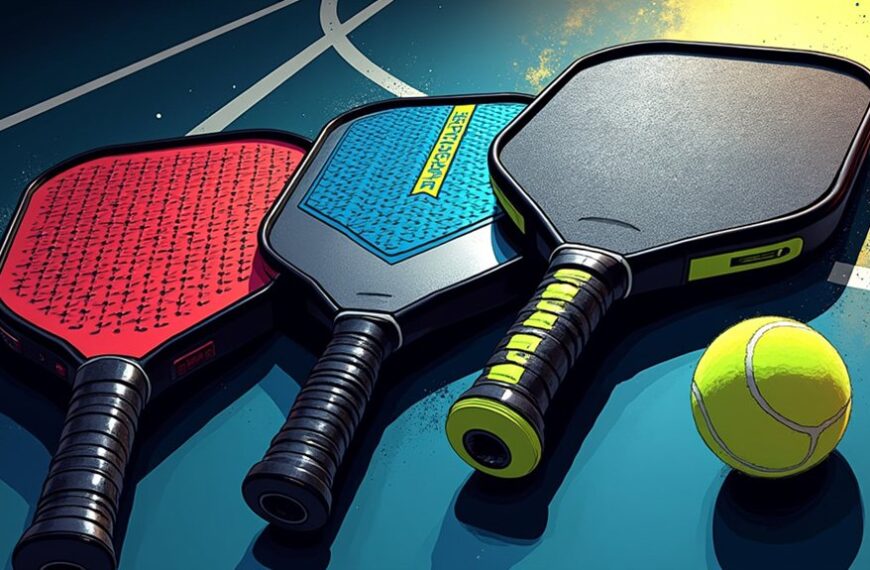
The 16mm core of the pickleball paddles is a high-quality high-density polypropylene honeycomb design, which effectively reduces vibration and is strong and stable. The surface of the racket is T700 carbon fiber, which is strong and durable. The most outstanding advantage is light and easy to control. USAPA certification guarantees the quality of the paddles.

Edgeless Pickleball Racket: Designed with aerodynamic in mind, the racquet provides more swing strength and ball control. The edgeless pickleball paddle design also means that there is no risk of the edge-guard obstructing ball contact.