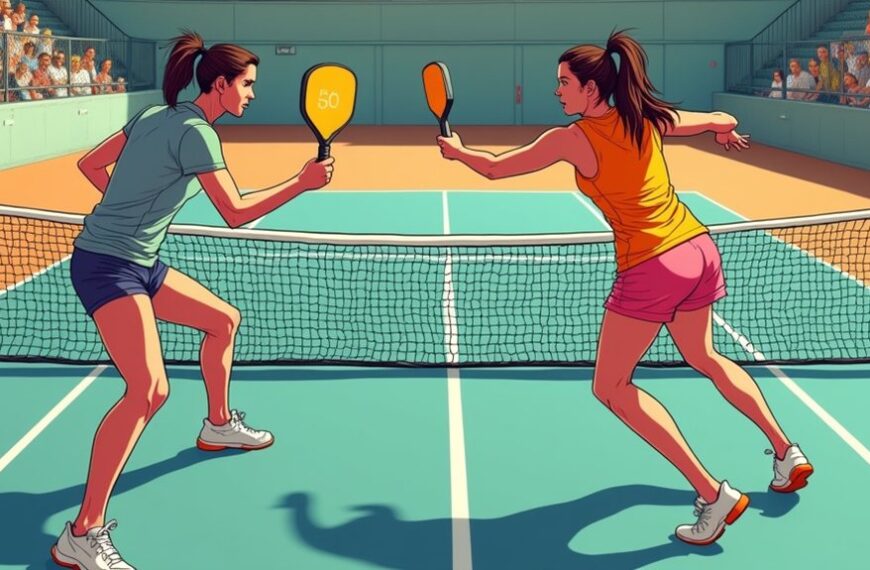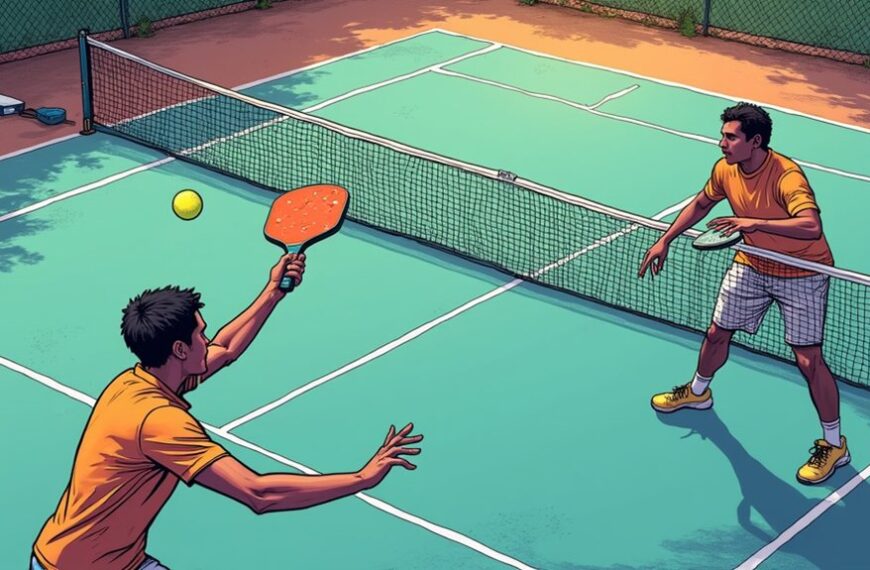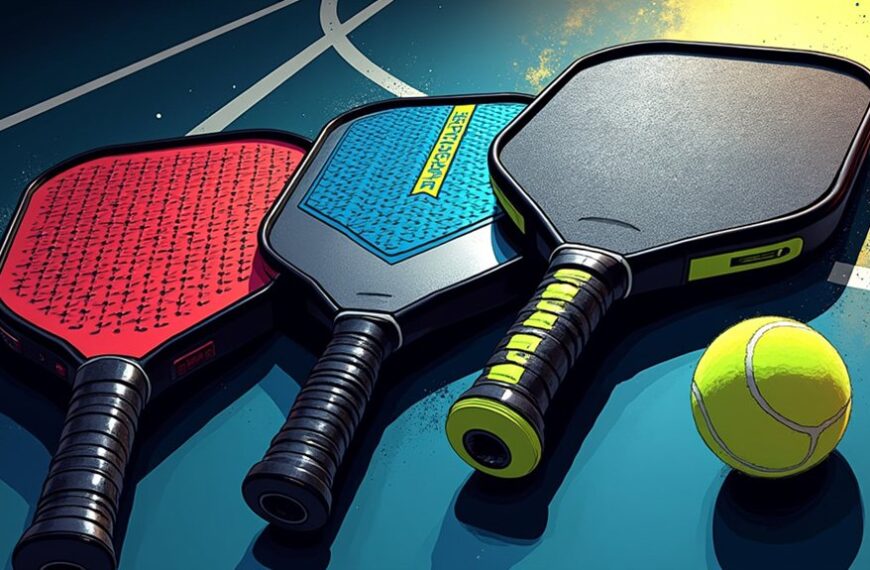
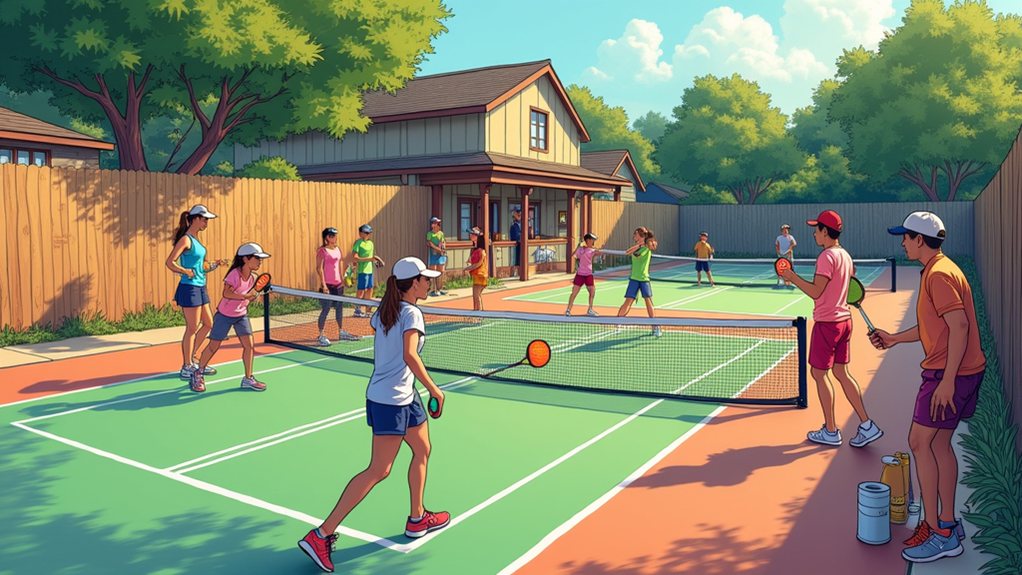
At your first pickleball open play session, you’ll find a structured, informal environment where players share court time through an organized rotation system. You place your paddle in a rack to show you’re waiting; winners stay on the court and losers move to the back of the line. Games are first to 11 points, win by 2.
Bring your own paddle, water bottle, and wear non-marking shoes. Introduce yourself to opponents, call “ball” loudly for stray balls, and keep language respectful. For more details on court procedures and skill level placement, continue exploring.
What Is Pickleball Open Play and How Does It Work?
Open play is a structured, informal pickleball session where players of all skill levels share court time through organized rotation systems.
How it works:
Place your paddle in the rack, join a game, winners stay, losers rotate—ensuring fair play for all.
- You place your paddle in a rack to show you’re waiting to play.
- When called, you join three other players for doubles.
- Winners stay on the court. Losers rotate off.
- Both players on the losing team move their paddles to the challengers’ rack.
- Winners move their paddles to the victors’ rack.
- The next players in line take the open spots.
- All four players leave the court after each game ends.
- Standard pickleball rules apply during play.
- You introduce yourself to unfamiliar players before each game.
This system guarantees everyone gets equal playing time throughout the session.
Staff members are available to answer questions about rotation procedures.

PICKLEBALL RACKET RACK SYSTEM: Determines the players for the next open court. Move the label adsorb on the rack to designate the players who are next to play. The 45° inclined paddle position design enables you to easily locate your paddle.

[Best Gift for Families] Niupipo Pickleball Paddles includes 2 durable adult pickleball paddles and 2 junior paddles, 2 indoor and 2 outdoor pickleball balls, and 1 convenient pickleball bag; providing everything your group requires. A high-quality fiberglass pickleball set can drastically alter a player's game. Show love for your family by providing them with the finest connection
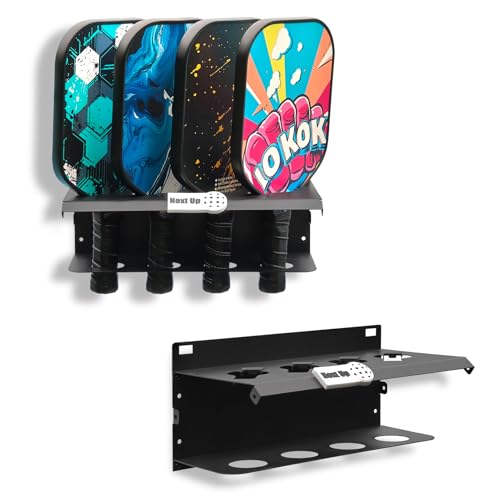
PICKLEBALL RACKET RACK SYSTEM: Determines the players for the next open court. Move the label adsorb on the rack to designate the players who are next to play. The 45° inclined paddle position design enables you to easily locate your paddle.
How Do I Choose the Right Skill Level for My First Session?
First, we ask you to assess your experience by thinking about how often you play and how well you know the rules.
Next, review the skill descriptions: 2.0-2.9 for beginners, 3.0-3.75 for intermediates, and 3.75+ for advanced players.
Finally, ask the staff for guidance if you’re still unsure which level fits you best.
- Assess your experience – consider your playing frequency and rule knowledge.
- Review skill descriptions – match your level to the 2.0‑2.9, 3.0‑3.75, or 3.75+ categories.
- Seek staff guidance – ask a staff member to confirm your court placement.
If you want to make your home sessions more comfortable between play days, a smart thermostat can help you maintain the ideal temperature with minimal effort.
Assess Your Experience
When you evaluate your abilities for open play, start by honestly rating your experience against three skill categories. Most facilities use these ranges to group players:
- Beginner (2.0-2.9): You know the rules but are still learning basic shots and positioning
- Intermediate (3.0-3.75): You play regularly and have consistent forehands and backhands
- Advanced (3.75+): You understand strategy, position well, and rarely make unforced errors
Consider how many months or years you have played. Think about whether you can keep rallies going with basic consistency.
Ask yourself if you win games against recreational players. Use your honest assessment to select the court that matches your current skill level. This fosters fair competition and maximizes your playing time.
Review Skill Descriptions
After you assess your abilities, review the skill descriptions to *validate* your court placement. Most facilities use three skill levels to organize play.
Beginner (2.0-2.9): You understand basic rules. You’re still learning strategy and technique. You may struggle with consistent shots.
Intermediate (3.0-3.75): You have playing experience. You make mistakes during matches. You’re refining your game.
Advanced (3.75+): You play strategically. You rarely make unforced errors. You understand positional play.
Match your abilities to the correct level. This *supports* fair competition. It also helps you develop skills against similarly skilled players.
Consider your current skill level honestly. Playing at the right level maximizes your learning experience. It also *guarantees* you enjoy the game and improves your overall experience.
Choose the level where you feel challenged but not overwhelmed. Your first session should feel comfortable. You want to learn, not struggle.
Seek Staff Guidance
If you’re unsure about your skill level, we recommend speaking with the staff at the facility before your first session.
Staff members observe open play regularly and can assess your abilities accurately. They’ll help you find the right court based on your experience.
Here’s what to discuss with staff:
- Tell staff how long you have been playing pickleball.
- Explain your familiarity with basic rules and scoring.
- Describe your comfort level with dinking and serving.
- Ask which court matches your current skill set.
Staff guidance makes sure you play with others at a similar level. This creates fair matches and helps you improve.
Don’t hesitate to ask questions. Staff want to help you have a positive experience.
What Is the Paddle Rack System and How Does It Work?
The paddle rack system forms the foundation of open play at pickleball facilities. You place your paddle in a rack or lineup to show you’re waiting to play. The rack tracks who plays next.
How it works:
- Place your paddle in the rack for your skill level
- When a court opens, the first two paddles (singles) or four paddles (doubles) move to the court
- Both winners and losers remove their paddles after each game
- The next players in line step onto the court
Some facilities use two racks. Winners place paddles in one rack. Losers use the other rack. A tennis ball marker shows which rack supplies the next game. Move the ball to the opposite rack after each game ends.
This system makes sure fair rotation. Everyone gets equal playing time. The order stays clear.
What Are the Standard Rules and Scoring at Open Play?
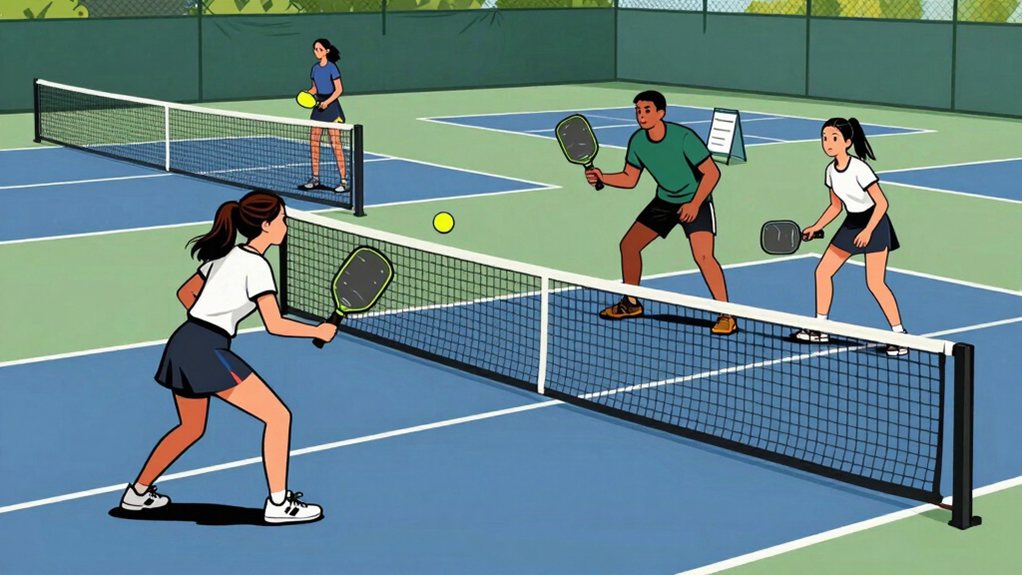
At open play, you follow standard pickleball scoring and serving rules.
Games are first to 11 points, and you’ve got to win by at least 2 points—only the serving team scores.
You serve from behind the baseline into the diagonal service box, and you get one serve attempt per turn.
Scoring Format
Understanding the scoring system helps you compete effectively during open play. Most open play sessions use rally scoring when many players are waiting. This means either team scores a point on every rally. Games typically go to 11 points, but some venues use 15 or 21 points.
You must win by at least 2 points to claim victory.
Here are the standard scoring formats:
- First-to-11 points with win-by-2 requirement
- First-to-15 points when rally scoring is activated
- First-to-21 points used in some tournament formats
- Only the serving team scores points in traditional scoring
Check with your facility for their specific scoring format. The score is called out before each serve. Most sessions call the score clearly at the start of each rally. This guarantees both teams know the current point total before play begins.
Serving Rules
Now that you understand scoring formats, let’s examine serving rules.
- You stand behind the baseline. You hit the ball diagonally into the opponent’s service court.
- Your serve must be underhand. Your paddle must contact the ball below waist level.
- The ball must land inside the diagonally opposite service court. It must clear the non-volley zone.
- You receive one serve attempt. A miss results in loss of serve to your partner in doubles.
- The serve sequence starts on the right side. Teams alternate sides after each point.
- At open play, we follow standard rules. The server calls the score before each serve.
Key serving requirements:
- Underhand motion required
- Ball must bounce once before returning (serving team lets it bounce first, then receiving team lets it bounce once)
- No volleying allowed until ball bounces on your side
How Does Court Rotation Work at Open Play?
When players finish a game, both winning and losing teams leave the court immediately, and the next players step on based on their paddle order in the rack. This keeps the rotation flowing continuously. Here’s how it works:
- Place your paddle in the rack when you arrive at the open play session
- Wait for your turn as paddles are called in order from the rack
- Step onto the court quickly when your paddle is called
- Return your paddle to the rack after your game ends
Some facilities use separate racks for winners and losers. At these locations, winners place paddles in one rack and losers in another.
A marker indicates which rack supplies the next players. You check the marker before stepping on. This system helps fair play and equal court time for everyone.
What Etiquette Should I Know Before My First Visit?
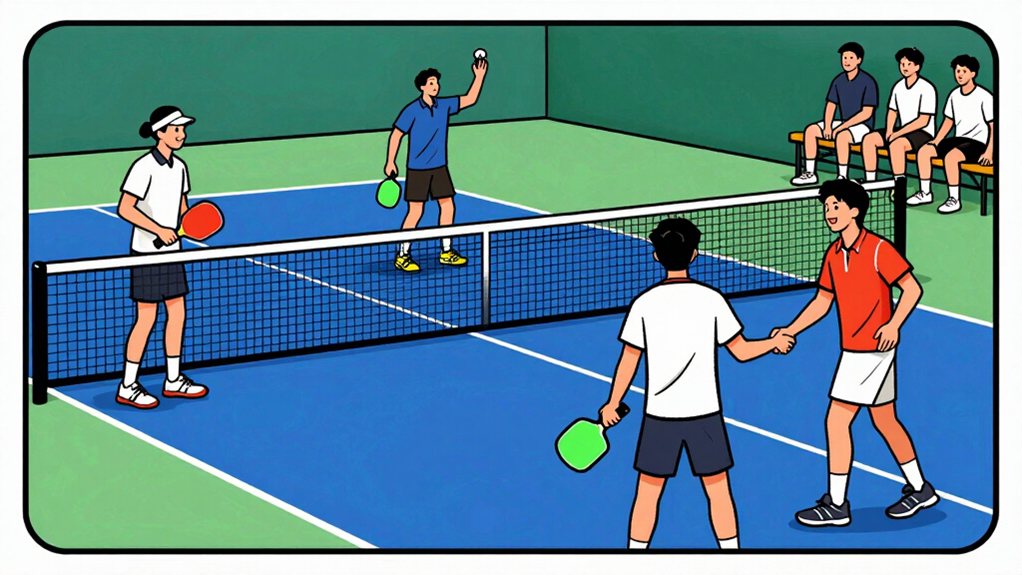
You should introduce yourself to each opponent before play begins. We expect a brief name exchange. Wait for the paddle rack signal before you step onto the court. Call “Ball” loudly when a stray ball enters your area. Keep language clean and respectful at all times. Follow the rotation system to keep play fair for all participants.
| What to Do | Why It Matters |
|---|---|
| Introduce yourself | Builds friendly atmosphere |
| Wait for paddle signal | Assures correct rotation |
| Call “Ball” | Prevents injuries |
| Keep language clean | Shows respect |
| Follow rotation system | Keeps play fair |
- Introduce yourself before each match.
- Wait for paddle rack signal before court play.
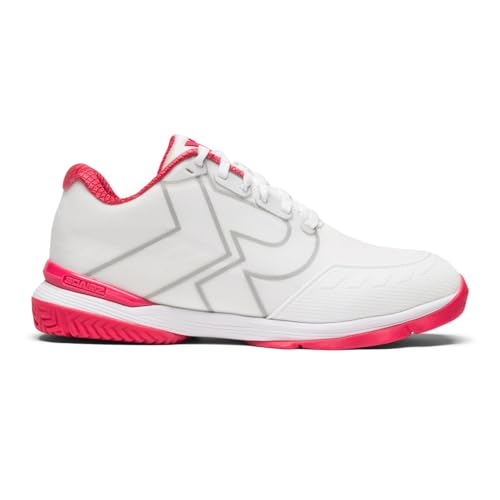
Precision Performance: Built for pickleball, not in a boardroom but on the pickleball court itself for over three years, with insights from top pros. The Sqairz XRZ Women's Pickleball court shoes are engineered for precision, allowing players to make quick cuts and explosive pivots with confidence. Its patented roomier toe box promotes natural toe spread, enhancing balance and enabling players to dominate every rally effectively.

Innovative, durable, and breathable mesh upper with synthetic support overlays

FIT: Built for Court Sports: K-Swiss men’s pickleball shoes have a wide toe box that suits the flexibility needed for pickleball, volleyball, and more. Heels stay secure, no slipping, even during quick moves.
What Should I Bring to Open Play?
In preparation for open play, gather these key items to ensure a seamless session. Your paddle is critical, you can’t borrow one at every facility.
Wear supportive athletic shoes with non-marking soles to protect your ankles and the court surface.
Bring a water bottle and light snacks to maintain energy throughout the rotation system. A small towel helps you wipe sweat between games.
- Your paddle (check for cracks and grip tape condition)
- Proper court shoes with non-marking soles
- Water bottle (at least 16 ounces)
- Towel for perspiration
Arrive early to secure your spot in the paddle rack. Most facilities provide balls, but you may bring your own for practice.
Wear comfortable, breathable clothing that allows full movement. A hat or visor shields your eyes from sunlight near outdoor courts.
What Happens When I Step On the Court?
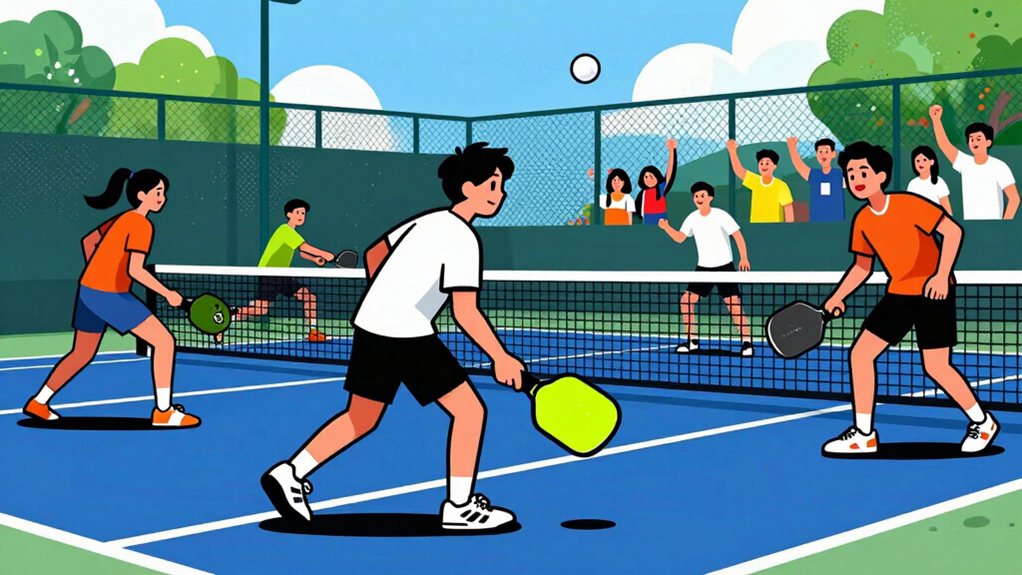
Once your paddle is in the rack, find a seat or standing spot near the courts. Watch the current game closely. When the game ends, all players leave the court at the same time. The next two or four paddles in order move onto the open court.
| Court Area | Purpose | Player Action |
|---|---|---|
| Baseline | Serve position | Stand behind the line |
| Service box | Target area | Hit ball into diagonal box |
| Kitchen | Non-volley zone | Step in only after bounce |
You will rotate after each game. Winners may stay or move to the winner’s rack depending on the system. Losers move to the challengers’ rack. Wait for your turn again.
Introduce yourself to new players. Follow the paddle order exactly. Stay ready between games. Do not touch other paddles without asking.
Know which court matches your skill level. Check the posted schedule for session times. Ask staff if you are unsure where to play at this facility.
What Are the Best Tips for Enjoying Your First Open Play Session?
Prepare for your first open play session by arriving early, finding the correct skill level, and learning the paddle rotation system. This preparation guarantees you move seamlessly into play and maximize your court time.
- Introduce yourself to teammates and opponents before each game. This builds rapport and prevents misunderstandings during play.
- Follow the paddle rack system strictly. Place your paddle in the correct order and never move other players’ paddles without asking.
- Call out “ball” loudly when a stray ball enters your court. Never walk across active courts while play continues.
- Accept line calls honestly. When uncertain, give your opponent the benefit of the doubt.
These practices create fair, enjoyable games for everyone involved.
Frequently Asked Questions
How Much Does an Open Play Session Cost?
Open play sessions typically cost between $5-15 per person, depending on the facility. You’ll pay at the front desk when you arrive. Some clubs offer packages or monthly memberships that reduce your per-session costs if you play regularly.
How Long Does a Typical Open Play Session Last?
A typical open play session lasts between 1-3 hours, depending on the facility. You’ll rotate through games during your time slot, and you can stay for the full play duration or leave when you need to.
Do I Need to Register in Advance, or Can I Just Show Up?
You can usually just show up to open play, but some facilities don’t allow walk-ins. Check your local court’s policy online or call ahead to confirm if walk-ins are welcome or need reservations at all.
Is There an Orientation for First‑Time Players?
Most venues host a quick 10-minute orientation; you’ll be matched with a veteran who walks you through paddle racks, scoring, and etiquette, so you step on feeling ready like a chick breaking its shell today.
Are There Age Restrictions for Participating in Open Play?
Most open play sessions don’t have strict age restrictions, though some facilities offer junior, adult, or senior-specific times. Contact your local facility to learn about their specific age policies and any designated sessions.
Final Thoughts
- Confirm your skill level always before you arrive.
- Bring approved paddle, proper shoes, and water.
- Use the paddle rack system to join a court.
- Follow the court rotation schedule; play three games then we rotate.
- Always keep score using the rally scoring system; each rally ends on a fault.
- Respect etiquette: call out “out,” don’t argue, and keep conversations brief and enjoy.
- In 2023, over 4.8 million Americans played pickleball, a 20% increase from 2022.

KEEP YOUR HANDS-FREE & HYDRATED: Stay hydrated on the go with the patented WanderFull Original HydroBag; ideal for sightseeing, festivals, sports events, travel, or dog walks. Enjoy convenience and comfort without compromising on style.

Pro-Series Lid: Folding straw lid is leakproof when closed. Durable straw with Max-Flow for quick hydration between points. 32 Ounce, Dropshot Teal
Smooth Slide Lid for Effortless Sipping: Featuring our innovative one-handed slide lid, this Water Bottle with Straw offers ultimate convenience. A quick push opens the straw for easy drinking, and a simple slide locks it securely closed—making on-the-go hydration seamless and hassle-free.