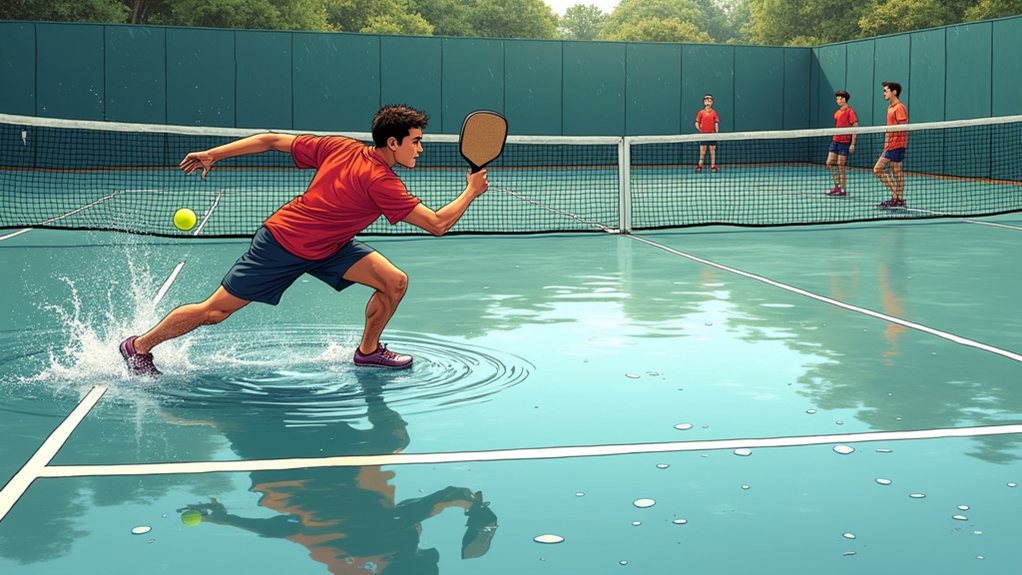
Avoid wet pickleball courts because 90.5% of injuries come from falls, and beginners face the highest risk. Wet surfaces are extremely slippery regardless of shoe tread. Check courts for wet spots, pooled water, or glossy sheen before playing. Balls absorb water and become heavier, changing flight.
Paddle grips become slippery, reducing control. Move indoors or wait 30-60 minutes for courts to dry. You’ll learn more detailed safety tips this way for better protection against injury.
Why Wet Courts Put Beginner Pickleball Players at Higher Injury Risk
Wet pickleball courts become extremely slippery, creating surfaces that are treacherous regardless of court grit or shoe tread. You face higher injury risks as a beginner because you lack advanced footwork techniques and court awareness developed by experienced players.
Backpedaling, a common beginner movement, becomes exponentially more dangerous on wet surfaces and is already one of the most common injury factors.
Falls account for 90.5% of all pickleball injuries. Lower extremity injuries make up 32.0% of all injuries.
You may suffer bruises at best, and broken bones at worst, potentially sidelining you for weeks.
- You lack advanced footwork developed by experienced players
- Your backpedaling becomes extremely dangerous when wet
- You can’t recognize visual cues indicating unsafe conditions
National emergency room visits increased from 1,313 in 2014 to 24,461 by 2023.
Pickleball injuries increased 765.6% between 2013 and 2022, with falls as the primary injury mechanism affecting chiefly older adults and beginners.

BREATHABLE 360-DEGREE PERFORMANCE KNIT UPPER - Engineered mesh upper provides all-day ventilation while conforming to your foot for a secure, custom-like fit during intense court play

Pickleball Shoes For Men:Designed for pickleball and tennis players, these men’s court sneakers deliver stability and comfort for every match.
How to Identify Unsafe Court Conditions Before You Play
How can you tell if a pickleball court is unsafe before you step onto it? Look for these warning signs:
Look for wet spots, a tacky surface, pooled water, recent rain, and ask staff about drainage before stepping on.
- Visual inspection
- Check for standing water or wet spots on the surface
- Notice if the court appears darker in certain areas
- Look for a glossy or reflective sheen indicating moisture
- Surface texture test
- Place your hand flat on the court surface
- Feel for dampness or stickiness
- Check if the surface feels tacky rather than grippy
- Edge and boundary checks
- Examine the court’s edges and corners where water pools first
- Look for puddles near the net posts
- Check drainage areas for overflow
- Previous weather conditions
- Consider recent rainfall within the last 24 hours
- Check for morning dew on outdoor courts
- Note humidity levels that create invisible moisture
- Ask facility staff
- Inquire about recent court maintenance
- Request information about drainage performance
- Request information about drainage performance
For indoor courts, a premium wifi smart thermostat can help regulate humidity and temperature levels to minimize moisture buildup on playing surfaces.
The Injury Statistics Every Pickleball Beginner Should Know
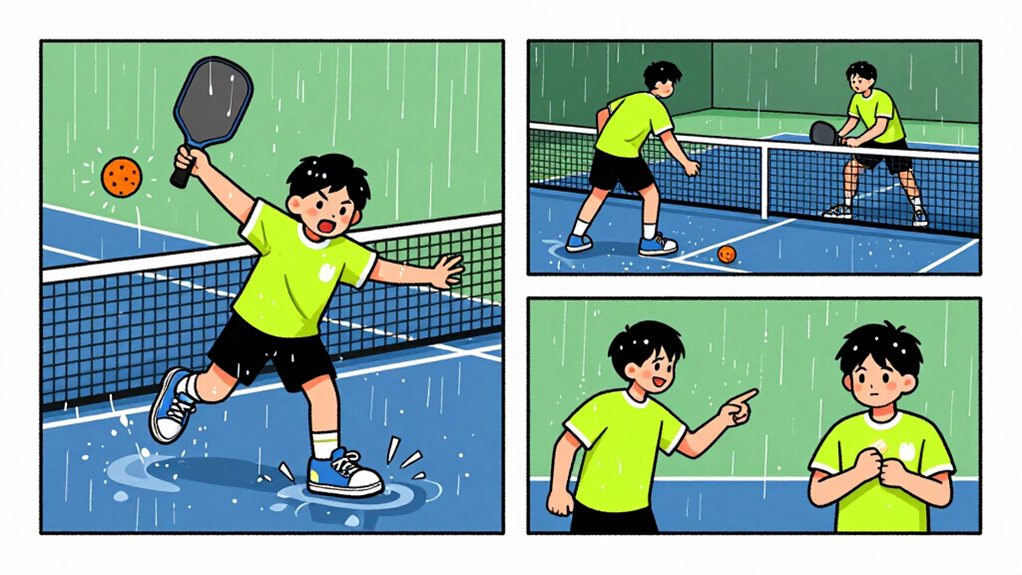
Consider these numbers before you step onto a wet court: pickleball injuries increased 765.6% between 2013 and 2022. Emergency room visits rose from 1,313 in 2014 to 24,461 by 2023. Falls cause 90.5% of all injuries. Lower extremity injuries account for 32.0% of total injuries.
| Year | ER Visits | % Change |
|---|---|---|
| 2014 | 1,313 | Baseline |
| 2022 | 24,461 | +765.6% |
| 2023 | 24,461 | Sustained |
| Falls | 90.5% | Primary |
You face higher risks as a beginner. Your lack of advanced footwork compounds wet court dangers. Backpedaling on slick surfaces causes the most common injuries. These statistics prove wet courts demand your respect and caution.
What Wet Courts Do to Your Equipment and Gameplay
When moisture settles on the court, it penetrates your equipment and compromises performance. Here’s what happens:
- Pickleballs absorb water and become heavier, changing ball flight.
- Your paddle grip becomes slippery, reducing your control over shots.
- The ball bounces unpredictably on wet surfaces, disrupting your timing.
- Your court shoes lose traction, making quick direction changes dangerous.
- Prolonged moisture exposure warps paddles and permanently damages grip tape quality.
These factors combine to create inconsistent gameplay.
You lose the reliable feedback your equipment normally provides.
Your shots lack precision.
Waterlogged balls rob your shots of precision, turning confident swings into errant strokes.
Your movements feel uncertain and unsafe.
The game becomes frustrating rather than fun.
You risk damaging expensive gear permanently.
Wet conditions alter every aspect of play, making it impossible to perform at your best.

TRANSFORM any court area into a pickleball court with the Franklin Sports Court Marker Kit. This kit includes all you need to quickly lay out the boundary areas for the game of pickleball in minutes.

🎾CONTAINS 84 MARKERS: 30 yellow I-shaped and orange I-shaped, 12 yellow L-shaped and orange L-shaped.(After receiving it, please press the court sticker firmly on a flat surface for a few minutes to restore its shape.)

Quick Regulation Pickleball Court Set-up: Create a full pickleball court in minutes with this pickleball court marking kit. Designed for regulation dimensions without paint or permanent installation—ideal for driveways, gyms, or community spaces.
Safe Playing Options When Courts Are Wet
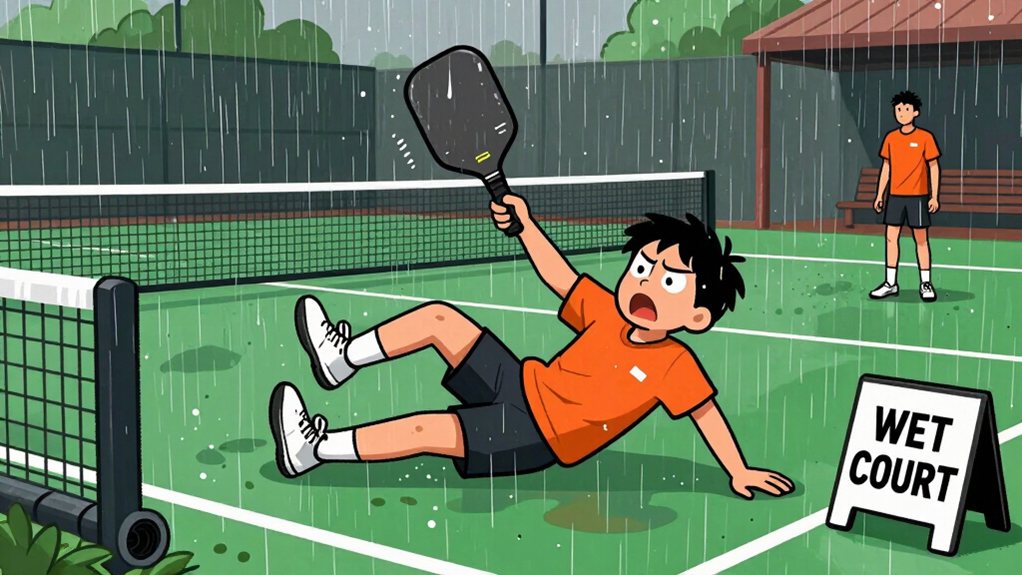
Instead of risking injury on wet courts, try these safe alternatives: Move your game indoors to a gym with covered courts. Wait until rain stops and the court dries completely, which typically takes 30 to 60 minutes. Use the time for off-court training, including footwork drills and strategy sessions.
| Option | Wait Time | Skill Development |
|---|---|---|
| Indoor Play | None | Limited by Space |
| Wait for Dry | 30-60 min | None |
| Off-Court Training | Any | Footwork & Strategy |
You preserve your equipment when you avoid wet conditions. Wet balls slow your game. Wet grips cause drops. Choose indoor facilities when available. Your safety matters more than any game.
Frequently Asked Questions
What Should I Do Immediately After Slipping on a Wet Court?
Immediately tuck your chin, protect your head, and try to roll instead of catching yourself with extended arms. Assess pain carefully before rising, and seek help immediately if you can’t move or feel sharp pain.
Does My Health Insurance Cover Injuries From Playing on Wet Pickleball Courts?
Since pickleball ER visits surged 1,765% from 2014 to 2023, check your policy’s coverage details. Most standard plans cover ER visits for accidental injuries regardless of location, but always verify specific terms and deductibles.
How Can I Report a Wet Court to the Facility for Maintenance?
Contact the facility manager directly or submit a report via their website or app. Note the exact court number and visible wet areas. Take photos as evidence. Request immediate closure until proper drying occurs.
What Legal Obligations Do Pickleball Facilities Have to Keep Courts Safe?
Your facility bears a duty of care to maintain reasonably safe conditions, like a landlord keeping walkways clear. You must address known hazards promptly, warn of dangers, and follow industry standards to prevent foreseeable injuries.
Are There Specific Shoes Designed to Prevent Slips on Wet Courts?
Yes, you can buy shoes designed for wet courts. Look for non-marking outsoles with micro-siping or hydrophilic rubber that channels water away. Brands like ASICS and Nike offer court shoes specifically rated for wet play.
Final Thoughts
In summary, wet pickleball courts are dangerous for you. You can prevent most injuries by waiting for the court to dry. We have seen beginners suffer ankle sprains and wrist fractures after slipping on wet surfaces.
In 2023, emergency rooms treated over 12,000 pickleball injuries, and wet conditions contributed to many of them. Think of a wet court like driving on black ice, you lose control before you can react. You can stay safe by checking conditions before you play. Wait for the surface to dry, choose dry courts, and protect yourself.

1 Roll = 1 Court - Don't waste money or the environment on tape you don't need. Our blue pickle ball tape is long enough to layout a single indoor court with some spare if needed.

Set contains 4pcs "L" shaped markers, 8pcs "T" shaped markers, and 1pc string backpack for storage. The boundary markers are perfectly sized to create a mini or full pickleball courts.