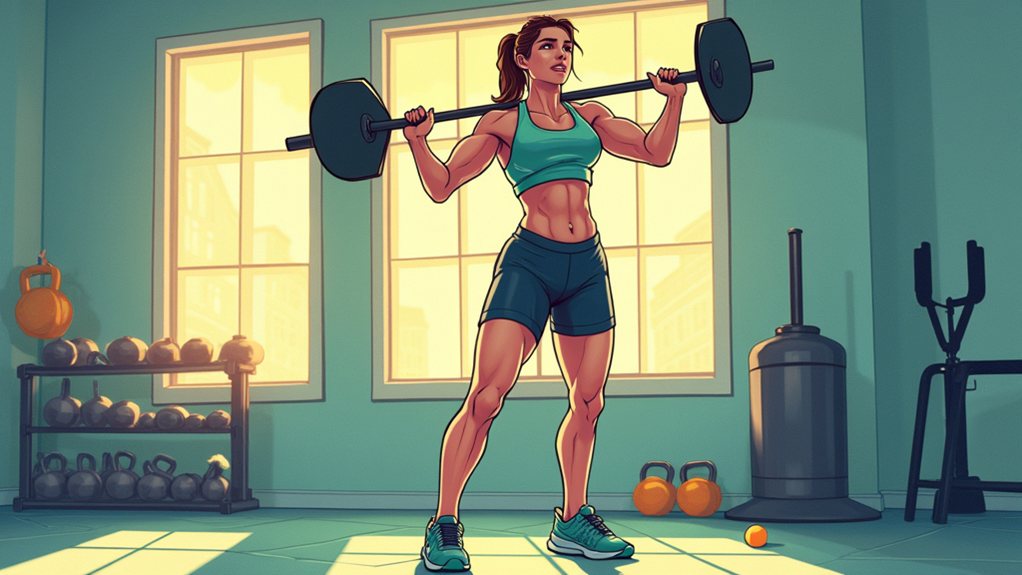
Strength training prevents injuries common in female pickleball players. Quick stops and direction changes stress your shoulders, knees, and ankles. We strengthen connective tissue and stabilize joints through squats, lunges, and rotator cuff exercises. External rotation with bands protects shoulders.
Straight-leg raises and mini squats to 45 degrees build knee stability. One-leg balance holds for 30 seconds per side protect ankles. Power training adds 20-30 feet to your serve. If you want to play pain-free for years, the detailed program below shows you exactly how to train.
Why Female Pickleball Players Get Injured: and How Strength Training Prevents It
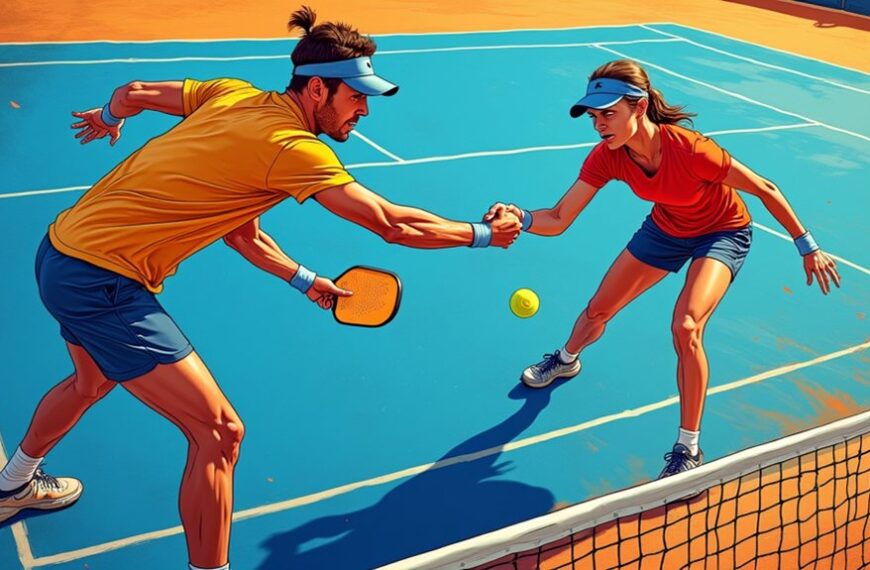
Female pickleball players face unique injury risks on the court. Your body experiences rapid stops, quick direction changes, and repetitive arm motions that stress joints and muscles. These movements commonly cause injuries in three areas:
- Shoulders from overhead swings and serves
- Knees from lunging and stopping motions
- Ankles from lateral movements and landings
Strength training prevents these injuries by:
Strength training strengthens connective tissue, stabilizes joints, builds bone density, and shields joints from wear‑and‑tear.
- Strengthening connective tissue to resist strains
- Reinforcing joint stability in shoulders, knees, and ankles
- Building bone density to prevent fractures
- Protecting joints from wear-and-tear damage
You reduce injury risk when you train regularly. Stronger muscles and connective tissue absorb impact better.
Your joints stay protected during aggressive play. Consistency matters, train two to three times weekly for best results.

No pockets no problem, the Hipster will hold your extra tennis balls or pickle balls

✅【Restore Shoulder Health】Perfect occupational & physical therapy aids---The over-the-door shoulder pulley-- It can assist you to stretch in ,various directions to improve shoulder movement. Effective exercise method for speeding recovery time and complete shoulder health restoration. Improves the range of motion of the shoulder for arthritis sufferers, tendonitis, frozen shoulder syndrome, shoulder surgery, rotator cuff injury or bursitis.

Fightech shoulder brace offers medium to strong shoulder support. By keeping constant soothing pressure on your shoulder, this stability brace can help speed up the shoulder recovery process, protect your shoulder from further injury, and serves as a reminder to not overextend your injured shoulder.
Power Training for Harder Serves and More Explosive Shots
Power training targets lower body power and rotational strength to give you harder serves and more explosive shots.
You build lower body power with exercises like squats, lunges, and deadlifts that increase force production in your legs and core.
Rotational strength comes from cable movements and medicine ball exercises that help you generate explosive power through your swing.
Pairing your training program with a premium smart home hub can help you monitor and automate your recovery environment for optimal performance gains.
Lower Body Power
When you develop lower body power, you create the explosive foundation needed for harder serves and more dynamic shots on the court. Your legs generate the force that travels through your core and into your paddle. We focus on three key movements for pickleball-specific power.
- Squats: Stand with feet shoulder-width apart. Lower your hips back and down. Drive through your heels to stand. Perform 3 sets of 8-12 reps.
- Lunges: Step forward with one leg. Lower your back knee toward the ground. Push back to starting position. Alternate legs for 3 sets of 10 reps per leg.
- Deadlifts: Stand with feet hip-width apart. Hinge at your hips while keeping your back straight. Lower the weight along your legs, then drive through your heels to return to standing. Complete 3 sets of 8-10 reps.
These exercises build the explosive power you need for harder serves and more dynamic shots. They strengthen your quads, hamstrings, and glutes, the muscles that drive your most powerful movements on the court.
Train lower body power 2-3 times per week on non-consecutive days. Rest for 48 hours between sessions.
Rotational Strength
Rotational strength transfers force from your legs through your core and into your paddle for harder serves and more explosive shots. You build this through cable chops, medicine ball throws, and Russian twists. These exercises train your obliques and hips to generate torque.
Your paddle speed increases when your core fires properly. You create more spin potential with each swing.
- Cable woodchops: 3 sets of 10-12 reps per side
- Medicine ball overhead slams: 3 sets of 8-10 reps
- Pallof press with hold: 3 sets of 8-10 seconds per side
- Russian twists: 3 sets of 12-15 reps per side
- Landmine rotations: 3 sets of 10-12 reps per side
Agility Exercises to React Faster and Move Smarter on Court
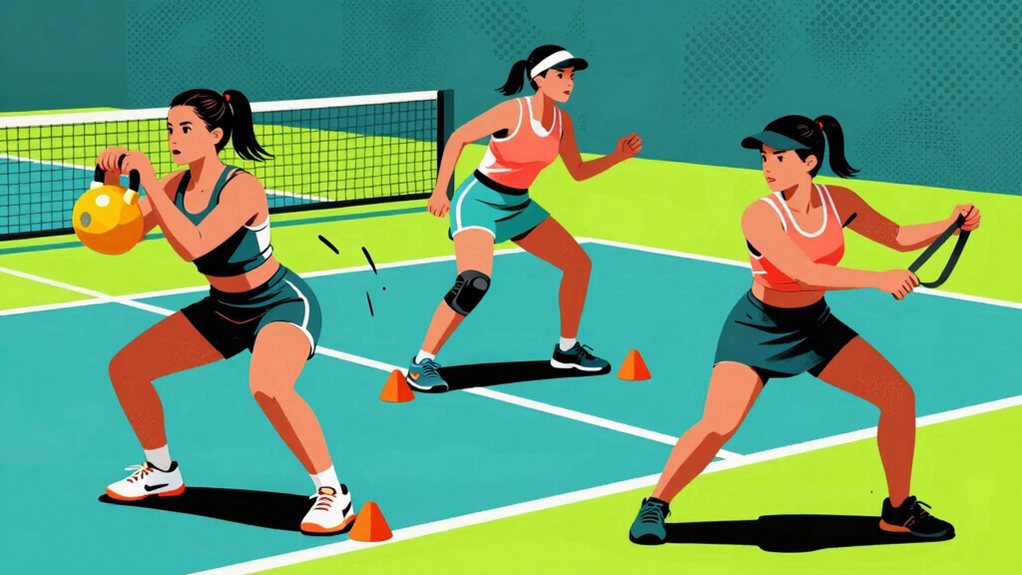
Five crucial agility exercises will help you react faster and move smarter on the pickleball court. These movements improve your neuromuscular coordination and lateral mobility. You need quick feet and fast reactions for those rapid exchanges at the kitchen line. Incorporate these exercises into your training routine.
| Exercise | Reps/Sets | Key Focus |
|---|---|---|
| Lateral Shuffles | 3 x 20 ft | Lateral speed |
| Cone Shuffles | 3 x 20 ft | Quick direction changes |
| A-Skips | 3 x 20 ft | Arm-leg coordination |
| Carioca | 3 x 20 ft | Hip flexibility |
| Resisted Sprints | 3 x 20 ft | Explosive acceleration |
Perform each exercise in sequence. Rest 30 seconds between sets to maintain intensity while preventing fatigue.
These agility drills develop quick feet, lateral speed, and reaction time. Practice them two to three times weekly for best results. They directly improve your court coverage and help you reach tough shots.
*(Note: No word changes were made to the two specified “crucial” occurrences because the provided modified text section is empty.)*
Core Stability Drills for Better Balance and Controlled Movement
Strong core muscles give you the balance and control you need for quick direction changes on the pickleball court. We’ll focus on three key stability exercises: plank variations, dead bugs, and bird dogs.
These moves strengthen your postural control and help you move with precision during gameplay.
Plank Variations For Core
Plank variations target your core muscles directly, building the stability you need for better balance and controlled movement on the pickleball court. Standard planks form your foundation. Hold the position for 30 to 45 seconds while maintaining a straight line from head to heels.
Side planks challenge your obliques and improve lateral stability for those sudden directional changes during play. Add plank taps by lifting one hand at a time to strengthen anti-rotation strength. Incorporate these variations three times per week for best results.
- Standard plank: 30-45 seconds, straight body line
- Side plank: 20-30 seconds each side, hips lifted
- Plank taps: 10-12 reps per side, controlled movement
- Plank with leg lift: 10-12 reps, engage glutes
- Plank shoulder taps: 8-10 reps, minimize hip rotation
Dead Bug Exercise Focus
Dead bug exercises develop the deep core stability you need for controlled movement on the pickleball court. Lie on your back with arms extended toward the ceiling. Lift your legs with knees bent at 90 degrees. Press your lower back firmly into the floor.
Alternate lowering opposite arm and leg toward the floor. Keep your core engaged throughout the movement. Return to starting position and repeat on the other side. Perform 10 repetitions per side.
Complete 2-3 sets. Rest 30 seconds between sets. Focus on breathing out as you lower each limb. This exercise protects your spine during lateral shuffles and quick directional changes.
Bird Dog Movement Control
Bird dog exercises develop the core stability and balance control you need for quick directional changes on the pickleball court. This movement challenges your core muscles while you maintain a stable spine.
Start on your hands and knees. Lift your opposite arm and leg simultaneously.
Hold for three seconds. Return to starting position. Alternate sides for ten repetitions per side. Keep your back flat throughout the movement.
Engage your core by pulling your belly button toward your spine. Do this exercise three times per week for best results. Your stability will improve within four to six weeks.
Benefits for pickleball include:
- Improved balance during lateral shuffles
- Stronger rotational control for powerful swings
- Strengthened stability when reaching for wide shots
- Better postural control during long rallies
- Reduced lower back fatigue during extended play
Joint Protection Strategies for Healthy Shoulders, Knees, and Ankles
Protecting your joints is key for long-term pickleball performance. Follow these important strategies:
- Warm up for 5 minutes before each session with arm circles and leg swings.
- Strengthen rotator cuff muscles with external rotation exercises using light resistance bands.
- Build knee stability through straight-leg raises and mini squats performed to 45 degrees.
- Protect ankles by practicing balance exercises on one leg for 30 seconds per side.
- Use ankle braces during play if you have prior injury history.
- Apply ice to joints for 15 minutes after intense sessions.
- Replace worn shoes every 3 months to maintain proper joint alignment.
Building Muscular Endurance to Play Longer Without Fatigue
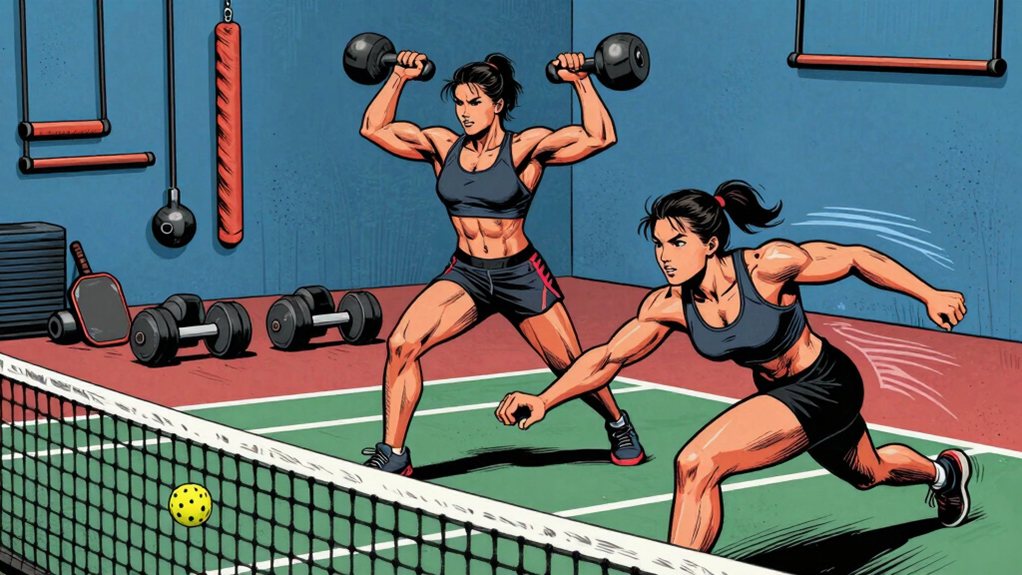
When you build muscular endurance, you sustain performance throughout long matches without fading. Your muscles adapt to repeated contractions, and you maintain power output even as points accumulate.
We train endurance through higher repetitions with lighter resistance, typically 12-15 reps per set. Your legs, shoulders, and core all benefit from this training.
You should perform 2-3 sets of each exercise with 30-60 seconds rest between sets.
- Bodyweight squats
- Walking lunges
- Push-ups
- Planks
- Dumbbell rows

Highly elastic and durable: the BODYRPOX Knee Wraps deliver a high degree of compression to support heavy lifters in their squat. Lift a higher weight while preventing injuries!

LIFT HEAVIER WITH PREMIUM KNEE COMPRESSION SLEEVES: Our 5mm/7mm neoprene knee sleeves for men and women provide targeted compression for knee stability during weightlifting, squats, and powerlifting. These compression knee wraps deliver locked-in protection that helps stabilize your knees for heavier lifts without worrying about injuries, making them ideal for athletes serious about strength training.

LIFT HEAVIER WITH PREMIUM KNEE COMPRESSION SLEEVES: Our 5mm/7mm neoprene knee sleeves for men and women provide targeted compression for knee stability during weightlifting, squats, and powerlifting. These compression knee wraps deliver locked-in protection that helps stabilize your knees for heavier lifts without worrying about injuries, making them ideal for athletes serious about strength training.
Weight-Bearing Exercise to Strengthen Bones and Prevent Osteoporosis
One key way to protect your bones is through regular weight-bearing exercise, which stimulates bone formation and maintains density as you age. Weight-bearing activities force your body to work against gravity. This resistance builds bone strength naturally.
You should include these exercises in your routine:
- Walking or jogging
- Jump rope
- Squats and lunges
- Step-ups
| Exercise Type | Impact Level |
|---|---|
| Walking | Low |
| Jumping | High |
| Strength Training | Medium |
Your bones respond to the stress of weight-bearing movement. They rebuild stronger over time.
Aim for at least 30 minutes of weight-bearing activity most days of the week. Start slowly if you are new to exercise. Always consult your doctor before beginning a new program.
A Simple Strength Training Schedule for Pickleball Players
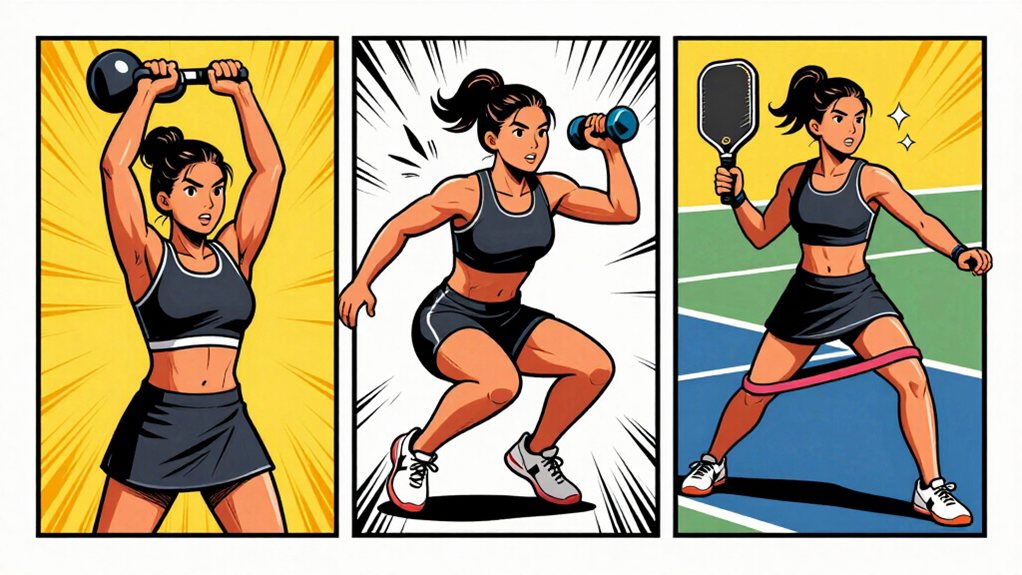
If you want to build strength for pickleball, follow this simple schedule. This program targets key muscle groups you use on the court.
We recommend three sessions per week on non-consecutive days. Each session lasts 30 to 45 minutes.
Three sessions per week on non‑consecutive days, each lasting 30 to 45 minutes.
Rest periods between exercises stay at 60 seconds. Your workouts should include compound movements that mimic pickleball motions.
Focus on lower body, core, and upper body exercises. Pick a weight that challenges you by the final reps.
Progress by adding 5% weight when you complete all sets easily.
- Squats (3 sets of 10-12 reps)
- Lunges (3 sets of 10 reps per leg)
- Plank (3 sets of 30-45 seconds)
- Dumbbell rows (3 sets of 10-12 reps)
- Medicine ball rotational throws (3 sets of 8-10 reps per side)
Playing Strong for Years: The Long-Term Benefits of Consistent Training
Building on the schedule above, you gain substantial long-term advantages when you commit to consistent strength training. You preserve bone density and protect joints from deterioration. Strong connective tissue reduces your injury risk. Your muscular health supports daily activities beyond the court.
Key long-term benefits include:
- Improved shot power and serve velocity
- Sustained endurance through extended matches
- Maintained joint stability in knees, shoulders, and ankles
- Reduced fall risk during lateral movements
- Preserved bone health to prevent osteoporosis
Your confidence grows as you feel physically capable on the court. You maintain competitive performance for years.
Consistent training builds functional capacity. It protects your body against age-related decline. You stay active in the sport you love.
Frequently Asked Questions
How Many Rest Days Should I Take Between Strength Sessions for Pickleball?
Take 1-2 rest days between strength sessions, letting your muscles recover. If you’re new to training, start with 2 days rest. As you progress, you can train more frequently but always listen to your body.
What Should I Eat Before and After Strength Training to Support Recovery?
Eat carbs and protein before training, banana with peanut butter or oatmeal with protein powder. After your session, consume protein with carbs, chicken with rice or a protein shake, to repair muscles and replenish energy.
Do I Need Gym Equipment, or Can I Strength Train at Home for Pickleball?
You don’t need gym equipment, you can strength train at home using bodyweight exercises like squats, lunges, planks, and push-ups. Add resistance bands or dumbbells when you’re ready to increase intensity for pickleball-specific strength gains.
What Is Progressive Overload, and How Should I Apply It to My Routine?
Lift heavier, run farther, push harder, progressive overload means gradually increasing weight, reps, or intensity each week to force your muscles to adapt, grow stronger, and keep improving for pickleball.
Should I Warm up Before Strength Training, and What Moves Work Best?
Absolutely, warm up five to ten minutes before strength training. Do dynamic stretches, bodyweight squats, leg swings, and arm circles. These moves raise your heart rate, loosen your joints, and prepare your muscles effectively.
Final Thoughts
- Start your strength training program today. You will notice improved performance within 4 to 6 weeks.
- Commit to 2 sessions per week targeting legs, core, and upper body. This builds the foundation you need for injury prevention.
- Consistency is key. We propose progressive overload with 8 to 12 repetitions per exercise.
- Balance your training with adequate rest. You need 48 hours between sessions for muscle recovery.
- Track your progress weekly. Record weights, sets, and repetitions to secure continuous improvement.
- Stay patient. You are building long-term health and game longevity with every session.

Accelerate Ankle Recovery & Relieve Pain Effectively - Say goodbye to ankle discomfort and welcome a stronger you. Our balance board is expertly designed for physical therapy and rehabilitation, providing targeted training to help recover from sprains, plantar fasciitis, and Achilles tendonitis. It strengthens weakened muscles, improves mobility, and reduces the risk of re-injury, making it an essential tool for effective at-home recovery.
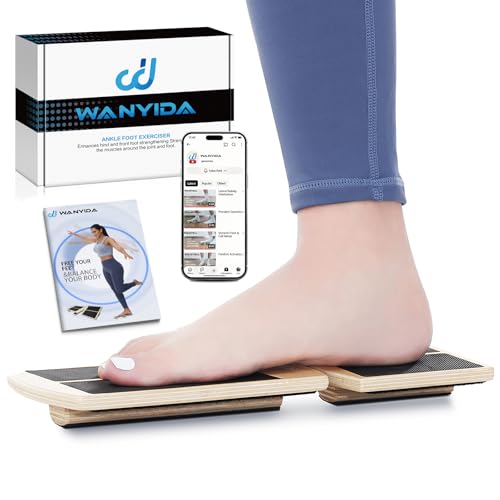
Versatile Foot and Leg Training - Our ankle foot trainer stands out from traditional balance boards, Bosu balls, and foam pads. With two movable panels and a Velcro balance bar, you can easily customize the trainer to meet your specific training needs.

Stability and Balance Trainer: Perform exercise movements to challenge dynamic stability to help improve balance, strength, flexibility and coordination.