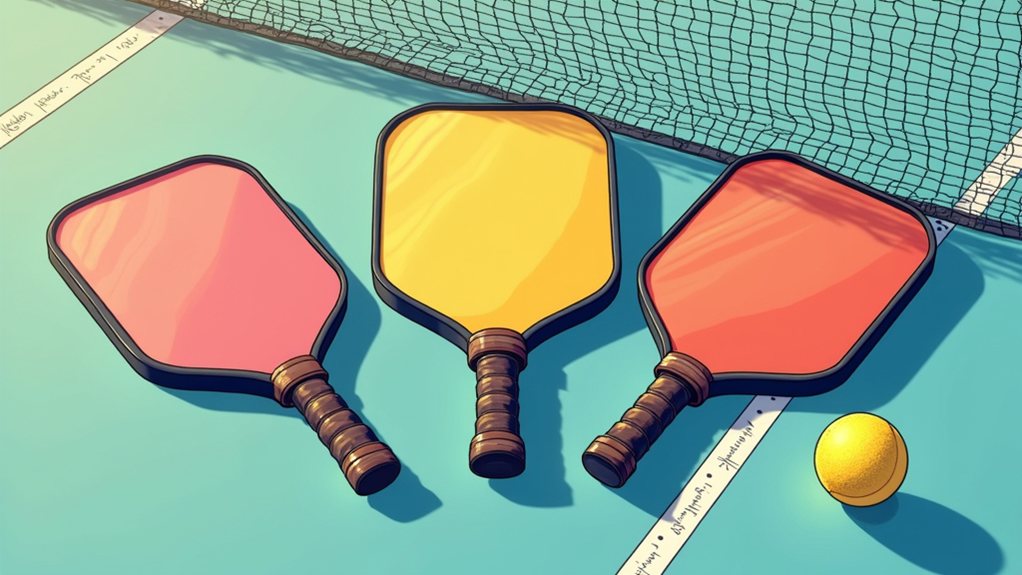
Official USA Pickleball paddle specifications require your combined length and width to stay at or under 24 inches, with length not exceeding 17 inches. Width typically ranges from 7 to 8.25 inches. Thickness has no maximum, with thin paddles at 10,12 mm for quick response and thick paddles at 14,20 mm for control. Include the edge guard when measuring.
You need the USA Pickleball Approved stamp for tournament play. Surface texture must meet Rz no greater than 30 µm and Rt no greater than 40 µm. Core options include polypropylene, Nomex, and EPP. Exploring further will help you understand how these specs impact your game.
Pickleball Paddle Size Limits: What the Rules Actually Say
Pickleball paddle size limits are set by USA Pickleball. Your paddle must meet specific requirements for official play. Here are the key rules:
- Combined length and width, including edge guard and butt cap, mustn’t exceed 24 inches (60.96 cm).
- Paddle length can’t exceed 17 inches (43.18 cm).
- Typical lengths range from 15 to 17 inches.
- Typical widths range from 7 to 8.25 inches.
- Handle lengths typically range from 4 to 5.5 inches.
We measure from the furthest points of the paddle. The edge guard and butt cap are included in these measurements. Your paddle must fall within these limits to compete in sanctioned events. Thickness has no maximum restriction. These rules help guarantee fair play across all skill levels. USA Pickleball also regulates paddle surface texture limits, requiring an Rz no greater than 30µm and an Rt no greater than 40µm as measured by the Starrett SR100 Surface Roughness Tester.

HIGH PERFORMANCE: The Pilot pickleball paddle is built for high performance play and long-lasting durability so pickleball players can play their best year after year

PROFESSIONAL QUALITY: Designed by Franklin pickleball pros, this premium quality paddle has been constructed to compete, and win, at the highest level

HIGH PERFORMANCE: The Pilot pickleball paddle is built for high performance play and long-lasting durability so pickleball players can play their best year after year.
Pickleball Paddle Length: Maximums and Why They Matter
The overall size limits were covered in the previous section. Now, let’s focus on paddle length specifically. You need to know that your paddle can’t exceed 17 inches in length.
Paddles may not exceed 17 inches in length, ensuring fair play and consistent shot dynamics across all competitive levels.
This limit supports fair play and consistent shot dynamics across all competitive levels.
The maximum length rule prevents players from gaining unfair reach advantages. Typical paddle lengths range from 15 to 17 inches. Most players select paddles between these measurements based on their playing style and physical attributes.
- Maximum paddle length: 17 inches (43.18 cm)
- Typical paddle lengths: 15 to 17 inches
- Elongated paddles: 16.5 to 17 inches for extra reach
- Standard paddles: approximately 16 inches for balanced play
Pickleball Paddle Width and Edge Guards: How They Affect Play
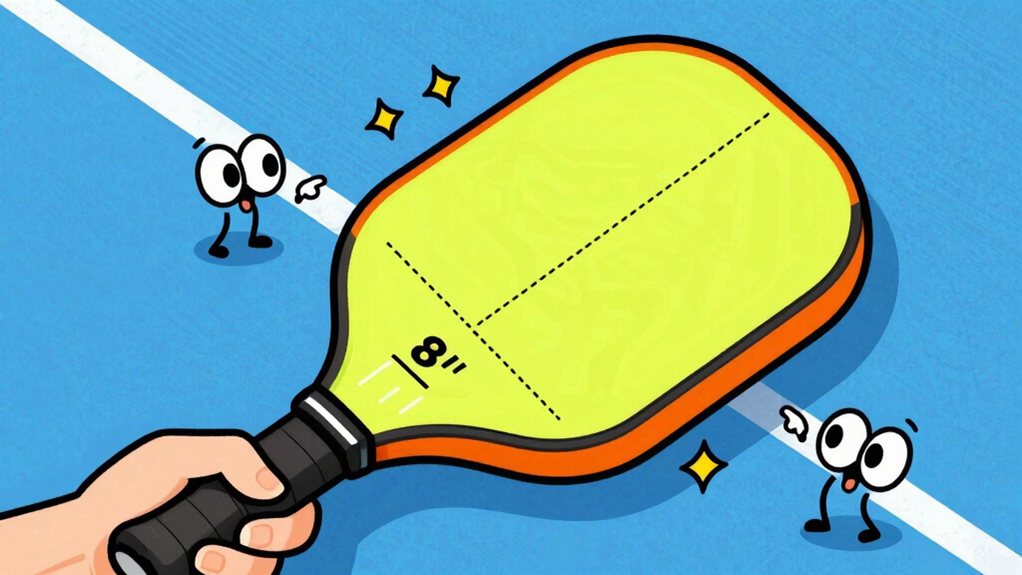
When choosing your paddle, width matters as much as length. Width directly influences your control, sweet spot size, and maneuverability.
Typical width ranges include:
- Narrow: 7 to 7.5 inches
- Standard: 7.5 to 8 inches
- Widebody: 8 to 8.25 inches
Narrow paddles improve reach and quick reactions. Widebody paddles give you a larger sweet spot and more forgiveness on off-center hits.
Edge guards protect your paddle from cracks and chips. They wrap around the hitting area’s perimeter. Most guards add less than 0.25 inches to total width. You must include the edge guard when measuring overall dimensions.
Rule check: Combined length and width, including edge guard, can’t exceed 24 inches. Your paddle length can’t exceed 17 inches.
Choose a width that matches your playing style. A wider face helps beginner players. A narrower face suits advanced players who prioritize speed. Test both widths before you buy.
Pickleball Paddle Thickness: Finding the Right Feel for Your Game
- Thin paddles (10‑12 mm) give you quick rebounds and more power.
- Thick paddles (14 mm and up) give you better control and reduce vibration.
- We’ll choose the thickness that matches the feel you want in your game.
Thin Paddle Advantages
Understanding thin paddle advantages helps you choose the right equipment for your playing style. Thin paddles measure 10-12 mm (0.4 inches) in thickness.
You gain quick ball response and increased power on drives. The lighter feel improves your wrist speed during volleys.
These paddles suit aggressive players who attack the ball early.
- Faster ball return due to thinner core construction
- Greater power generation on offensive shots
- Increased maneuverability for quick net reactions
- Lighter overall weight improves handling and control
Thick Paddle Advantages
If you prefer control over raw power, a thicker paddle delivers that benefit. Thicker paddles typically measure 14 mm to 20 mm (0.6 to 0.8 inches). You feel less vibration on impact. The larger sweet spot helps you place shots precisely.
Your wrist stays calmer during dinks and drop shots. We recommend thicker paddles if you have arm fatigue concerns. The added mass reduces strain during long rallies.
| Thickness | Feel | Best For |
|---|---|---|
| 14 mm | Balanced control | Intermediate players |
| 16 mm | Soft touch | Beginners, arm comfort |
| 18 mm | Maximum stability | Tournament play |
| 20 mm | Minimal vibration | Power players |
You sacrifice some quickness at the net. You lose a bit of pop on drives. Consider your playing style before choosing.
Pickleball Paddle Weight: Light, Medium, or Heavy?
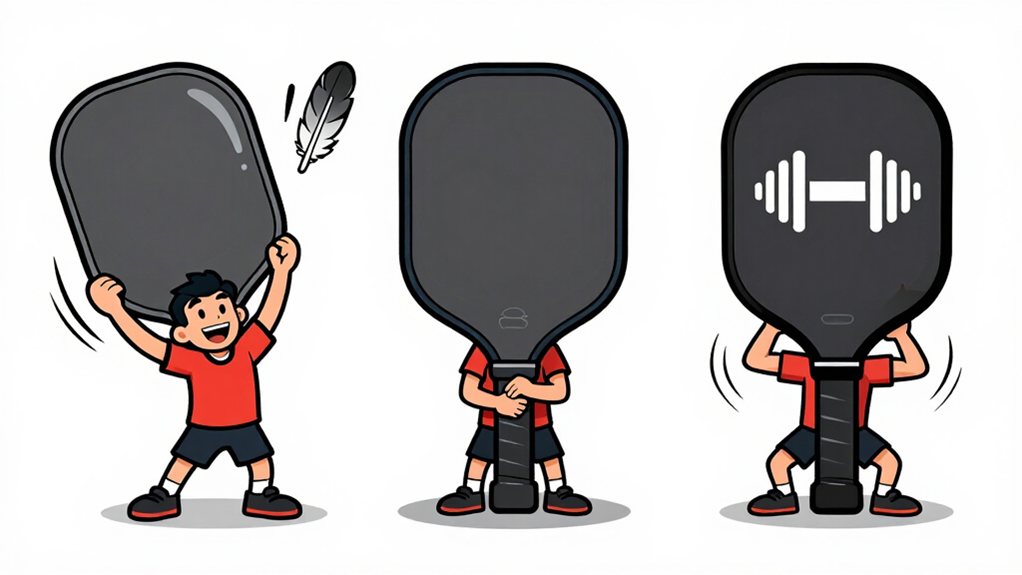
When selecting a pickleball paddle, weight is often the first specification players evaluate because it directly impacts your performance on the court. Lighter paddles offer quick maneuverability and better control. Midweight paddles give you a balance of power and control. Heavy paddles add power to your shots but can cause fatigue during long matches.
- Lightweight: 7.3 oz and under, ideal for control and quick reactions at the net
- Midweight: 7.4-8.4 oz, balanced power and control for all-around play
- Heavyweight: 8.5 oz and up, maximum power but can fatigue your arm
- Your choice depends on your playing style and physical strength
Choose a paddle weight that matches your game. Test different weights before you commit.
Pickleball Paddle Surface: Friction Limits and What You Can Use
You need to understand paddle surface rules before you buy. The USAPA limits how rough your paddle face can be—texturing that creates too much friction gives you unfair spin advantage.
Approved surfaces include non-abrasive polymer, composite, and graphite faces without holes, indentations, or trampoline-like materials.
Texture Restrictions
Although pickleball paddle surface texture may seem like a minor detail, it plays a critical role in fair play and equipment approval.
It’s you must understand that overly textured surfaces create unfair advantages. The USA Pickleball Association sets strict limits on surface roughness.
- Paddle faces can’t feature deep indentations or holes that alter ball behavior.
- Raised patterns or bumps are prohibited if they generate excessive spin.
- The surface must pass standardized friction testing before approval.
- Any paddle exceeding approved texture limits will be rejected from competition.
Manufacturers must make sure their surfaces meet these requirements.
If your paddle feels overly rough or shows visible texture patterns, it may fail inspection.
Always verify that your equipment meets current texture restrictions before playing in sanctioned events.
Approved Surface Types
For pickleball paddle surfaces, you need to know which materials and finishes pass official inspection. You cannot use textured or rough faces that exceed friction limits. These surfaces might give you unfair spin advantages. Approved face materials include sleek composite, graphite, fiberglass, and carbon fiber.
Your paddle must have the “USA Pickleball Approved” marking. No holes, indentations, or trampoline effects are allowed. Here are the main approved surface types:
| Surface Type | Characteristics |
|---|---|
| Composite | Smooth, durable |
| Graphite | Light, consistent |
| Fiberglass | Good touch, quiet |
You should choose based on your playing style. Composite faces offer control. Graphite reduces weight. Fiberglass gives power. Your surface choice affects ball placement and spin.
Core Materials: Polypropylene, Nomex, and EPP Compared
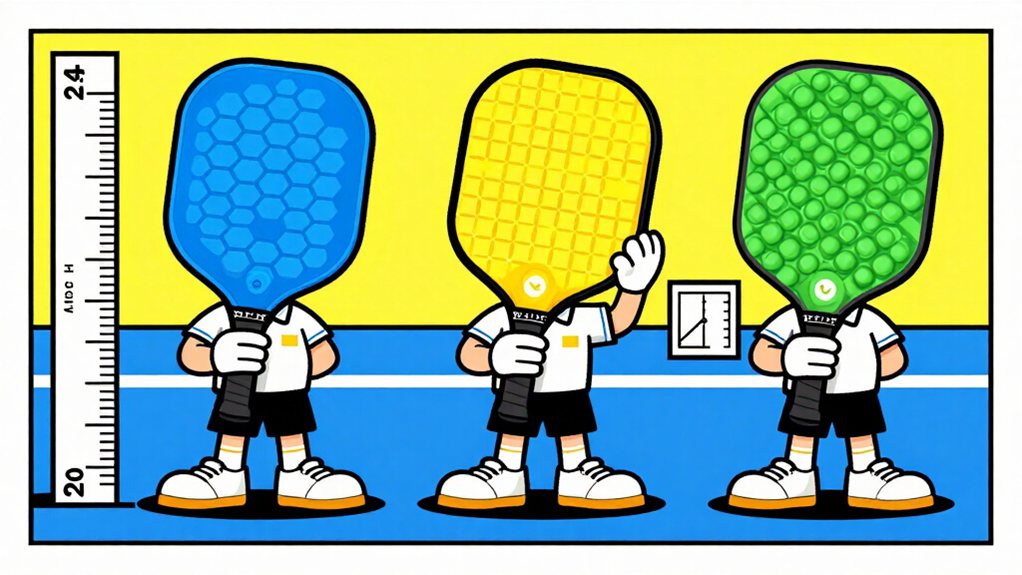
Because the core material affects feel, stability, and performance, it’s one of the most important factors in paddle selection. You’ll find three approved core materials in modern paddles.
Core material shapes feel, stability, and performance—key to selecting the right paddle.
Polypropylene cores offer a quiet feel with balanced power and control. Nomex cores provide high durability and a loud pop for aggressive players. EPP cores deliver excellent shock absorption and a soft feel preferred by many professionals.
Each core type creates a distinct playing experience. Consider your playing style when choosing. The right core matches your priorities on the court.
- Polypropylene, quiet feel, balanced power, control-focused
- Nomex, loud pop, lightweight, high durability
- EPP, excellent shock absorption, soft feel, professional preference

Massive Sweet Spot: The 3X Power series paddle features a redesigned internal composition for an expanded sweet spot. Helps eliminate vibration and improve shot consistency and control.
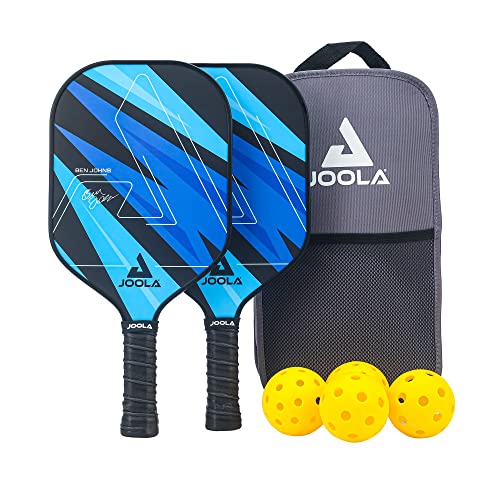
OFFICIAL PADDLE SPONSOR OF WORLD #1 PICKLEBALL PLAYER BEN JOHNS & THE PPA TOUR: An innovator & global leader in table tennis for 70+ years, JOOLA teams up with Ben Johns to create a new line of pickleball equipment that will forever change the game

Massive Sweet Spot: The 3X Power series paddle features a redesigned internal composition for an expanded sweet spot. Helps eliminate vibration and improve shot consistency and control.
Pickleball Paddle Face Materials and Construction: What Lies Beneath
The paddle face sits above the core and directly contacts the ball. The face material determines how much spin you generate and how the ball feels on impact.
Common face materials include:
- Fiberglass (glass fiber): provides good power and spin
- Carbon fiber: offers maximum control and durability
- Graphite: lightweight and provides consistent feel
- Raw carbon: textured surface for better spin
- Composite blends: combine multiple materials for balanced performance
You will find faces typically use 1 to 3 layers of material. More layers increase durability but add weight.
The surface finish may be smooth, textured, or rough. Textured faces help you generate more spin on serves and returns.
The USAP requires that faces can’t have holes, indentations, or rough texturing exceeding standardized friction limits. This rule prevents unfair spin advantages.
The construction involves bonding layers to the core using heat and pressure. This creates a unified paddle structure.
Look for consistent bonding with no delamination.
Pickleball Paddle Shapes: Finding Your Perfect Match
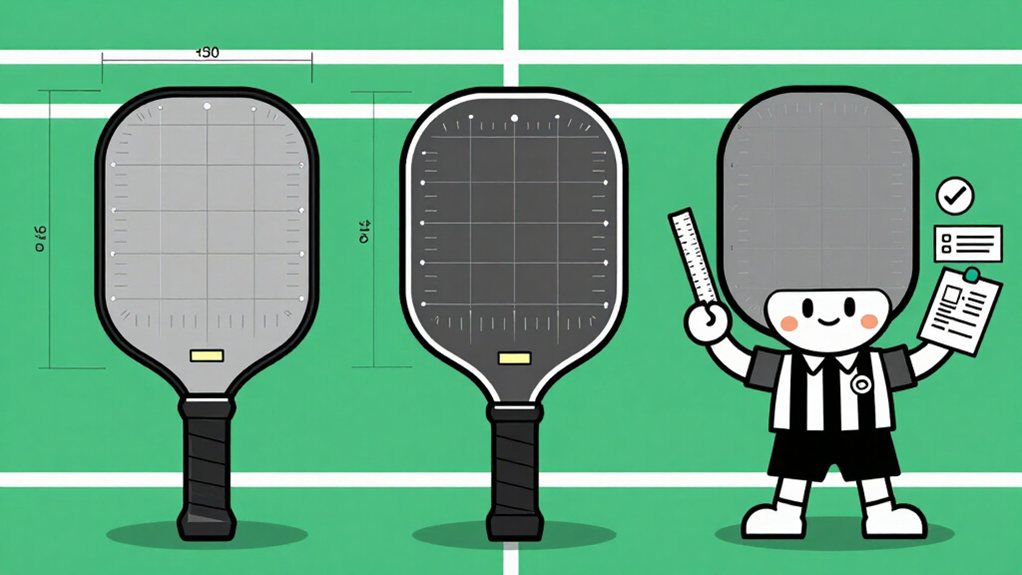
Standard shape paddles are about 16 by 8 inches, giving you control and power, and are the top choice for most players.
Elongated paddles extend your reach by up to 2 inches, so you’ll cover more court area on the baseline.
We’ll look at how each shape influences your game and which one fits your style.
Standard Shape Advantages
If you’re seeking a paddle that performs reliably across most game situations, the standard shape delivers balanced performance. You get generous sweet spot coverage across its 16-inch length and 8-inch width. The wider face absorbs shock effectively, giving you consistent ball control on dinks and drives alike. Your defensive transitions feel smooth thanks to the balanced weight distribution.
- Sweet spot size: The standard shape gives you a larger forgiveness zone, helping you maintain accuracy on off-center hits.
- Control focus: The wider face provides stability for placement shots and strategic ball placement.
- Versatility: You can attack and defend without switching paddle types, making it ideal for intermediate players.
- Beginner-friendly: New players find the standard shape easier to master due to its forgiving nature.
Elongated Shape Reach
Beyond the standard shape, the elongated paddle gives you a notable reach advantage. The extended length measures between 16.5 and 17 inches.
The narrower width sits around 7 inches. This shape helps you cover more court ground without overstretching your arm.
Benefits include:
- Extended reach for distant balls
- Additional leverage for powerful drives
- Better reach on serves and returns
- Ideal for taller players
You trade a smaller sweet spot for extra length. You gain 1 to 1.5 inches of reach compared to standard paddles.
This proves useful at the non-volley zone line. Many competitive players choose this shape for its reach and power combination.
USA Pickleball Approval: What the Stamp Really Means
When you buy a pickleball paddle, look for the “USA Pickleball Approved” stamp on the paddle face. This stamp means the paddle passed official testing and meets all governing rules. Without this stamp, you can’t use the paddle in sanctioned tournaments or league play.
Make sure your paddle bears the USA Pickleball Approved stamp, or you won’t be able to compete in sanctioned events.
The stamp confirms the paddle meets size limits, surface requirements, and material restrictions set by the governing body.
- The stamp verifies the paddle length doesn’t exceed 17 inches
- It confirms the combined length and width stay within 24 inches
- The face meets friction and texture standards for fair play
- The paddle has required markings including brand name and model
Always check for this stamp before purchasing to guarantee tournament eligibility.
Frequently Asked Questions
Can I Use a Paddle With a Custom Design?
You can use a custom-designed paddle if it meets official specs. Your design can’t exceed friction limits or create unfair spin. Make sure it has required markings and approval.
Do Paddle Color or Graphics Affect USA Pickleball Approval?
Colorful custom graphics won’t cost you approval. USA Pickleball focuses on specifications, not style: dimensions, surface friction, materials, and structural integrity matter. Your paddle passes if it meets technical requirements, regardless of vibrant visual designs.
How Often Should I Replace My Pickleball Paddle?
Replace your paddle when you notice cracks, delamination, or when the surface loses its grip. For regular players, that’s every 1-3 years. Heavy players or those who play competitively may need to replace it annually.
What Is the Best Paddle Weight for a Beginner?
Absolutely mind-blowing as it sounds, you need a midweight paddle around 7.4 to 8.4 ounces! It’ll give you that balance of power and control as you’re learning, making your shots feel absolutely amazing and satisfying!
Can I Use a Paddle for Both Indoor and Outdoor Games?
Yes, you can use one paddle for both indoor and outdoor games since the official specifications don’t differ. Choose based on weight, thickness, and material that matches your skill level and playing style preferences.
Final Thoughts
We use this checklist to stay within USA Pickleball rules:
- Length ≤ 17 in., width ≤ 7 in.
- Edge guard included, diagonal ≤ 24 in.
- Core: choose polypropylene, Nomex, or EPP.
- Face: seamless, textured, or graphite.
- Weight: no USAPA limit; players choose 7,9 oz.
- Look for the USA Pickleball stamp on the paddle.
Do you meet these exact specs? If yes, you’ll still compete with confidence in any tournament.

Premium Pickleball Set: AOPOUL pickleball paddle set includes 4 premium paddles, 4 cooling towels, 4 high-performing pickleball, and a carrying bag. With AOPOUL pickleball set, you can promote family friends interaction and have a great time.

【USAPA APPROVED - TOURNAMENT READY】Officially USAPA approved pickleball paddle that meets all tournament requirements. Legal for tournament, league, and recreational play. Trusted pickleball paddle for beginners, intermediate players, and competitive players.

DURABLE, QUALITY PICKLEBALL RACQUETS: A lightweight fiberglass paddle face surface is ideal for those who want power and speed in their hitting and returns, even with a backhand. The wide-body shape creates an ideal surface for spins, slices, and pop on those power shots. The polymer honeycomb core offers an ideal blend of power and precision.