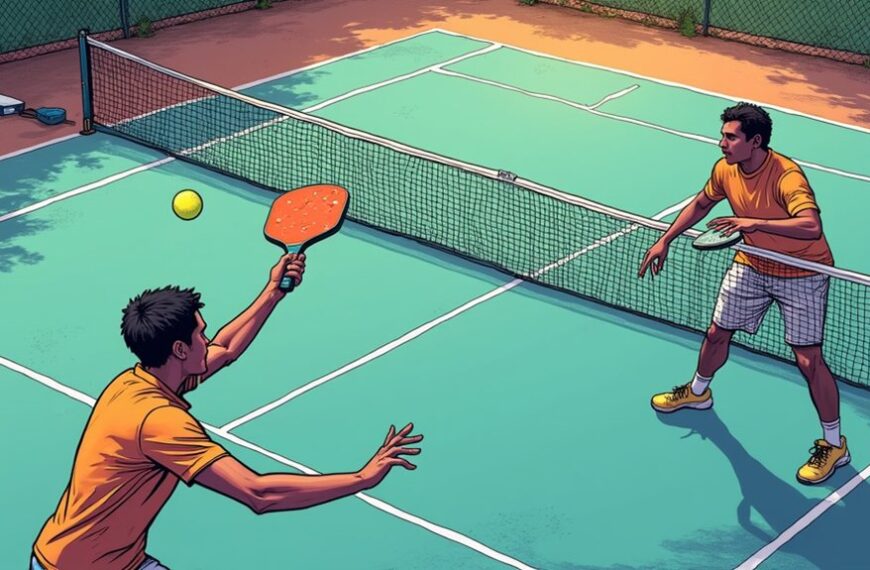
Pickleball is played on a 20-foot by 44-foot court with a net 36 inches high at the center and 34 inches at the baselines. You serve underhand, below waist level, diagonally to the opponent’s service box. The two-bounce rule requires each side to let the ball bounce once before volleying. You cannot volley inside the 7-foot kitchen (non-volley zone).
Games are played to 11 points, win by two. Mastering these fundamentals sets the foundation for competitive play.
Pickleball Court Layout: Understanding the Dimensions and Key Zones
A standard pickleball court measures 20 feet wide and 44 feet long, with a net stretched across the middle. The net stands 36 inches high at the center and 34 inches at the baselines. You find two key zones on the court:
- The non-volley zone (kitchen) – a 7-foot area extending from the net on both sides. You can’t volley while standing inside this zone.
- Service boxes – two diagonal areas on each side of the net where serves must land.
Court lines mark each zone clearly. The baseline runs across each end. The service lines divide the court into service and non-service areas. The centerline bisects the court between the service boxes.
You notice the court stays the same size for both singles and doubles play. The net sits in the middle, creating two equal halves for gameplay. This layout provides clear boundaries for all players. All court lines measure 2 inches wide and must remain clearly visible to ensure accurate line calls during play.

TRANSFORM any court area into a pickleball court with the Franklin Sports Court Marker Kit. This kit includes all you need to quickly lay out the boundary areas for the game of pickleball in minutes.

PICKLEBALL NET WITH WHEELS, PADDLES, PICKLEBALLS AND COURT LINE MARK, A COMPLETE SET: This pickleball set includes official size pickleball net, a free standing steel frame with wheels, 4 outdoor pickleball balls (40-holes), 4 deluxe wooden pickleball paddles, a complete set of pickleball court marking kit, a soft measure tape (118 Inch length), and a portable carry bag for easy transport.

EVERYTHING YOU NEED: Our pre-measured pickleball court marking kit includes (2) sidelines, (2) baselines, (2) middle serve lines (2) kitchen lines, and net hash marks, all ready to peel-and-stick. Each kit includes step-by-step illustrated instructions to guarantee a perfectly square, regulation court — even for first-time installers.
Mastering the Pickleball Serve: Technique, Rules, and Placement
In this section, we break down the vital elements of a strong pickleball serve. You’ll learn proper serve technique, understand the key serving rules, and discover effective placement strategies.
Let’s examine each component so you can develop a reliable and strategic serve.
Serve Technique Basics
Grip your paddle firmly and position yourself behind the baseline to begin the serve. Your feet stay behind the line while one foot remains grounded at contact.
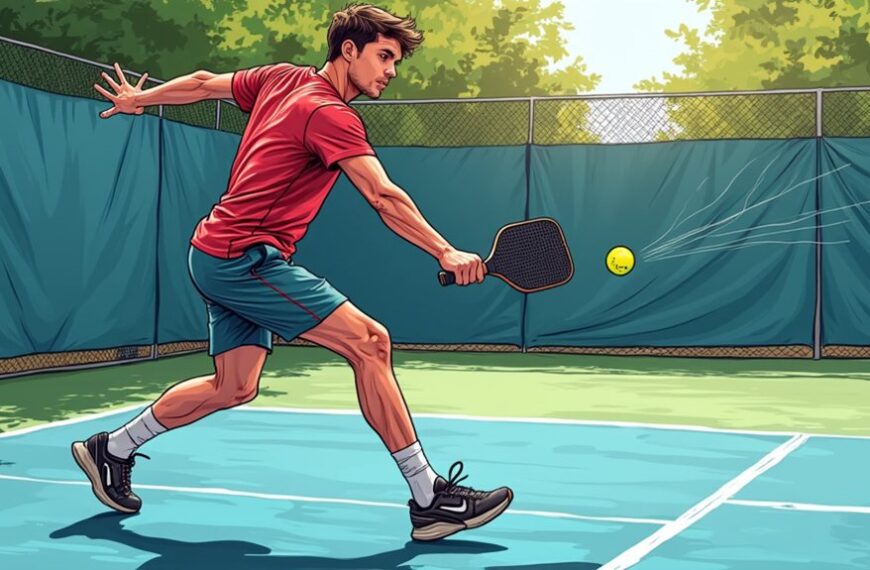
Swing your arm in an upward arc and strike the ball below waist level. This underhand motion creates the proper trajectory for an effective serve. The ball travels diagonally to the opposite service box.
A well-placed serve forces your opponent back and starts the point in your favor.
Master your serve technique with these fundamentals:
- Keep your wrist firm and controlled throughout the entire swing
- Make contact at knee height or slightly below for consistency
- Follow through toward your target after ball contact
- Use a continental or eastern grip for better paddle control
- Practice dropping the ball and hitting it on the rise for the drop serve
Serve Rules Overview
Now that you’ve mastered the physical motion of serving, let’s examine the rules that govern a valid serve. These rules make sure fair play and consistent starts to each point.
- Serve must travel diagonally to the opposite service box.
- Your feet must stay behind the baseline until the ball is struck.
- You get only one serve attempt per turn.
- Contact must occur below waist level with an underhand motion.
If you hit a fault, the serve transfers to the other team without points awarded. For the drop serve, you release the ball without adding upward force.
Both players serve in doubles until two faults occur, then side-out happens.
Remember that the ball must clear the kitchen on its first bounce. Follow these rules to ensure you avoid losing your serve.
Serve Placement Strategy
Strategic serve placement determines whether your opponent starts with an offensive or defensive position. You control the point from your first strike. Aim deep to push opponents back. Target corners to stretch their reach. Use varied placement to keep them guessing.
The serve must land in the diagonal service box. Clear the kitchen on every serve. The ball bounces once before your opponent returns. Wait for the double bounce before advancing.
Master these key placement strategies:
- Target right-handed players’ backhand sides
- Hit deep to corners to limit aggressive returns
- Serve centrally to create confusion between partners
- Mix soft drops and hard drives to vary pace
- Analyze opponent positioning and exploit gaps
The Two-Bounce Rule: What Happens After the Serve
This rule requires the ball to bounce once on each side before you can volley it. Here’s what happens after the serve:
- The serving team hits the ball diagonally into the opponent’s service box.
- The receiving team must let the ball bounce once before returning it.
- The serving team then lets that return bounce once before hitting it back.
- Only after these two bounces can players volley the ball in the air.
- This rule prevents aggressive net play immediately after the serve.
- You can’t step into the kitchen and volley until two bounces happen.
- Both teams have time to position themselves properly during this phase.
- The ball must land inside the proper boundaries on each bounce.
- Once two bounces occur, you can hit the ball without letting it touch the ground.
- This rule creates a fair and controlled start to each rally.
Pickleball Scoring System: Games, Points, and Winning Conditions
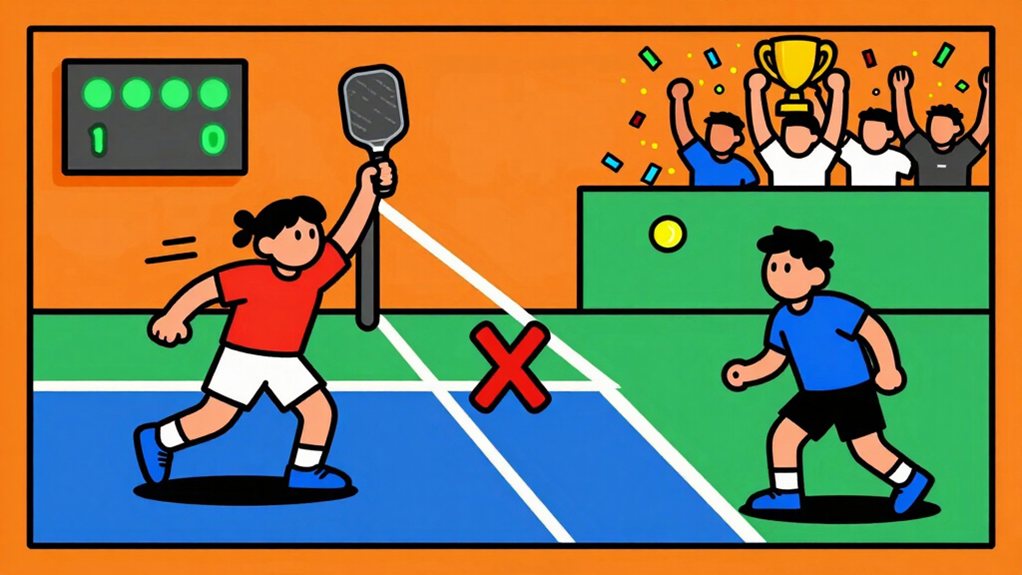
In pickleball, you score points only when your team serves and the opponent faults.
Most games go to 11 points, but tournaments may use 15 or 21 points.
You must win by at least two points, which means if the score reaches 10-10, play continues until one team leads by two.
Game Point Structure
When you play pickleball, you score points only when your team is serving. This is called side-out scoring. In most recreational games, you play to 11 points. Tournament play sometimes uses 15 or 21 points.
The serving team must win the rally to score. When the serving team faults, the serve transfers to the other side without points awarded.
Key scoring elements:
- Points are awarded only to the serving team
- Games are typically played to 11 points
- A side-out occurs when the serving team loses a rally
- The score is called as your score, opponent’s score, and server number
- Both players serve in doubles before side-out occurs
Winning By Two
Two points separate the winning team from the losing team in most pickleball games. You need a two-point advantage to win a game. This rule prevents ties and guarantees a clear winner.
The two-point requirement applies at any score once both teams reach at least 11 points.
- Standard games end at 11 points with a two-point lead.
- Tournament games end at 15 or 21 points with a two-point lead.
- You keep playing until one team achieves the required lead.
- The score must reach 11 before you can declare a winner.
- If the score is 10-10, you continue until one team leads by two.
Example scenarios:
- 11-9, game over, winning team takes the match.
- 13-11, game over, winning team takes the match.
- 10-10, no winner yet, keep playing.
You must maintain your two-point lead throughout the game.
Doubles Play in Pickleball: Partner Rotation and Serving Order
Since doubles play involves two teammates on each side, you need to understand how the serving order works. In doubles, both partners serve until each commits two faults.
The first server starts from the right-hand court. After each point, the server switches sides.
The first server starts from the right‑hand court, then switches sides after every point.
When the serving team loses a point, the other team gains the serve through a side-out. The receiving team also rotates serving duties between partners.
Key points about the serving order:
- First serve comes from the right court
- Server alternates sides after each point
- Both teammates serve in rotation
- Two faults end that partner’s turn
- Side-out transfers serve to the other team


Breathable mesh upper and tongue add comfort
The Pickleball Kitchen: Non-Volley Zone Rules and Violations
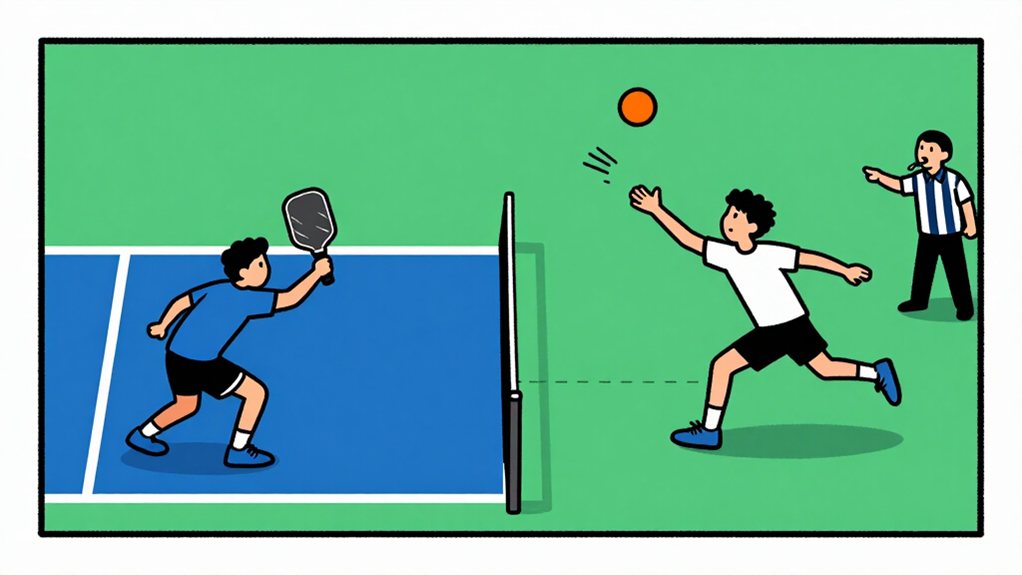
If you want to play competitively, you must understand the kitchen rules. The kitchen is the 7-foot non-volley zone extending from the net on both sides. You cannot volley the ball while standing inside this area.
Momentum from your swing also matters. If your momentum carries you into the kitchen after hitting a volley, you commit a fault. Stay out of the kitchen until the ball bounces. You may enter the kitchen to play a groundstroke or after the ball passes the net. Keep your feet behind the kitchen line when volleying. This rule prevents aggressive net attacks and keeps rallies longer.
| Rule | Description | Violation |
|---|---|---|
| No Volley | Do not hit ball while in kitchen | Fault |
| Momentum | Do not enter kitchen after volley | Fault |
| Entry | You may enter after ball bounces | Legal |
| Position | Keep feet behind line when volleying | Fault |
Frequently Asked Questions
What Is the Maximum Allowed Paddle Size in Pickleball?
Your paddle cannot exceed 24 inches in length and 8 inches in width, including the edge guard and perimeter. These official USA Pickleball dimensions represent the maximum allowed size you can use in sanctioned tournament play.
Can a Serve That Hits the Net Be Replayed?
Studies show 12% of serves hit the net during play. No, you can’t replay a serve that hits the net, it counts as a fault. The ball must clear the net and land in the diagonal service box.
What Happens if a Player Touches the Net During Play?
If you touch the net during play, you commit a fault. You’ll lose the point immediately, and your opponent scores. You must avoid net contact whether you’re volleying or moving around the court.
How Do You Decide if a Ball Is in or Out?
You determine if a ball is in or out by checking where it lands. If any part touches the line, it counts as in. You call it yourself on your side, and your opponent calls it on theirs.
Are There Specific Shoe Requirements for Playing Pickleball?
Funny you ask, you don’t need special shoes, but you shouldn’t wear running shoes. Indoor court or tennis shoes give you the lateral support and grip pickleball demands. They’re not required by rules, but they’ll protect your ankles during quick direction changes.
Final Thoughts
Remember, you control the flow when we follow the rules. The kitchen is a firewall that protects you from volley mistakes. Use the two,bounce rule to set up your shots. Score points only when your team serves and wins a rally. Follow these steps to stay legal:
- Serve from the right side, aim diagonally.
- Let the ball bounce once after the serve.
- Keep your feet out of the kitchen when you volley.

SILENT SERVE: These quiet foam pickleballs are designed for premium performance without the noise, so players can keep the game going wherever and whenever they play