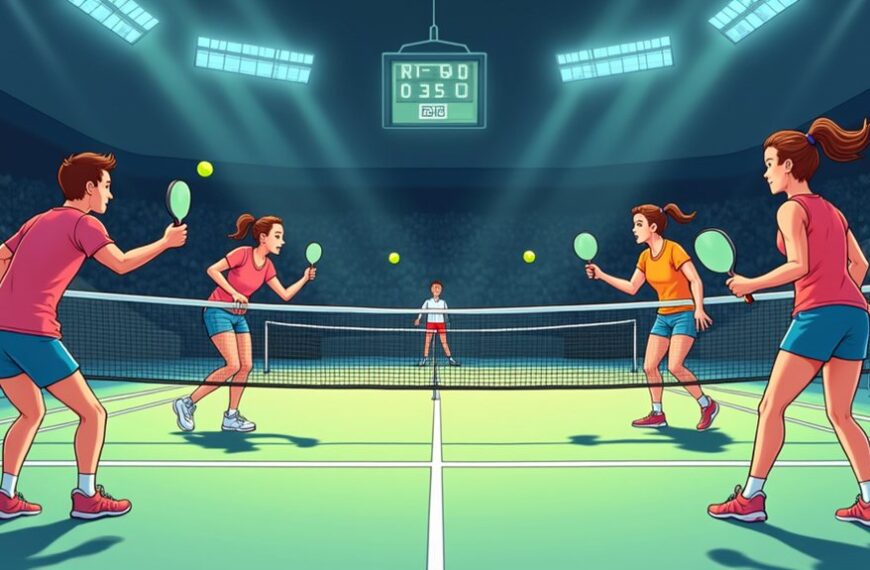
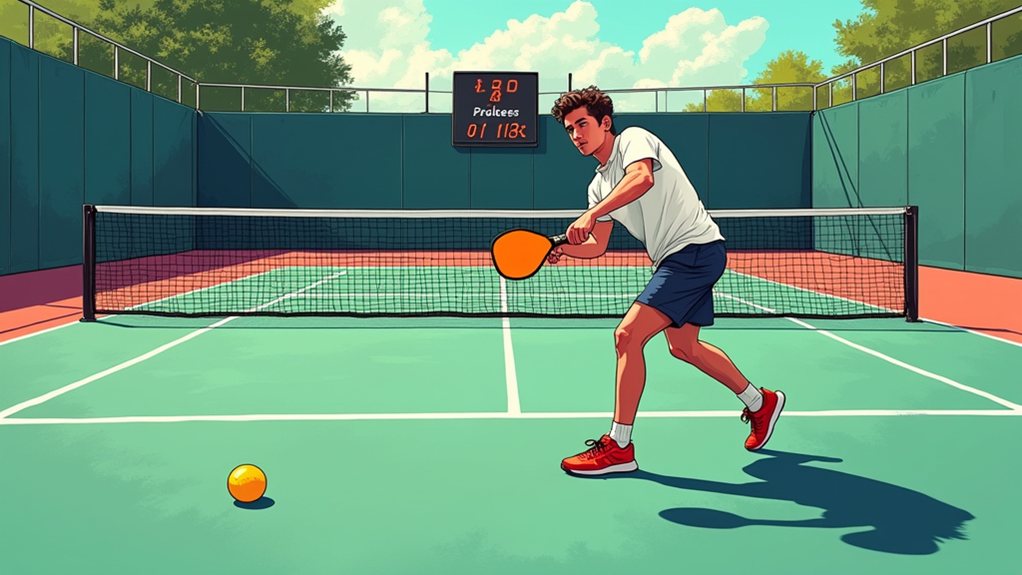
Your score, opponent score, and server position (1 or 2). In singles, use two numbers. Serve from the right court on even scores, left on odd scores. Under side-out scoring, only the serving team scores; under rally scoring, either team scores on each rally. Starting teams get one serve at 0-0-2.
Mastering these rules will help you compete more effectively.
Pickleball Scoring Rules: 11 Points and Win by 2
Pickleball games are played to 11 points, and you must win by a margin of 2 points. This means the game continues beyond 11 if the score is tied at 10-10. You keep playing until one team reaches 11 with a 2-point lead.
In tournament play, games often go to 15 or 21 points. The 2-point win rule still applies regardless of the target score.
Traditional side-out scoring is the official method. Only the serving team can score points. When the serving team faults, they lose their serve, called a side-out. The receiving team then becomes the serving team.
Rally scoring was introduced provisionally in 2025 for select formats. This allows either team to score on each rally, regardless of who served.
Key rules to remember:
- Games end at 11 points with a 2-point margin.
- Tournament games may use 15 or 21 points.
- Only servers score points under traditional rules.
- Side-out occurs when the serving team faults.
Most tournaments use best-of-three games to determine match winners across all scoring formats.

Easy, Fast, & Effective: Proprietary blend of soft rubber quickly removes ball residue, dirt, and minor scrapes/scratches. A few swipes and leave your paddle looking new. Ergonomic size and shape.
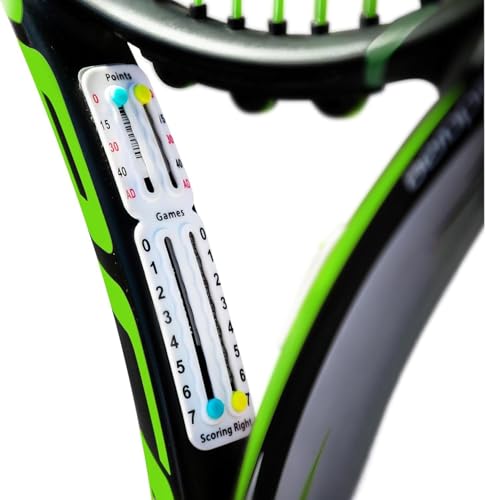
Lightweight & Practical: The convenient, lightweight, and portable score keeper is the perfect way to keep track of the points, games, and sets in any tennis match
![[Upgraded] A11N Pickleball Practice Rebounder, Adjustable Angle Dual-Sided Pickleball Dink Pad - Dink Board for Forehands Backhands Training](https://m.media-amazon.com/images/I/41SP8u6fDwL._SL500_.jpg)
Your Ultimate Training Partner: Take your pickleball game to new heights. Hone your forehands, backhands, dinks with this all-in-one training solution. Perfect for kitchen control and beyond.
Understanding the Three-Number Score Call
Now that you know games end at 11 points with a 2-point margin, let’s look at how you call the score during play. In doubles pickleball, you use three numbers for every score call.
The first number shows your team’s score. The second number shows the opposing team’s score. The third number indicates which server you are, either 1 or 2.
- First number: Your team’s serving score
- Second number: The receiving team’s score
- Third number: Server position (1 for first server, 2 for second server)
You announce “7-3-2” when you have 7 points, the opponent has 3 points, and you’re the second server. The server calls the score before each serve as a matter of etiquette.
The game starts at 0-0-2 for doubles first serve. This three-number system keeps everyone informed throughout the match.
How Serving Position Works: Even Scores Right, Odd Scores Left
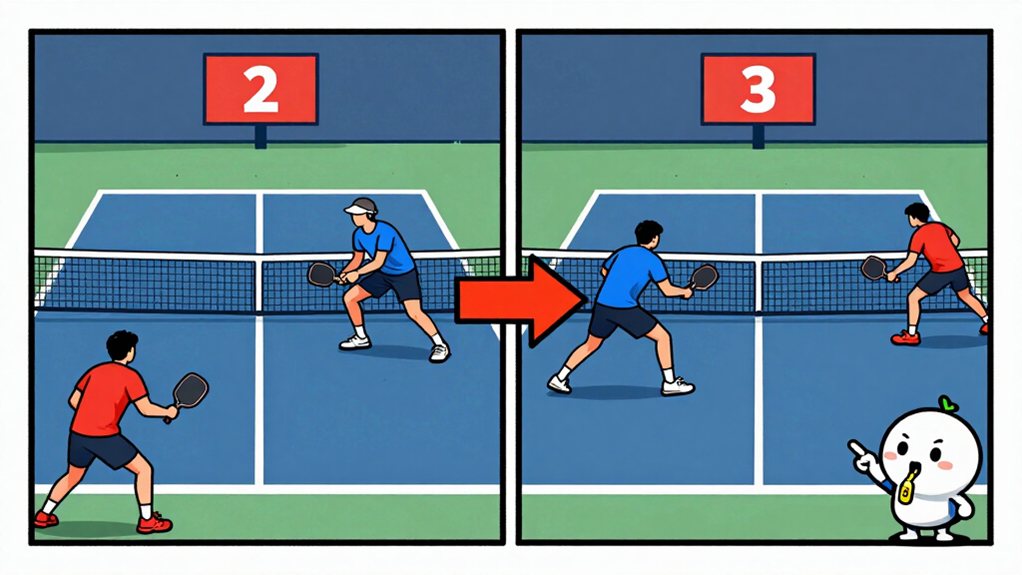
When your score is even, you serve from the right court. When your score is odd, you serve from the left court. This rule applies to every server throughout the game. You must switch courts after each point you win.
- You stand in the right court when your score reads 0, 2, 4, 6, 8, or 10.
- You stand in the left court when your score reads 1, 3, 5, 7, 9, or 11.
- Your partner follows the same pattern when it becomes their turn to serve.
- The receiving team never switches courts.
This even-odd court system keeps both teams aligned. We call this “sides in” when both teams stand in the correct courts. You only change position when your team’s score changes.
The First Serve Exception: Why Starting Teams Get One Serve
Understanding court position leads us to the first serve exception in pickleball. When the game starts, your team receives only one serve opportunity. This rule applies only at 0-0-2.
After that initial serve, your team gains two serves if you win the rally. This gives the receiving team a chance to get into the game. Here are the key points about the first serve exception:
- The first serving team starts with server number 2, meaning only one serve is allowed before side-out.
- If your team wins the rally after the first serve, your partner becomes server 1 and gets a second serve.
- After a side-out, the receiving team becomes the new serving team and gets both players the opportunity to serve.
- This exception only happens at the very beginning of each game when the score reads 0-0-2.
Singles vs Doubles Scoring: What’s Different?
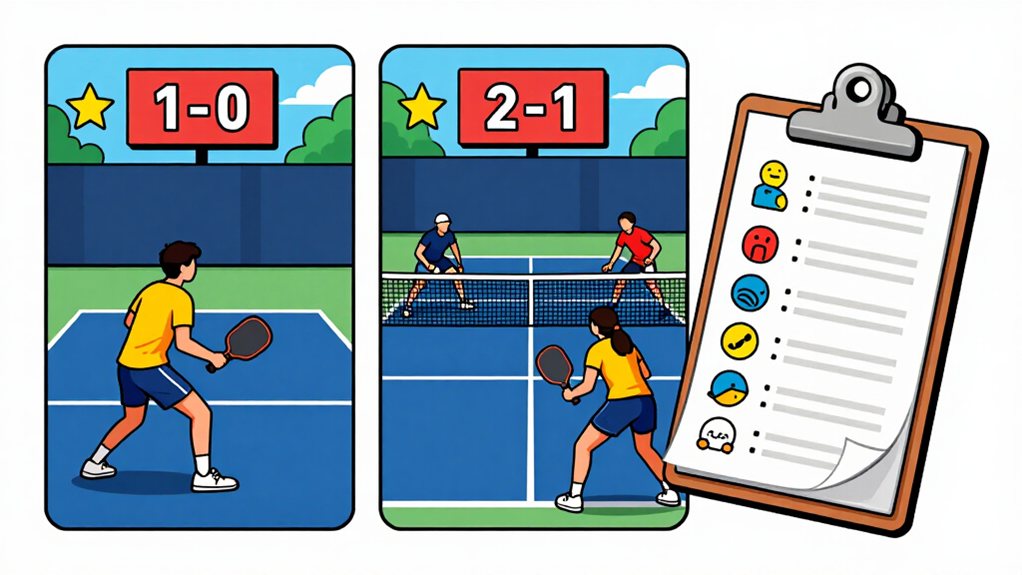
How does singles scoring differ from doubles scoring? Let’s break it down for you.
Discover how singles scoring shifts the game—simpler serve rotations, faster points, same two‑point win requirement.
- Score format changes
- Doubles uses three numbers: your score, opponent’s score, server number
- Singles uses two numbers: your score, opponent’s score
- Your serve rotation works differently
- In doubles, each teammate serves in sequence
- In singles, you serve alone
- You serve once per turn
- A side-out occurs after your single fault
- Court position follows your score
- Even score: serve from right court
- Odd score: serve from left court
- This matches the doubles pattern you already know
- Games move faster in singles
- Fewer serve turns mean quicker point exchanges
- You must win by two points just like doubles
- Games still end at 11 points in most play
Understanding these differences helps you transition smoothly between singles and doubles formats.

COMPREHENSIVE RULES REFERENCE: Educational pickleball poster displays all essential game rules including serving techniques, scoring system, line calls, and fault guidelines in an easy-to-read format for quick reference during play
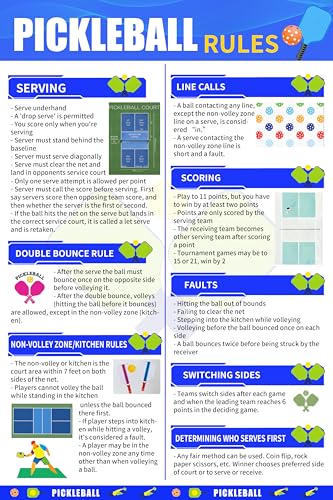
COMPREHENSIVE RULES REFERENCE: Educational pickleball poster displays all essential game rules including serving techniques, scoring system, line calls, and fault guidelines in an easy-to-read format for quick reference during play

Let’s Rally - Pickleball Scratch-Off Cards INCLUDES 22 birthday or retirement party game cards.
Side-Out vs Rally Scoring: Which Method Applies to You
Pickleball uses two scoring methods: traditional side-out scoring, where only the serving team scores points, and rally scoring, introduced provisionally in 2025 for select formats.
In side-out scoring, you earn a point only when you serve and win the rally; if you fault, the other team gains the serve but doesn’t score a point.
Rally scoring differs because both you and your opponent can score on any rally, regardless of who serves.
Side-Out Basics
While most recreational games use side-out scoring, you should know that rally scoring became an option in 2025 for certain tournament formats. In side-out scoring, only the serving team scores points. You can’t score when you’re receiving. This means you must win rallies while serving to build your score. When you fault while serving, the other team gains the serve through a side-out.
Here are the key points about side-out scoring:
- Only the serving team can score points during a rally
- The receiving team must win the rally to force a side-out and gain the serve
- A side-out occurs when the serving team faults, awarding the serve to the receiving team
- The score call uses three numbers: your score, their score, and whether you’re the first or second server
You announce the score as “your score-their score-server number” before each serve. For example, if you have 7 points, they’ve 3, and you’re the first server, you call “7-3-1.”
This format helps everyone track the game state clearly.
Rally Scoring Overview
You should understand both scoring methods if you plan to play in tournaments. Rally scoring allows both teams to score on every rally, regardless of who serves. This differs from traditional side-out scoring where only the serving team earns points.
Key rally scoring facts:
- Any team scores when they win a rally
- The serve rotates, but points keep accumulating
- Games still end at 11, 15, or 21 points
- You must win by 2 points
Rally scoring debuted in 2025 for select tournament formats. Check your event rules before you play. Some events use rally scoring exclusively, while others maintain side-out scoring. Your choice affects strategy and positioning throughout each game.
Common Scoring Mistakes That Cost New Players Points
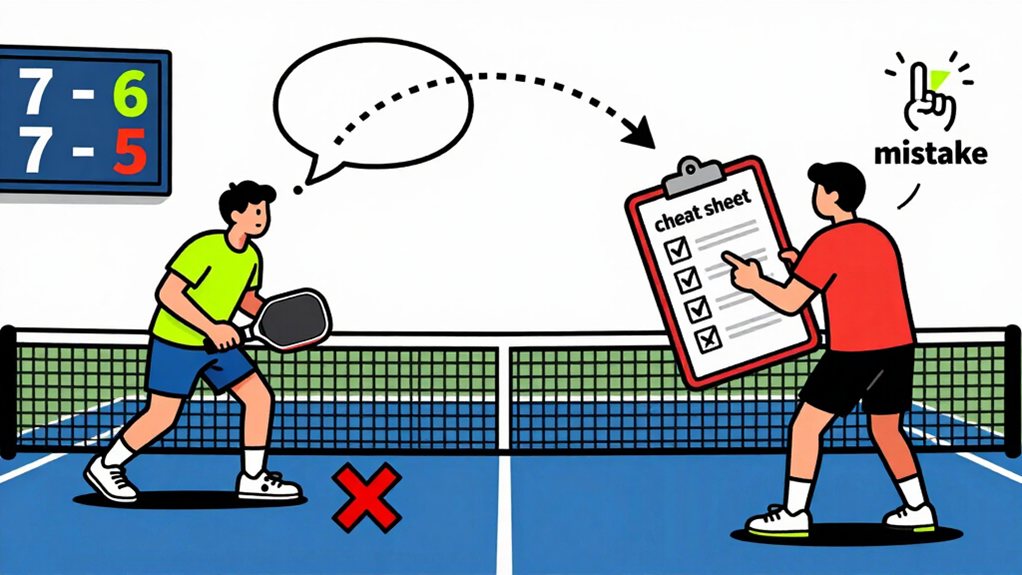
Learn to avoid these scoring mistakes before they cost you valuable points in your next match. Many new players lose points by not calling the score correctly. You must announce your score, then the opposing score, then your server number before each serve.
Another common error involves court positioning. You must switch sides when your score is odd and stay when it’s even. Here are the most frequent scoring errors:
- Forgetting to say the three-number score before serving, which results in a fault and loss of serve
- Not switching courts after scoring, leading to confusion about serving position
- Announcing the score in the wrong order: always state your points first, then the opponents’, then your server number
- Misunderstanding when a side-out occurs, receiving team only gains the right to serve after the serving team faults
Frequently Asked Questions
What Happens if the Ball Hits the Net on a Serve?
If the ball hits the net during your serve, it’s considered a “let” and you’re allowed to serve again. The rally doesn’t count, and you re-serve from the same court position without any penalty.
How Many Points Are Required to Win a Tournament Match?
Picture this: you’re battling for tournament glory! Tournament matches require you to win by 2 points, using either 15 or 21 points. The game continues until you achieve that winning two-point margin.
Do Players Switch Sides After Each Game in a Match?
You switch sides after each game in a match, and you also switch at the 11-point mark in games to 11. This always guarantees fair play and equal court conditions throughout the entire match period.
Is There a Limit on How Many Consecutive Faults a Server Can Make?
Fretful fault-finding shows no such limit, you simply keep serving until you fault, giving the receiving team a side-out. You then become the receiver until your team wins the rally back and scores a point.
What Happens if the Server Serves Out of Order?
If you serve out of order, you commit a fault. The opposing team receives the point, and you must resume serving in the correct sequence. Your partner or opponent then takes their proper turn according to the rotation rules.
Final Thoughts
Keep these seven rules in your back pocket. You must win by 2 points. Call the three-number score: yours, theirs, server number. Stand on the correct side when the score is even or odd. Remember the first serve exception. Use rally scoring in games. Avoid mistakes that cost points.
- Master these rules, and you play with confidence.
- Practice proper calls.
- Check your position before each serve.
- You will win more points when using correct procedures.
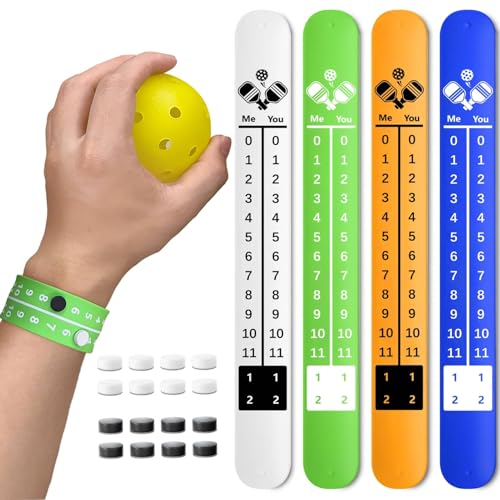
SCORER BRACELET: Keep your game sharp with this lightweight and portable pickleball score keeper. At 8.5” (215mm) long and 0.98” (25mm) wide, it comfortably fits most wrists and tracks scores from 0 to 11. No more forgetting points—this score keeper makes scoring easy

NEVER LOSE TRACK OF THE SCORE AGAIN! Attach this pickleball scorekeeper right over the butt of your paddle and start using it right away. Also easy to remove if desired.

Precision 3D-Printed Quality: Each headband is individually 3D-printed, resulting in a unique texture and high-strength finish that holds up through every victory dance.