
Check the Briffidi SW1 number on a 105-125 scale to read a pickleball paddle swing weight chart. The pivot point sits 2 inches from the handle end. Lower numbers (105-110) mean maneuverable paddles for control. Higher numbers (113+) give more power but slower changes for power players.
A 5-point difference is noticeable; a 10-point difference feels major. Use these numbers to match paddle feel to your game style, and you’ll be on the right track.
What Is Swing Weight and Why It Changes Your Game?
Swing weight measures how heavy a paddle feels when you swing it. It isn’t the same as the weight you see on a scale. Instead, it’s the mass moment of inertia about the paddle’s pivot point.
Why does this matter? Consider these points:
- A higher swing weight gives you more power. The paddle carries more momentum through the ball.
- A lower swing weight gives you better control. You can change direction faster.
- Head-heavy paddles increase swing weight. Handle-heavy paddles lower it.
- Longer paddles raise swing weight. The mass sits farther from your hand.
- You’ll notice a 5-point difference on the Briffidi scale. A 10-point difference is notable.
Your playing style should guide your choice. Control players benefit from lower numbers. Power players benefit from higher numbers. Just as swing weight affects how you move through the ball, your footwear setup impacts performance too, since factory insoles lack proper arch support and cause fatigue that throws off your swing mechanics during long matches.

A Specialized Brand for Pickleball - Our professional design team is dedicated to creating top-quality lead tape for the highest level of Pickleball competition. Trust that our lead tape you're getting is the best.

Lead Tape Size: High Adhesive Lead Tape Set with 30pcs lead tapes, 3g/0.1oz for each pickleball lead tape; 5 cm/ 2 inches in length, 1 cm/ 0.4 inch in width. Lead tapes are essential accessory for players.
Swing Weight vs. Static Weight: What’s the Difference?
Have you ever wondered why two paddles with the same weight can feel completely different when you swing them? The answer lies in understanding the difference between static weight and swing weight.
Static weight measures the total mass of your paddle. You find it by placing the paddle on a scale. It tells you how heavy the paddle is when it sits still.
Static weight measures the total mass of your paddle, showing its heaviness when at rest.
Swing weight measures the perceived heaviness during your swing. It tells you how the paddle feels in motion. This feels different because it depends on weight distribution.
Key differences:
- Static weight is a fixed number. Swing weight changes based on balance point.
- A head-heavy paddle has higher swing weight than a head-light paddle of the same static weight.
- You feel swing weight during your game, not only static weight.
Choose based on how it feels in motion, not just the scale number.
How Swing Weight Is Measured (and Why the Method Matters)?

Why does the measurement method matter when determining your paddle’s swing weight? The method you use changes the numbers you see.
Swing weight measures mass moment of inertia (MOI) about a pivot point. This isn’t the same as static weight on a scale.
Manufacturers use different pivot points when they measure. Some measure 2 inches from the handle end. Others measure at 10cm. These different positions produce different values for the same paddle.
The most accurate method uses a swing weight machine. This device measures the oscillation period of your paddle. Technicians then calculate MOI using the parallel axis theorem.
You can estimate swing weight yourself. Multiply paddle weight by swing radius squared, then multiply by 1.33. This gives you a reasonable approximation.
The chart you read must match the measurement method used. Otherwise, you compare apples to oranges.
Understanding the Briffidi SW1 Scale and Common Ranges
The Briffidi SW1 scale provides a standardized measurement for pickleball paddle swing weight, with most paddles falling between 105 and 125 on this scale.
You’ll notice that widebody paddles typically register around 107, standard shapes at 110, and elongated paddles at 113 or higher.
Understanding where your paddle lands on this scale helps you anticipate its feel during play, since a 5-point difference is noticeable and a 10-point difference is major.
Briffidi Scale Explained
When you need to measure swing weight precisely, the Briffidi SW1 provides standardized readings in the 105-125 range. This scale converts complex moment of inertia measurements into simple numbers you can compare across paddles. We calculate the reading by oscillating the paddle on a rig and timing the period. The device applies the parallel axis theorem to give you a consistent metric.
Key aspects of the Briffidi SW1 include:
- Standardized pivot point at 2 inches from the handle end
- Results expressed in a unitless index for easy comparison
- Calibration against ASTM F2398 pendulum method
- Lower values indicate easier maneuverability
- Higher values suggest more power potential
The scale eliminates guesswork by providing objective data. You use these numbers to match paddle feel to your playing style without relying on subjective weight descriptions alone.
Typical Range Values
Most paddles on the Briffidi SW1 scale fall between 105 and 125. This range captures the majority of recreational and competitive paddles. You’ll notice a 5-point difference feels noticeable during play. A 10-point difference feels notable.
Here are typical ranges by paddle shape:
- Widebody paddles: 105-110
- Standard paddles: 107-112
- Elongated paddles: 110-125
Lower numbers mean quicker swings and better control. Higher numbers provide more power but reduce maneuverability.
Control players often prefer 107-110. Power players select 113 or higher. Test paddles within the same shape for fair comparison.
Remember that head-heavy designs push values higher. Handle-heavy designs lower them.
Pivot Point Location: Why 2 Inches Changes Everything
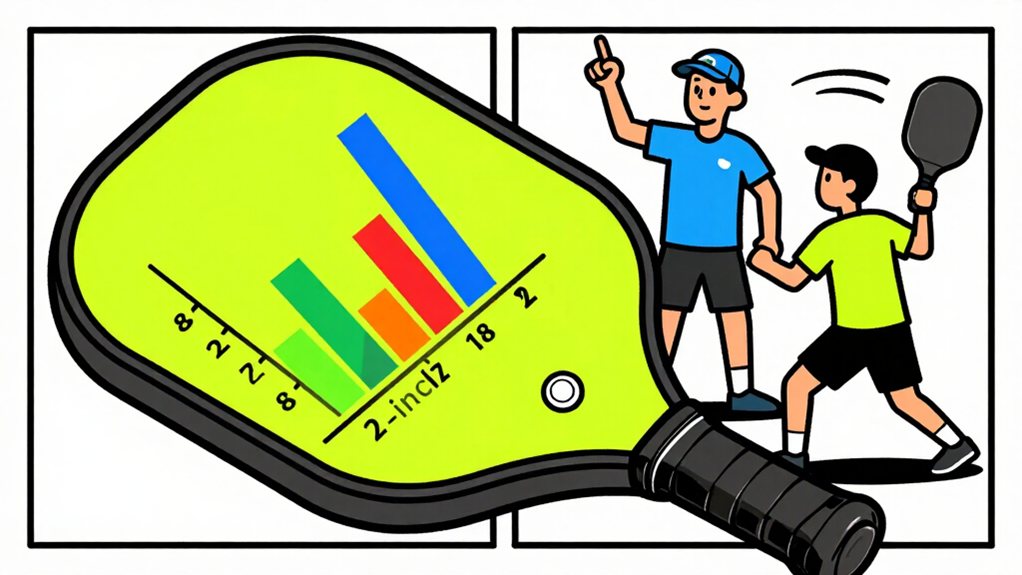
The pivot point is the location where you measure swing weight, and it determines your reading.
Manufacturers measure 2 inches from the handle end, and moving this point 2 inches either way changes swing weight from 572 to between 372 and 841 oz-in².
You must know the pivot point location to compare paddles accurately.
2 Inch Pivot Impact
Why does the pivot point location matter so much? It changes your swing weight reading dramatically. When manufacturers measure swing weight, they choose a specific point on the handle as the pivot. This point becomes the center of rotation.
Moving the pivot 2 inches toward the paddle head lowers the swing weight. Moving it 2 inches toward the handle raises it. The math uses the distance from the pivot to all the mass in the paddle. Change the pivot, change the result. This is why comparing paddles requires knowing the measurement point.
Here’s what shifts with each inch of pivot adjustment:
- The measurement point determines how much mass sits at a given radius
- Different pivot locations produce different swing weight numbers for the same paddle
- Manufacturers often use 2 inches from the handle end as their standard
- Swapping the pivot by just 1 inch creates a large numerical shift
- You must know the pivot location before you compare two paddles
Swing Weight Variation
When you move the pivot point just 2 inches, the swing weight numbers change dramatically for the same paddle. This variation occurs because swing weight measures mass moment of inertia about a specific pivot point. Different manufacturers place the pivot point at different distances from the handle end.
Standard measurements use 2 inches from the handle end as the reference point. When you shift the pivot point outward, you increase the swing radius. This increase raises the moment of inertia value. The opposite occurs when you move the pivot point inward. You must know the pivot point location to compare paddles accurately.
| Pivot Point Location | Typical Swing Weight Range |
|---|---|
| 2 inches from handle | 372-572 oz-in² |
| 4 inches from handle | 572-841 oz-in² |
| Standard reference | 572 oz-in² (average) |
Check the pivot point location before comparing swing weight values. This step guarantees fair comparisons between different paddle models.
Effect on Readings
Building on the swing weight variation you just read about, we now examine how pivot point location affects your readings. The pivot point is where you hold the paddle. Standard machines measure at 2 inches from the handle end. This location determines your recorded swing weight. Moving the pivot point changes the results markedly.
- Standard measurement uses a 2-inch pivot point from the handle end
- Measuring closer to the head lowers the swing weight reading
- Measuring further from the head raises the swing weight reading
- A 2-inch shift changes swing weight from approximately 372 to 841 oz-in²
- Always check the pivot point used when comparing paddle charts
This is why charts differ between manufacturers. Some use 2 inches, others use 10cm. Always note the pivot point before comparing values.
How Paddle Shape and Design Affect Swing Weight
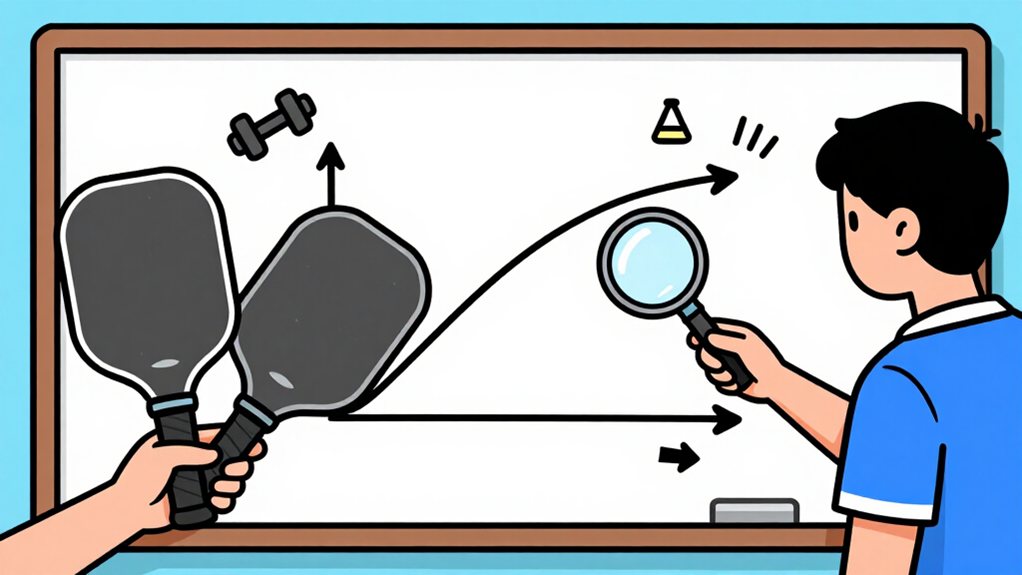
Consider how paddle shape directly influences swing weight. The mass moment of inertia changes based on where weight sits in the paddle.
Look at these shape categories:
- Widebody paddles, average swing weight of 107. The wider head spreads weight evenly. You get quicker swings.
- Standard shapes, average swing weight of 110. Balance sits near the middle. You receive moderate power and control.
- Elongated paddles, average swing weight of 113 or higher. Extra length pushes mass outward. You gain reach but lose maneuverability.
Head-heavy designs add mass toward the top. This raises swing weight. Handle-heavy designs do the opposite. They lower swing weight for faster reactions.
When you read the chart, note each paddle’s shape category. Compare numbers within the same shape for fair assessment. This helps you find the feel you want.
Low Swing Weight vs. High: Finding Your Feel
Because swing weight directly affects how your paddle feels during play, you must choose a level that matches your game. Low swing weight paddles feel quick and maneuverable. High swing weight paddles feel more powerful and stable. Your ideal feel depends on arm strength, reaction time, and court coverage needs.
Swing weight shapes paddle feel—choose low for quick handling, high for power and stability, based on your strength and court coverage.
When testing paddles, notice how each responds at contact. Does the paddle swing feel effortless or weighted? Do you sense control or momentum? These sensations guide your selection.
Consider these factors when finding your feel:
- Physical comfort during extended play
- Responsiveness at ball contact
- Stability through the swing path
- Recovery speed between shots
- Overall confidence holding the paddle
Visit a local demo day to test multiple swing weights. Hands-on testing reveals what numbers can’t convey.

PICKLEBALL PADDLE WEIGHTS & COUNTERBALANCE: Weighted cap coins and pickleball paddle weights that counterbalance your paddle - a pickleball paddle counterbalance and cap coins pickleball players use to lower the balance point for faster hands.
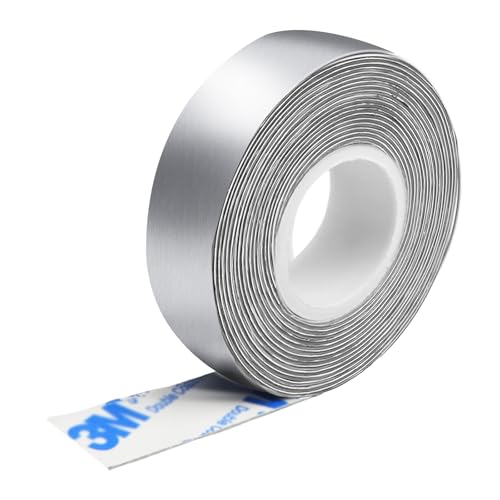
【Perfect Dimensions】- 1/2'' x 60'' lead tape. 2 gram per inch. This golf lead tape has just the right dimensions that will ensure easy application, Improve game with low cost.

【Say Goodbye to a Heavy Paddle Head】Designed for pickleball paddle end caps, these weights shift the balance point toward your hand, neutralizing head-heavy paddles for faster, more responsive swings with precise control.
Matching Swing Weight to Your Playing Style

Your playing style determines the best swing weight for you. Control players benefit from lower swing weights (107-110) for quick maneuverability, while power players prefer higher swing weights (113+) for added drive.
Match your paddle’s swing weight to your style: choose light for precision, heavy for power.
Control Players Choose Light
If you prioritize ball placement over power, you’ll benefit from a lighter swing weight.
Control players need quick paddle reactions for dinks, drop shots, and third-shot drops. Lower swing weights around 105-110 on the Briffidi scale give you faster swing speeds and better maneuverability.
Your wrists and arm stay relaxed during long rallies.
You maintain precise shot placement without exerting extra effort.
Key benefits of choosing light:
- Faster paddle acceleration for touch shots
- Reduced arm fatigue during extended play
- Improved wrist snap for spin generation
- Quicker reaction time at the net
- Better control over delicate placements
Power Players Choose Heavy
Power players benefit from heavier swing weights because extra mass generates more ball speed and depth. You generate higher momentum when you swing a paddle with an boosted swing weight. The extra kinetic energy transfers into your shots, giving you more power and deeper ball placement.
Look for swing weights above 115 on most charts. Elongated paddle shapes often sit in this higher range. Head-heavy designs also push swing weights upward.
Your swing speed decreases with heavier swing weights. You compensate by using your body’s rotation and full arm extension. Practice generating power from your legs and core, not only your wrist.
Test paddles in the 115-125 range before you buy. You want enough weight to add power but still maintain control. Balance is key. Aim for a paddle that feels heavy in the swing without feeling sluggish at contact.
Match Weight to Style
Control players benefit from lighter swing weights for quick reactions and precise ball placement. You want a paddle that moves fast through the kitchen.
Look for swing weights around 105-110 on the Briffidi scale. This range gives you the responsiveness you need for control.
Power players choose heavier swing weights for more force. Heavier paddles generate greater momentum through the air. You sacrifice some speed for increased shot power.
Find your ideal weight by testing different paddles on the court.
Match your swing weight to these five factors:
- Your skill level and experience
- The paddle shape you prefer to use
- Your physical strength and arm endurance
- The balance point of the paddle head
- Your typical court position and role
Testing Swing Weight: What 5-10 Points Actually Feel Like
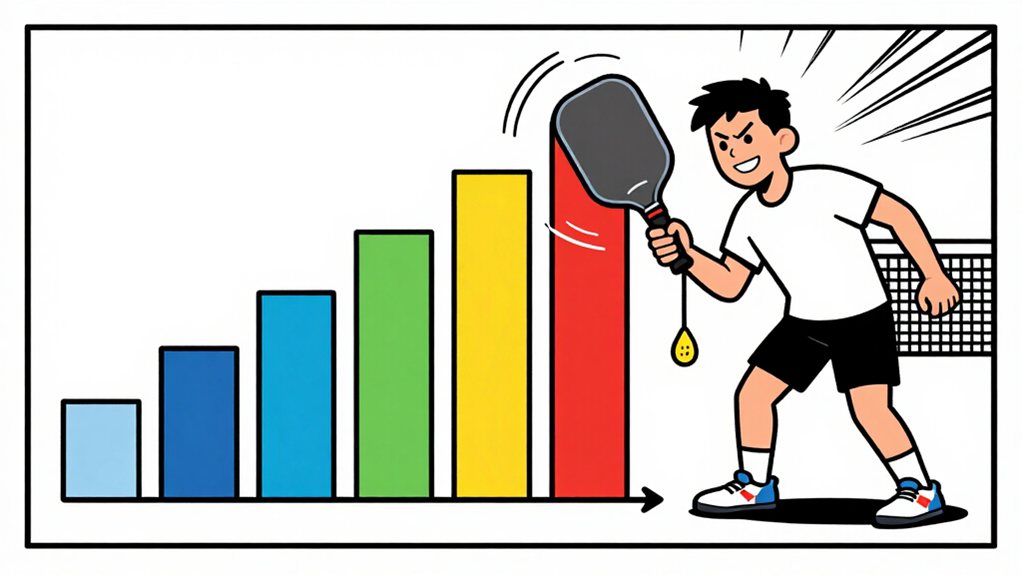
When testing swing weight, you need hands-on experience with actual paddles to understand what the numbers mean.
A 5-point difference creates a subtle but noticeable shift. You feel slightly more resistance at the top of your swing.
A 10-point difference delivers a dramatic change. The paddle feels substantially heavier or lighter.
Try this test:
- Hold each paddle at the handle end.
- Swing like you’d during a forehand drive.
- Note the resistance at the point of contact.
- Compare two paddles with 10-point swing weight gap.
Your muscles tell you the truth. Charts give you numbers. Your hands give you reality.
Visit a shop with multiple paddle options. Test paddles across the 105-125 range. Find your feel threshold.
Choosing the Right Swing Weight for Your Skill Level
Your skill level plays a major role in determining which swing weight feels right for you. Beginners benefit from lower swing weights because these paddles let you swing faster, react quicker, and develop proper technique without excess mass.
Intermediate players often prefer medium swing weights for a balance of power and control. Advanced players typically choose higher swing weights for maximum power on drives and serves.
We match paddle characteristics to your current abilities for the best experience.
Consider these factors when selecting your swing weight:
- Lower swing weights (105-110) suit beginners learning proper technique
- Medium swing weights (110-115) work for players building consistency
- Higher swing weights (115-125) match experienced players with fast swings
- Your speed and reflexes determine which range feels comfortable
- Test several paddles before committing to one swing weight category
Frequently Asked Questions
Can I Modify Swing Weight After Buying a Paddle?
You can modify swing weight by adding weight tape to the head or handle, or changing grips. However, changes are limited compared to choosing a paddle with your ideal swing weight from the start.
Does Swing Weight Affect Wrist Strain or Injury Risk?
Higher swing weights place more strain on your wrist during repeated swings, increasing fatigue and injury risk. You should choose a lower swing weight if you experience wrist discomfort or want to prevent strain long-term.
Are There Tournament Rules Limiting Maximum Swing Weight?
Check this shocking fact: USA Pickleball doesn’t impose swing weight limits, you’re completely free to choose any paddle! Most competitive paddles range 105-125 oz-in², so focus on what feels right for your game.
How Does Grip Thickness Influence Swing Weight Perception?
Thicker grips shift mass closer to your hand, reducing perceived swing weight despite the paddle’s actual swing weight. Thinner grips move mass farther away, making the paddle feel heavier during swings, decreasing maneuverability.
Do Temperature or Humidity Changes Affect Swing Weight Measurement?
Temperature and humidity can subtly alter paddle materials, potentially shifting weight distribution slightly. However, these effects remain minimal in practice, you’ll rarely notice measurement differences from environmental changes during standard testing conditions.
Final Thoughts
Now you understand swing weight and how it shapes your game. Follow these final steps:
- Test paddles in the 200-250 SW1 range for balanced control and power.
- Choose lower values if you prioritize quick reactions, higher values if you want more force.
- Grip the paddle 2 inches from the butt cap for accurate feel.
- Trust your on-court results over theory.
Your ideal paddle awaits, step onto the court and find it. Time waits for no one, but the perfect swing weight is worth the search.

Precision Weight Tuning: Each 3g strip helps fine tune paddle feel, stability and shot response without bulky accessories. This pickleball lead tape set makes it easier to adjust contact feedback, pace and consistency for drills, league play, open court sessions and everyday practice

[Best Gift for Families] Niupipo Pickleball Paddles includes 2 durable adult pickleball paddles and 2 junior paddles, 2 indoor and 2 outdoor pickleball balls, and 1 convenient pickleball bag; providing everything your group requires. A high-quality fiberglass pickleball set can drastically alter a player's game. Show love for your family by providing them with the finest connection

Precision Weight Tuning: Each 3g strip helps fine tune paddle feel, stability and shot response without bulky accessories. This pickleball lead tape set makes it easier to adjust contact feedback, pace and consistency for drills, league play, open court sessions and everyday practice