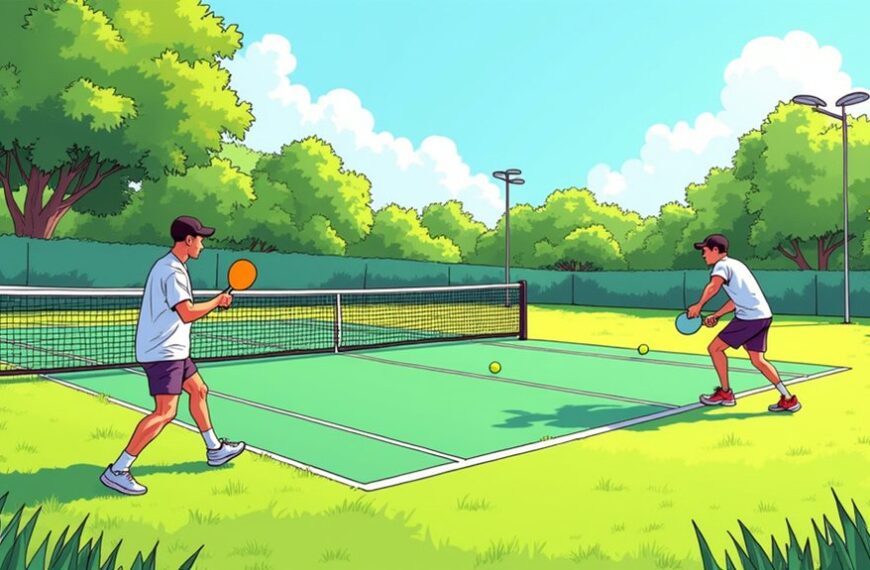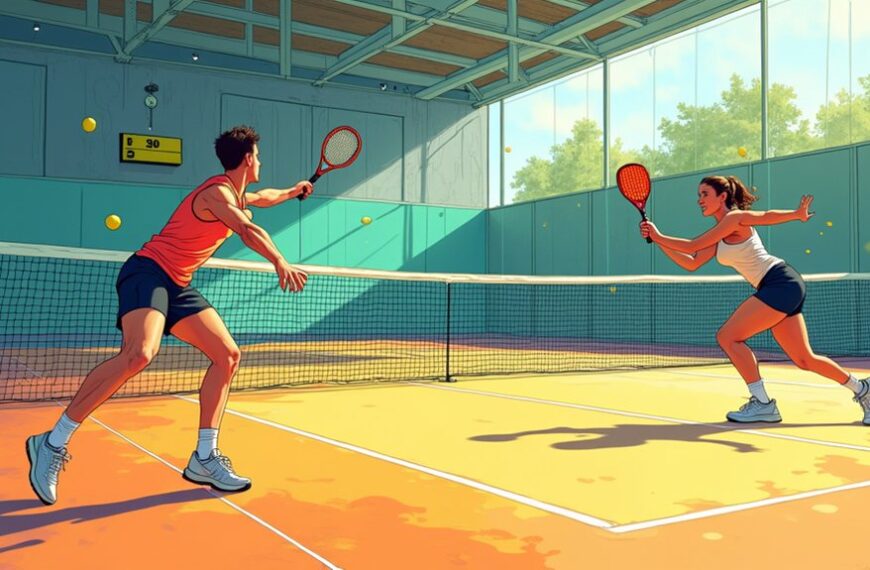
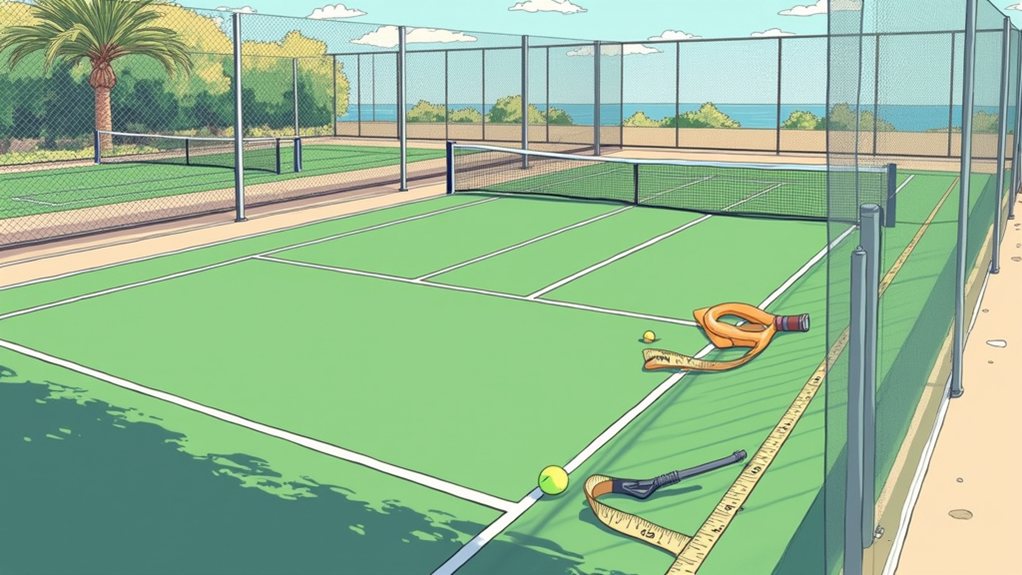
The official padel court measures 20 meters long and 10 meters wide, giving you 200 square meters of playing surface. The net spans 10 meters across, standing 88 cm high at the center and 92 cm at the posts. Back walls reach 4 meters in height. Side walls measure 4 meters for the first 3 meters, then drop to 3 meters for the remaining 7 meters.
Leave at least 6 meters of free height above the court. Service lines sit 6.95 meters from the net. All court lines are 5 cm wide. For more details on spacing requirements and comparisons to tennis courts, keep exploring.
Official Padel Court Dimensions: Length, Width, and Playing Area
Since padel combines elements of tennis and squash into one dynamic sport, we should first establish its official court dimensions. A standard padel court measures exactly 20 meters in length and 10 meters in width.
This creates a total playing surface of 200 square meters or 2,150 square feet.
Under FIP regulations, tolerance allows 0.5% excess or defect in these measurements. For safe play and player movement, experts recommend a footprint of 22 meters by 12 meters.
This additional space accommodates proper positioning around the court.
Key dimensions to remember:
- Length: 20 meters (65.6 feet)
- Width: 10 meters (32.8 feet)
- Playing area: 200 square meters
- Recommended footprint: 22m x 12m
- Tolerance: 0.5% per FIP rules
These specifications help ensure consistent padel courts worldwide. The court’s size influences rally duration and strategic play.
These specs ensure consistent padel courts worldwide; court size dictates rally duration and strategic depth.
You’ll find these measurements apply to all official padel facilities. Players should also verify court measurements and temporary rules before competing, as certain court configurations may include features like gaps between net posts and fencing that affect play.

IMPRESSIVE DURABILITY: Functional and extra resistant, the Babolat Court Padel Ball is one of the best balls currently available.

DESIGNED FOR PADEL: Crafted for padel enthusiasts seeking convenience, the Babolat Court S Padel Bag features a compartment tailored to accommodate two padel rackets alongside a divider. With this bag, you can neatly store your rackets, organize your essentials, and transport all the necessary equipment and accessories to excel on the court.

IMPRESSIVE DURABILITY: Functional and extra resistant, the Babolat Court Padel Ball is one of the best balls currently available.
Net Height and Pole Placement Specifications
Now that you know the court dimensions, let’s examine the net specifications. The net runs 10 meters across the court width, matching the lateral boundaries. At the center the height is 88 cm, while at the posts it rises to 92 cm. Place the posts at the outer edges of the court, aligning them with the side lines.
Make certain the net is taut and the height tolerance doesn’t exceed 5 mm.
- Measure 88 cm from the ground at the net’s midpoint.
- Verify each post reaches 92 cm.
- Align posts with the court’s side lines.
- Check that the net stays straight and height variation is within 5 mm.
Accurate net setup makes sure fair play and consistent bounce. Players and officials should verify measurements before each match.
Wall Height Requirements: Back Walls and Side Walls
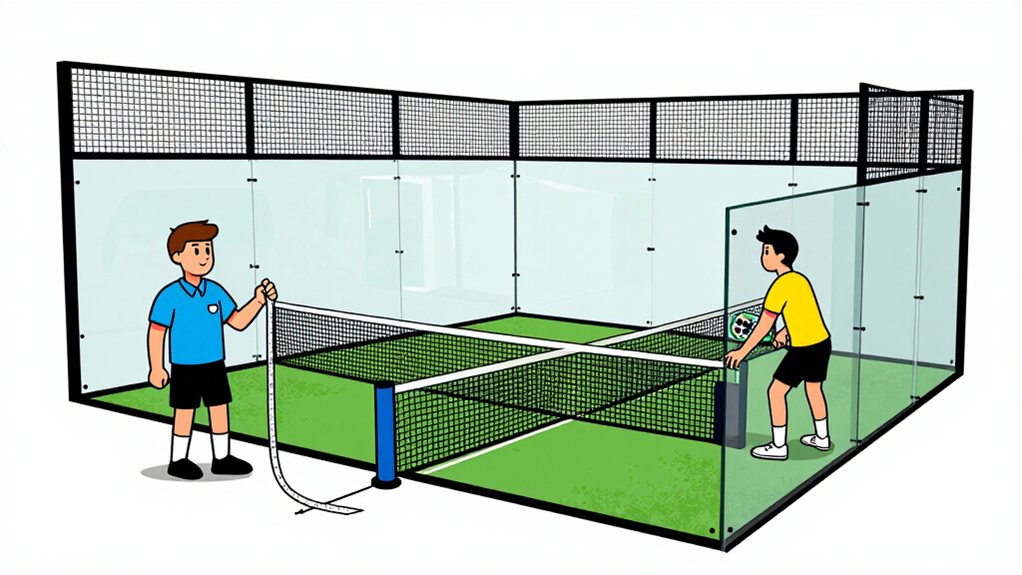
We’ll recommend that you set the back wall at a consistent 4‑meter height across the entire rear of the court.
For side walls, you’ll install 4‑meter glass for the first segment from the back, then use 3‑meter mesh or steel fence for the remainder.
It’ll guarantee safe play and proper ball rebound.
Back Wall Height Standard
When installing a padel court, you must confirm back walls reach a specific height to comply with official regulations.
Official back wall height standard:
- Walls measure 4 meters (13.1 feet) tall
- This measurement applies to both end walls
- Height provides proper ball rebound during play
- Regulations guarantee fair and consistent gameplay
- Tolerance follows FIP guidelines at 0.5%
You must verify wall height before court approval. Measure from ground level to top of wall. Use proper measuring tools for accuracy. Check that walls meet the 4-meter requirement.
Confirm both back walls are equal in height. Document measurements for inspection records. Consult official guidelines for any variations. Proper installation prevents future compliance issues.
Follow these steps to meet official standards.
Side Wall Height Variation
Although back walls maintain a constant 4-meter height, side walls feature a graduated design that changes along their length. This variation serves a practical purpose. It allows you to see over lower sections when positioned near the net while maintaining ball containment along the full wall length.
The side wall measurements follow this pattern:
- First 3 meters from back wall: 4-meter height using glass panels
- Remaining 7 meters: 3-meter height using mesh or steel fence
- Total side wall length runs 20 meters per side
You must understand why this matters. The taller glass sections keep balls in play when hit with power.
The lower mesh sections allow visibility for players tracking the ball.
Key specifications:
- Glass height: 4m (first third from back)
- Mesh height: 3m (remaining two-thirds)
- Changeover point occurs 3m from back wall
This graduated system ensures proper gameplay. The higher glass prevents balls from escaping. The lower sections don’t obstruct your view.
Court Line Markings and Service Area Layout
Proper line markings define the service area on a padel court. You’ll find the service line positioned 6.95 meters from the net. This line runs parallel to the net across the full court width. The central service line divides the service area into two equal halves. It extends 20 centimeters beyond the service line on each side.
Locate the service line 6.95 m from the net, run it parallel across the court, and draw a central line extending 20 cm beyond each side.
Key specifications:
- All court lines measure 5 centimeters wide
- Lines appear in white or black for maximum contrast
- The service boxes create two equal playing zones
You must guarantee all markings meet these exact measurements. Precise line placement guides proper serve positioning and player movement during competitive play. Regular inspection maintains visibility and accuracy over time.
Mini Padel Court and Singles Court Size Variations
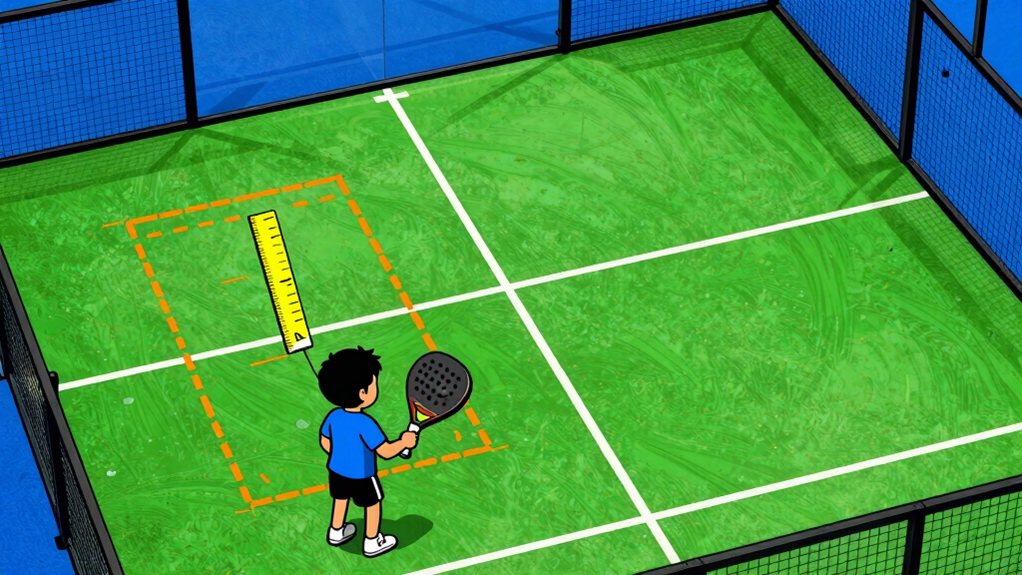
You can adapt padel courts to fit smaller spaces or different play styles.
A mini padel court measures 10 meters by 5 meters with 2‑meter back walls and side walls that start at 2 meters then drop to 1 meter.
For singles play, the width narrows to 6 meters while keeping the standard 20‑meter length.

DESIGNED FOR PADEL: Crafted for padel enthusiasts seeking convenience, the Babolat Court S Padel Racket Bag features a compartment tailored to accommodate two padel rackets...
Mini Padel Size
Mini padel offers flexible alternatives that accommodate smaller spaces and specific play styles. You’ll set up a compact court quickly in a garage, backyard, or indoor facility.
- Length: 10 m
- Width: 5 m
- Area: 50 m²
Follow these steps:
- Measure the space. The mini court needs at least 10 m by 5 m.
- Confirm wall heights. Back wall 2 m, side walls 2 m then 1 m.
- Check clearance. Make sure at least 6 m of free height above.
| Dimension | Standard (m) | Mini (m) |
|---|---|---|
| Length | 20 | 10 |
| Width | 10 | 5 |
| Area (m²) | 200 | 50 |
| Back Wall Height | 4 | 2 |
| Side Wall Height (back) | 4 | 2 |
Make sure the net matches standard height: 88 cm at center and 92 cm at posts. Use 5 cm wide white lines for clear visibility. Verify line color contrast now.
Singles Court Specs
While mini padel offers compact options, singles court variations provide another space-saving alternative for players who prefer one-on-one matches. The singles padel court reduces width to 6 meters while maintaining the full 20-meter length. This creates a 120-square-meter playing area that fits comfortably in tighter spaces.
- Court width measures 6 meters, half the standard 10-meter width
- Court length stays at 20 meters, matching full-size specifications
- Total area equals 120 square meters, notably smaller than the 200-square-meter doubles court
- Net height remains 88 centimeters at center and 92 centimeters at posts
You get the same net specifications as the doubles court. The reduced width still allows for dynamic rallies and strategic play.
Clubs often configure courts for both formats, giving you flexibility for different group sizes.
Size Variation Guide
Although padel originally developed as a doubles game, variations in court size allow you to play in smaller spaces.
- Mini Padel Court
- Length: 10 meters (32.8 feet)
- Width: 5 meters (16.4 feet)
- Back walls: 2 meters high
- Side walls: 2 meters for first portion, 1 meter for remainder
- Free height above: 6 meters minimum
- Singles Padel Court
- Length: 20 meters (65.6 feet)
- Width: 6 meters (19.7 feet)
- Net height: 88 cm at center, 92 cm at posts
These variations let clubs and homeowners install padel where full-sized courts won’t fit. You maintain all official rules while using reduced space.
How Padel Court Dimensions Compare to Tennis and Other Racket Sports?
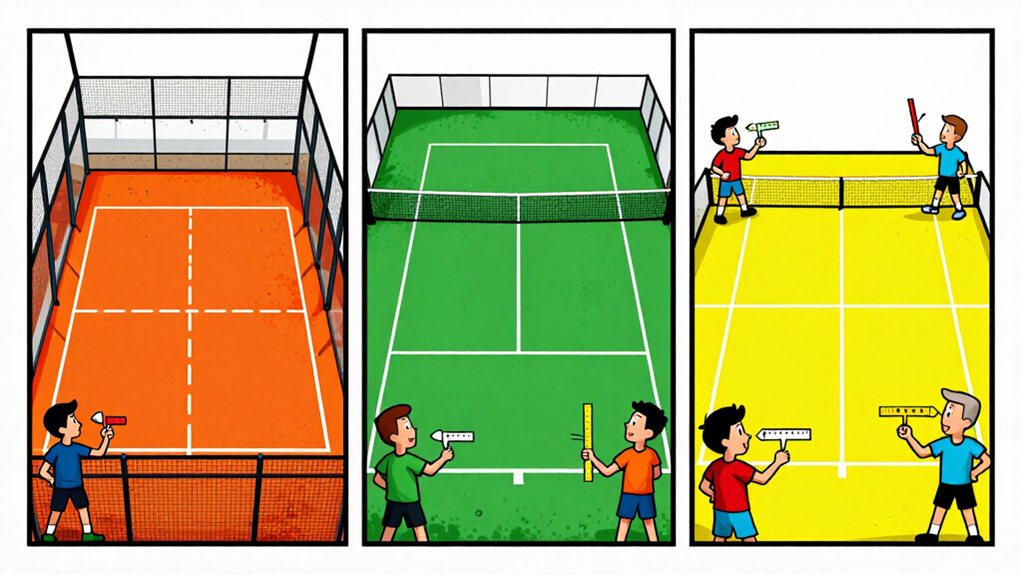
When you place a padel court next to a tennis court, you notice considerable size differences right away. A padel court measures 20 meters by 10 meters (200 square meters). A tennis doubles court spans 23.77 meters by 10.97 meters (260 square meters). You play on a much smaller area.
A padel court’s 20 m × 10 m (200 m²) footprint sits comfortably under a tennis doubles court’s 23.77 m × 10.97 m (260 m²), delivering intense, compact action.
- Padel courts are nearly half the size of tennis courts
- Padel courts offer more enclosed playing space than squash (9.75m x 6.4m)
- Pickleball courts measure 13.4m by 6.1m, smaller than padel
- Mini padel courts cut standard dimensions in half for beginners
You benefit from quicker rallies and easier coverage. The walls keep the ball in play longer.
Your game feels faster and more dynamic. The compact size suits players who want intensive matches.
Frequently Asked Questions
What Is the Minimum Ceiling Height Required for Indoor Padel Courts?
Indoor padel courts require a minimum ceiling height of 6 meters (approximately 20 feet) above the playing surface. You’ll need to make sure this clearance lets players hit overhead shots safely without any obstruction or restriction.
What Type of Surface Material Is Recommended for Padel Courts?
You should use artificial grass or synthetic turf with sand infill for your padel court surface. This material provides excellent footing, consistent ball bounce, proper drainage, good player comfort, and improved safety during competitive matches.
How Far Should the Perimeter Fence Be Positioned From the Court Boundaries?
Picture yourself freed entirely from boundaries! You should position your perimeter fence an amazing 1 meter (3.3 feet) away from all court edges, creating the ultimate safety buffer that lets you blast returns without worrying about crashing into walls.
Can Padel Courts Be Built on Slightly Uneven or Sloped Ground?
You can build on slightly uneven ground, but you must level it first. You’ll need professional grading and drainage systems to guarantee proper play, accurate ball bounce, and player safety.
What Are the Standard Lighting Specifications for Padel Court Illumination?
You need 500 lux minimum for recreation and 750-1000 lux for competitive tournaments. Place lights outside the court at corners or sides, maintaining 0.7 uniformity to eliminate dark spots across your entire playing surface area.
Final Thoughts
Let’s follow these steps we can confirm your padel court meets specs. 1. Measure playing area: 20 m long, 10 m wide. 2. Place net at 0.92 m height, with poles 0.50 m outside side lines. 3. Confirm back walls are 3 m high, side walls 3 m high. 4. Mark service line 6.95 m from net, and service box 4.115 m wide. When you see these dimensions align, your court is ready for play.

[Adjustable Poles with Height Marks] The adjustable poles with a 35.4"-61" height range and 3 clear height marks (42.1", 47.2", 61") make this net suitable for badminton, teen tennis, beach volleyball, and pickleball

10FT NET – Ideal for small spaces or indoor use. Perfect for 1-on-1 play with kids, allowing for fun and active games in compact areas.

Adjustable net settings for playing high net (61") or low net (34.5") games