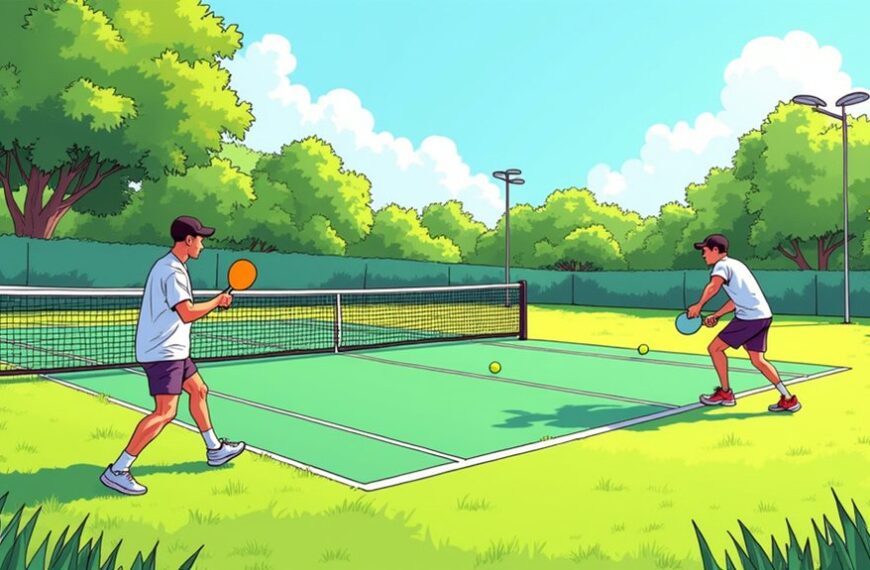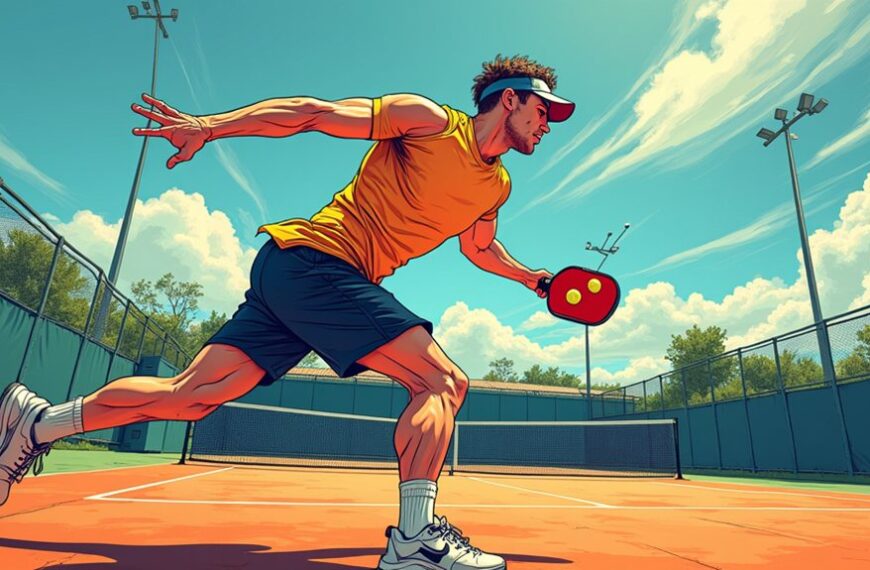
Paddle angle at contact determines shot consistency. Set your paddle face before contact and hold it steady through the swing. Adjust angle based on ball height: open 30° for knee height or lower, neutral at waist height, close slightly above waist. For forehands below net, open 15-30°; for backhands, open 10-20°. Use overhead tilt to direct balls left, right, or straight. Open slightly when dinking to lift over the net.
Practice index finger separation drills daily with 30 swings to improve micro-angle control. Keep net errors under 3 per 20 shots to build reliable consistency. Continuing further will reveal additional precision techniques for your game.
Paddle Angle: The Make-or-Break Factor in Consistent Play
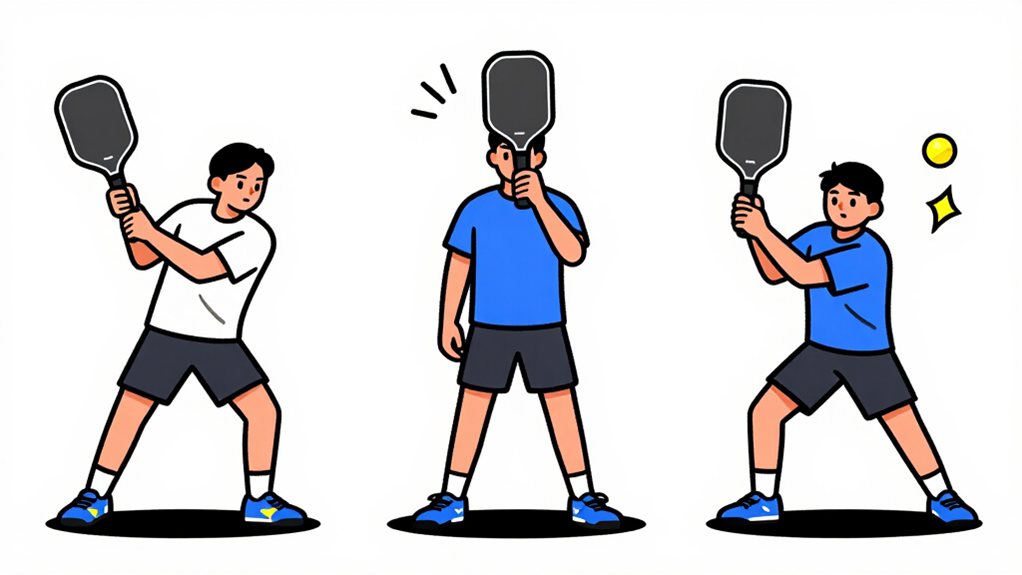
Master your paddle angle before contact—it’s the make-or-break factor that determines every shot’s path and consistency.
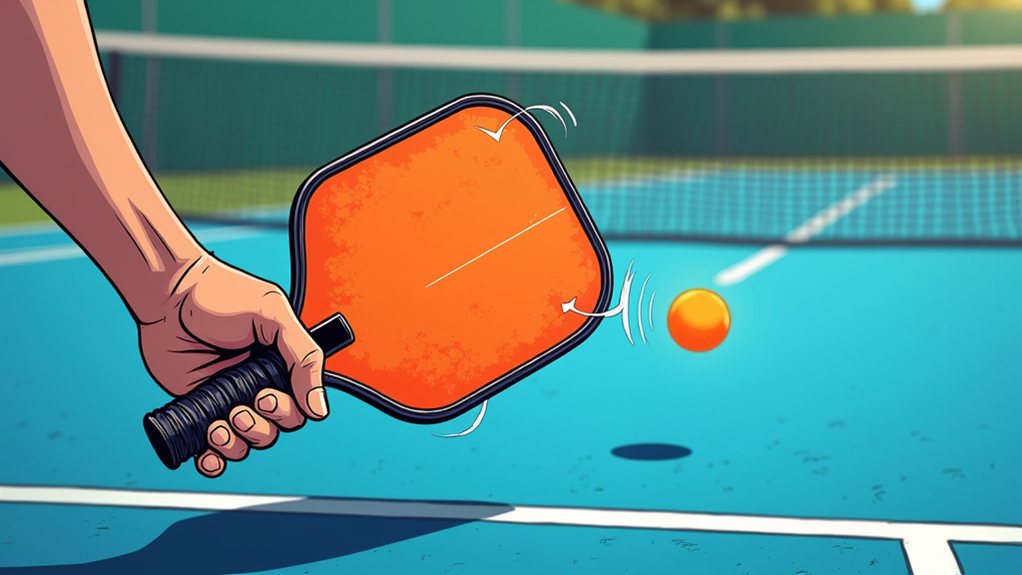
You control your paddle angle at contact, and that angle determines the ball’s path every time. Your pickleball paddle angle directly impacts pickleball shot control. Master these key points:
- Open face creates lift for low balls
- Closed face increases net risk
- Neutral angle works for mid-height shots
- Consistent angle produces consistent pickleball shots
Set your angle before contact. Hold the paddle steady through the swing. Adjust angle based on ball height, not after contact.
Read the incoming ball trajectory. Match your paddle face to the ball’s expected height.
Practice this:
- Stand at baseline
- Feed balls at different heights
- Observe how each angle changes your shot
- Record your results
You’ll feel the difference immediately. Your consistency improves when angle becomes automatic.

FAMILY-OWNED: At Selkirk, we are committed to fueling the pickleball obsession found within every player. Through uncompromising quality and a never-satisfied drive for innovation, we serve players around the world from beginners to pros.

PROFESSIONAL QUALITY: Designed by Franklin pickleball pros, this premium quality paddle has been constructed to compete, and win, at the highest level

FAMILY-OWNED: At Selkirk, we are committed to fueling the pickleball obsession found within every player. Through uncompromising quality and a never-satisfied drive for innovation, we serve players around the world from beginners to pros.
How Ball Height Determines Your Paddle Face Angle
The ball’s height at contact determines your paddle angle. When the ball drops below net height, you open your paddle face to create lift. This prevents the ball from hitting the net. You angle the paddle slightly upward to guide the ball over the net and into the court.
- Ball at knee height or lower: open your paddle face about 30 degrees.
- Ball at waist height: use a neutral angle, around 0 degrees.
- Ball above waist height: close your paddle slightly to drive the ball down.
Match your paddle angle to the ball height. This simple adjustment improves your consistency.
Practice sensing ball height before contact.
Your paddle responds to what your eyes see. Watch the ball descend. Anticipate its lowest point. Adjust your paddle face accordingly. Consistent contact points lead to consistent results.
Forehand vs. Backhand Paddle Angle Adjustments
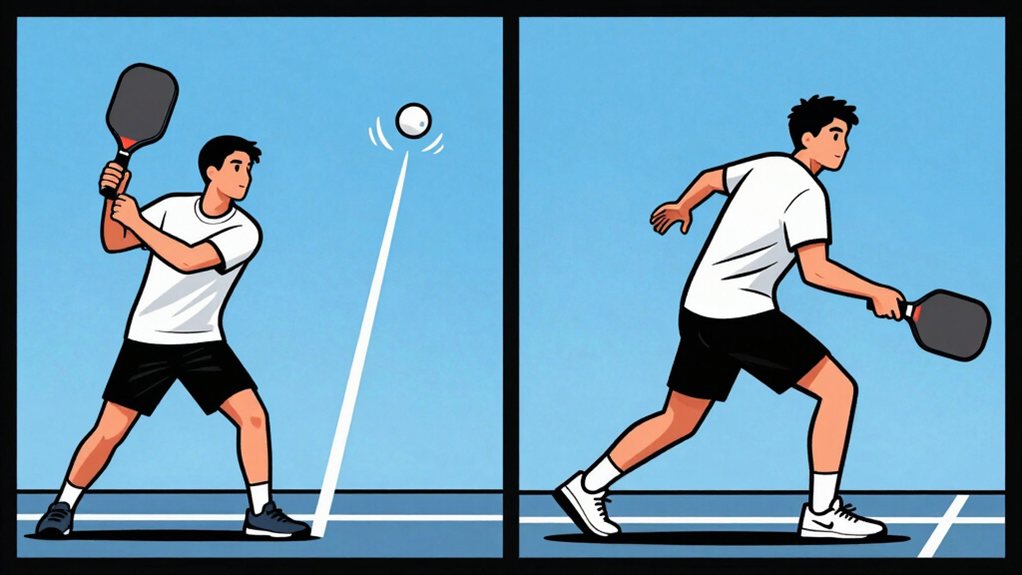
When comparing forehand and backhand paddle angles, the core principles remain similar, but subtle adjustments improve your consistency. On your forehand, you open the paddle slightly for balls below net height. Your wrist stays relaxed. You brush the ball to create lift.
On your backhand, you also open the paddle face to avoid net shots. You rely more on paddle angle than wrist snap. This change creates consistent contact.
| Stroke Type | Ball Height | Paddle Angle |
|---|---|---|
| Forehand | Below net | Open 15-30° |
| Forehand | At net | Neutral |
| Backhand | Below net | Open 10-20° |
You adjust angle based on ball position. You maintain a steady paddle face. You avoid flattening the paddle on downward swings. Practice these adjustments to build reliable consistency.
Direction Control With Overhead and Dinking Paddle Angles
When you’re hitting an overhead, tilt the paddle like a steering wheel to steer the ball left, right, or straight.
When you’re dinking, we open the paddle slightly to lift the ball over the net and place it deep or wide.
Apply three points:
1) Tilt for overhead direction; 2) Open for dink placement; 3) Keep wrist firm.
Just as a smart WiFi thermostat system lets you fine-tune your home’s comfort with precise control, mastering paddle angle gives you precise control over where the ball lands.
Overhead Angle Direction
Controlling overhead and dinking angles determines where your shots land on the court. Master overhead angle direction with these key techniques:
- Tilt your paddle like a steering wheel. The angle directs the ball, not power.
- Aim crosscourt to pull opponents wide. This opens the court for your next shot.
- Hit short diagonal drops to hinder opponent recovery time.
- Smash down-the-line to overwhelm middle defense.
- Use body rotation to generate natural angles. Rotate your shoulders and hips through contact.
Practice these directional controls daily. Your placement improves when you focus on angle over force. The paddle face at contact determines shot direction more than arm speed.
Remember: direction beats power in tight matches.
Dink Angle Placement
Once you master overhead direction, apply similar angle principles to your dinking game. Your paddle angle at contact determines where the ball lands. Open your paddle face slightly when dinking below net height to create lift and clear the net.
- Keep paddle open for soft, low shots.
- Close angle slightly when hitting above net to drive ball down.
- Tilt paddle toward sideline for crosscourt dinks.
- Use neutral angle for middle placement.
Your wrist guides direction. Rotate paddle left for right-side shots. Rotate right for left-side placement.
Practice these angles daily. Aim for 10-15 dinks per rally. Track your consistency. Adjust angle two degrees at a time. Small changes yield predictable results.
Directional Angle Tips
Mastering directional control means understanding how your paddle angle shapes each shot’s trajectory. We control direction with overheads by tilting your paddle like a steering wheel.
- Tilt right for crosscourt angles that pull opponents wide.
- Keep paddle neutral for down-the-line smashes that stay tight.
- Angle slightly left for short diagonal drops that hinder recovery.
For dinking, adjust angle to direct ball placement.
- Open paddle face toward the sideline for crosscourt dinks.
- Close angle slightly for dinks down the line.
- Use two-shot sequences by combining angle changes.
Read your opponent’s paddle position to predict their shot direction. You gain tactical advantage when you anticipate directional choices.
Solving the Most Common Paddle Angle Mistakes
We can identify paddle angle errors by recognizing when your shots consistently fall short or sail long.
You can correct these mistakes by adjusting your paddle face angle based on the ball’s height at contact.
We’ll learn to spot and fix three common errors: closing too much on low balls, opening too much on overheads, and ignoring opponent angles.

Enter your model number

Enhanced Comfort & Control
Identifying Errors
Frequently, players make the same paddle angle errors that hurt their consistency and increase unforced errors. You must learn to spot these mistakes during play.
- Watch for net shots on low returns. This signals a closed paddle face.
- Notice balls sailing long. This indicates an overly open face at contact.
- Detect excessive topspin on simple returns. You’re dropping your wrist too much.
- Observe inconsistent depth. Your paddle angle changes too much between shots.
- Track ball placement errors. Poor angle control creates unpredictable bounces.
- Identify forced errors. Opponents exploit your angle misreads consistently.
Study your paddle face position immediately after each shot. Look for patterns in your missed shots.
Video review reveals angle issues your feel misses.
Correcting Mistakes
Once you spot these patterns in your game, apply these corrections to improve your consistency.
- Net shots on low balls: You’re closing the paddle too much. Open your face slightly to create lift. Aim for a 15-20 degree open angle.
- Ball flying long: You’re opening too far. Close the angle to 30-45 degrees. Adjust based on ball height.
- Inconsistent spin: You’re snapping your wrist too hard. Let the paddle brush the ball. Maintain a steady angle through contact.
- Forehand errors: You’re flattening too early. Keep the paddle open for lift. Use natural wrist guidance instead.
- Backhand issues: You’re closing too fast. Open slightly to clear the net. Focus on paddle face position over wrist snap.
- Overhead misses: You’re dropping the paddle head. Tilt it like a steering wheel. Direct the ball with angle, not power.
Paddle Angle Drills for Reliable Consistency
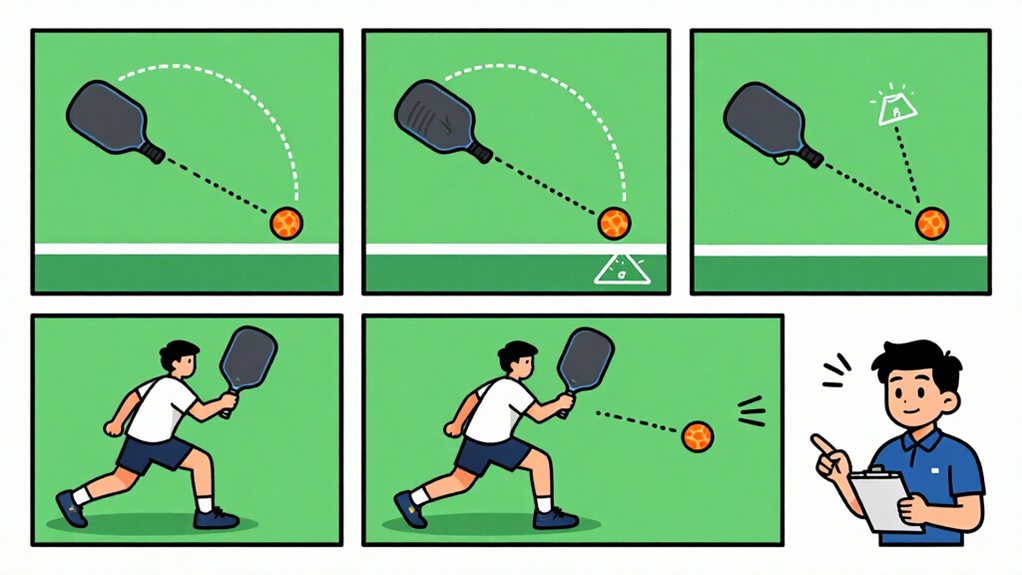
Developing consistent paddle angles requires deliberate practice with specific drills. Use the Three Target Drill for balanced practice.
Master paddle angles with purposeful drills—try the Three Target Drill for balanced, precise shot development.
Set up targets at crosscourt short, deep middle, and down-the-line positions. Hit 20 shots to each target.
Alternate between forehand and backhand sides. Count your net errors separately. Try to keep net errors under 3 per 20 shots.
Add index finger separation drills. Place your index fingers one inch apart on the handle. Practice micro-angle changes while maintaining control. Complete 30 swings with this grip daily.
Notice the subtle paddle face shifts.
For low ball practice, open your paddle face 15 degrees. Hit 15 low balls from the kitchen line. Focus on lift without excessive power. Track your consistency over one week.
Frequently Asked Questions
Does Grip Pressure Influence Paddle Angle Consistency?
You grip the paddle with steady, relaxed pressure to maintain consistent angle control. Excessive tension locks your wrist and prevents micro-adjustments, causing angle variations. Relaxed fingers let you subtly tilt the face on each shot.
What Paddle Angle Is Optimal for a Serve?
When you serve, tilt your paddle slightly closed, around 10-15 degrees. This sends your serve low over the net with a natural arc that lands safely and effectively in the court.
How Does Wind Affect My Paddle Angle Choices?
You’ll open your paddle more into the wind to lift serves and groundstrokes, and close it slightly downwind for added drive. Headwind requires more paddle face elevation; tailwind demands steeper downward angles for ball control.
Can I Use Paddle Angle to Increase Spin Without Losing Power?
Close your paddle slightly while brushing up, the angle creates spin, but aggressive swing speed maintains power. You don’t sacrifice force; you channel it through geometry for real devastating spin and pace.
What Adjustments to Paddle Angle Help When I’m Off‑Balance?
Keep your paddle face slightly open for stability. Use a shorter backswing and trust your natural wrist hinge. Focus on paddle angle over power. Let your body rotation guide the shot rather than forcing it.
Final Thoughts
Master your paddle angle, and we eliminate guesswork forever. Practice these steps every session: 1. Set your paddle face 10 degrees upward at contact. 2. Keep your wrist firm, and swing forward with a controlled follow-through. 3. Track your shot placement, and aim for the backcourt line on 80% of rallies.
Repeat these motions, and you will lock in consistent depth, reduced net errors, and stronger drives to boost your confidence and win more points.

MAGNETIC AUDIO CUE: This magnetic table tennis training device produces a clear click when its internal mechanism engages during a swing, giving users a repeatable sound reference for rhythm practice without claiming to measure stroke angle
MAGNETIC AUDIO CUE: This magnetic table tennis training device produces a clear click when its internal mechanism engages during a swing, giving users a repeatable sound reference for rhythm practice without claiming to measure stroke angle

Can be used with one hand