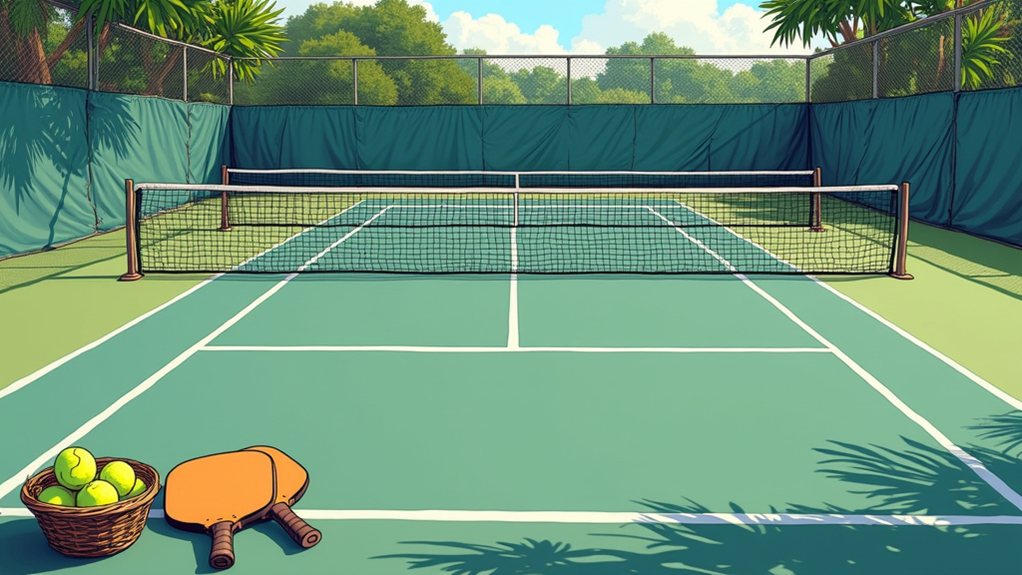
Yes, you can play pickleball on a tennis court. Lower the net to 34 inches at center using a weight and tape measure. Mark sidelines 3.5 feet inside tennis singles lines. Set the kitchen line 7 feet from the net on both sides.
Use temporary markers like cones or rubber strips, never chalk without permission. Place the baseline 20 feet from the net, using tennis service lines as reference. A standard 20×44-foot pickleball court fits easily within tennis boundaries. Check net height before each match for consistent play. For more detailed steps, keep going.
Essential Equipment for Converting a Tennis Court to Pickleball
Converting a tennis court for pickleball play requires minimal specialized equipment. You’ll need a portable net system, temporary court markers, paddles, and pickleballs.
Essential conversion items include:
- Portable pickleball net set to 34-inch center height
- Temporary line markers such as cones, water bottles, or rubber strips
- Pickleball paddles
- Plastic pickleballs (different from tennis balls)
Line marking process:
- Measure sidelines 3.5 feet inside tennis singles lines
- Mark kitchen line 7 feet from net on each side
- Establish baseline 20 feet from net
- Use tennis service lines as near-baseline reference
We recommend short rubber strips designed for court marking. They offer easy placement and removal without damaging the surface.
Cones work well for corners. Water bottles serve as temporary sideline markers.
Avoid tape or chalk unless you have explicit permission from the court owner. Permanent markers damage tennis court surfaces.
Temporary markers require approximately three to four sets for a full court layout.
You can store them in a single equipment bag for convenient transport between courts.
Many local parks departments also allow tennis courts with existing pickleball lines, which can eliminate the need for temporary markers altogether.
How to Adjust Tennis Net Height for Pickleball Play?
To play pickleball on a tennis court, you’ll need to adjust the net height. Pickleball requires a net height of 34 inches at the center, compared to tennis at 36 inches.
- Lower the tennis net by sliding the net strap to the side
- This lowers the center to 34 inches without changing strap tension
- You can also use a portable pickleball net that provides correct height automatically
- If adjustment is impossible, leaving the net at 36 inches is acceptable for casual play
- Always return the net strap to center position after use to maintain original tension
The adjustment is simple. You don’t need special tools. Just move the strap, and you’re ready to play.
Measuring and Marking Pickleball Court Lines on Tennis Surfaces
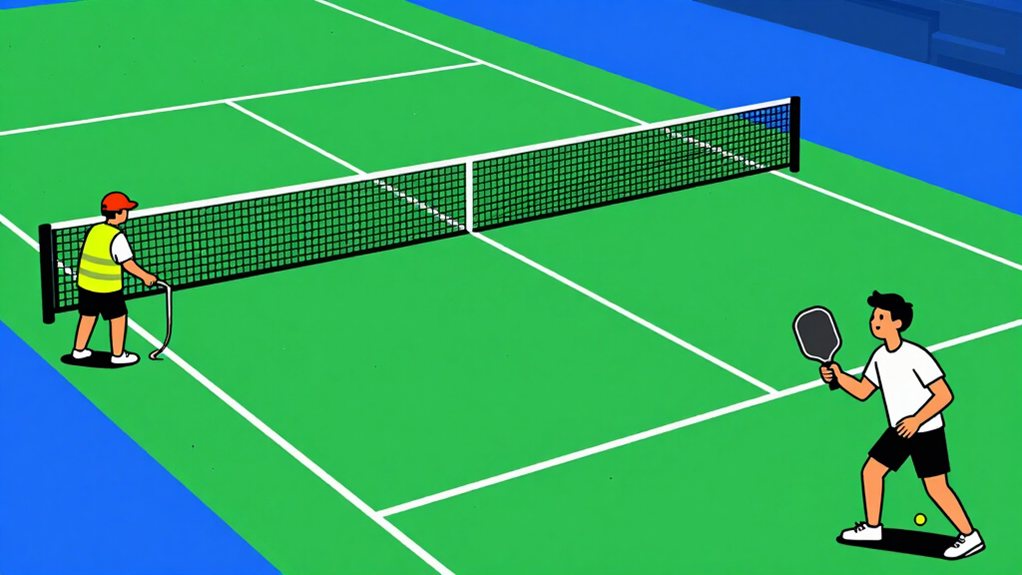
Looking to mark your pickleball lines on a tennis court? Follow these steps for accurate placement.
- Measure 3.5 feet inward from each tennis singles line to establish your sidelines. This creates the 20-foot pickleball width.
- Use the tennis service line as your baseline reference. The pickleball baseline sits just 1 foot beyond this line on each side.
- Mark your court boundaries using temporary markers like rubber strips or cones. Never use tape or paint without permission.
- Walk off distances when measuring. Seven heel-to-toe steps equal approximately 7 feet.
- Make sure all markers remain loose. Contact with a marker triggers a replay, so players can call a “let.”
Setting Up the Non-Volley Zone (The Kitchen) Correctly
The non-volley zone, commonly called the kitchen, extends 7 feet from the net on both sides of the court. You must measure this distance accurately to follow pickleball rules.
Stand at the net and walk 7 heel-to-toe steps toward each baseline. Place your markers at these points.
The kitchen width matches the court width. You can’t hit volleys while standing inside this zone during play. The line separates the kitchen from the playing area.
We mark the kitchen line parallel to the net. This zone applies to both service courts.
- Measure 7 feet from the net on each side using steps or tape
- Mark the kitchen line parallel to the net across the full court width
- The kitchen applies to both the right and left service courts
- You commit a fault if you volley while standing in the kitchen
- Players must keep both feet outside the kitchen when hitting volleys
Temporary vs Permanent Court Marking Solutions
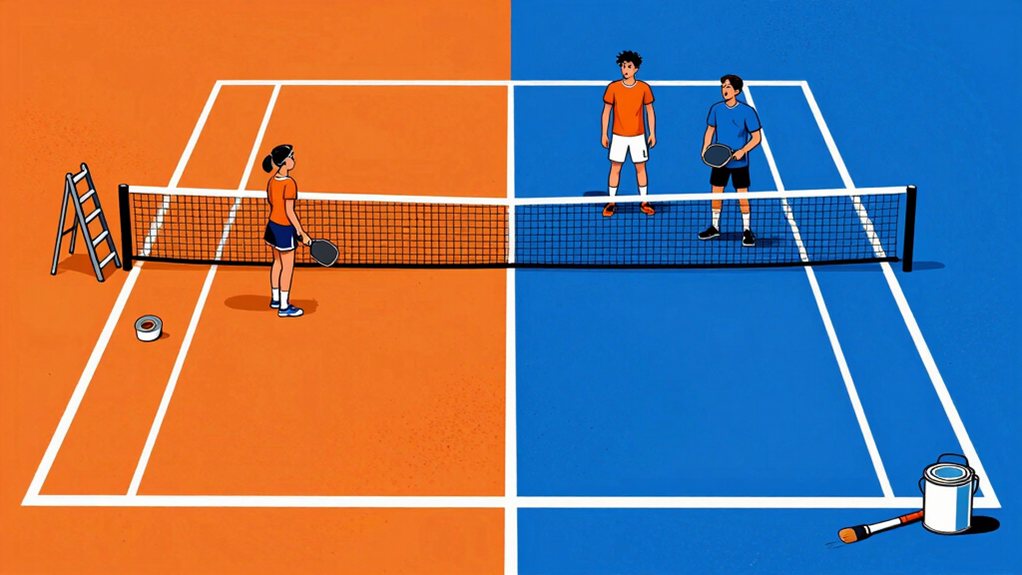
When setting up a pickleball court on tennis facilities, you must choose between temporary and permanent marking solutions.
Temporary options include:
- Cones, water bottles, or short rubber strips
- Chalk or tape (requires permission from owners)
- Walking off distances as quick measurements
Permanent solutions require:
- Paint application
- Professional installation
- Written approval from facility management
Temporary markers offer:
- No court damage
- Easy removal
- Flexibility for tennis and pickleball use
Permanent markings provide:
- Long-term durability
- Consistent gameplay appearance
- Professional setup
Consider your play frequency.
Consider how often you play; it determines whether temporary or permanent markings are the right fit.
If you play weekly, permanent markings save setup time.
If you play occasionally, temporary solutions protect the tennis court surface.
Always restore the net to its original height after play.
Verify local regulations before applying any permanent markings.
Game Rules When Using Non-Permanent Court Markers
Remember these game rules when you use non-permanent court markers for pickleball. Non-permanent markers require special handling during play.
You must replay any point if the ball touches a marker on the court.
This rule applies regardless of where the marker sits. Players can’t claim a fault when a ball hits a marker. The ball is considered “live” until it lands on the playing surface.
Establish a standing agreement with your opponents about marker contact before play begins. You give the benefit of the doubt to the ball being “in” on close line calls. Avoid stepping on or moving markers during active play.
- Replay the point immediately if the ball contacts any non-permanent marker on the court
- Don’t call a fault when a ball hits a marker; the point continues as a “let”
- Establish a pre-game rule that marker contact always results in a replay
- Give the benefit of the doubt to the ball being “in” on close line calls
- Keep markers secured and avoid moving them during active play to prevent interruptions
Pro Tips for Optimal Pickleball Experience on Tennis Courts
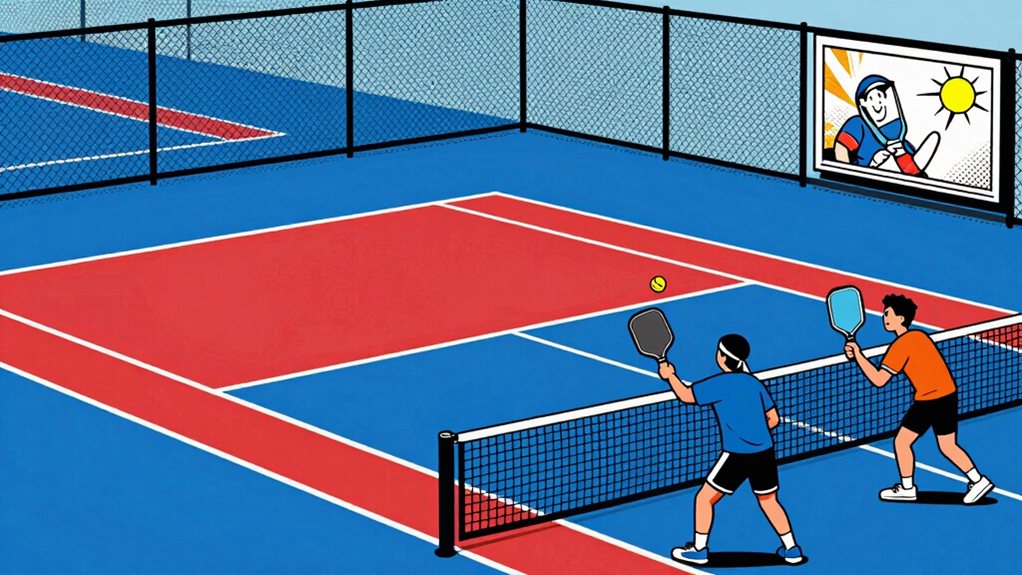
You can transform any tennis court into an ideal pickleball venue with these professional techniques.
- Measure boundaries precisely: use a 20-foot tape for the baseline, mark sidelines 3.5 feet inside tennis singles lines.
- Adjust net height: set the net to exactly 34 inches at center. Slide the strap sideways or remove it from the center hook temporarily.
- Use proper markers: apply bright rubber strips or tape for sidelines and baselines. Remove all markers after play.
- Establish clear rules: designate a player to call lets when balls contact boundary markers. Replay each point immediately.
- Position players strategically: maintain awareness because the reduced court size increases proximity between players.
- Bring portable nets: use two portable pickleball nets when converting a single tennis court into two full pickleball courts.
- Serve carefully: use underhand serves and respect the 20-foot baseline to prevent faults.
These steps make certain you enjoy regulation pickleball on any tennis surface.
Common Conversion Mistakes and How to Avoid Them
One common pitfall in tennis-to-pickleball conversion involves incorrect net height settings. You must lower the net to 34 inches at the center. Failure to adjust leads to illegal play. Use a tape measure or a marked ruler to confirm height.
Slide the net strap sideways if you can’t remove the pole. After play, restore the strap to the center.
- Using a 36-inch net instead of 34-inch net
- Ignoring the 7-foot kitchen line
- Skipping the sideline inward offset of 3.5 feet
- Leaving temporary markers loose on the court
- Not checking net strap tension after play
We also recommend verifying net height before each match. Use a portable net or adjust the strap each time you set up. Record any errors to improve future conversions promptly daily.
Why Tennis Courts Work Well for Pickleball Play
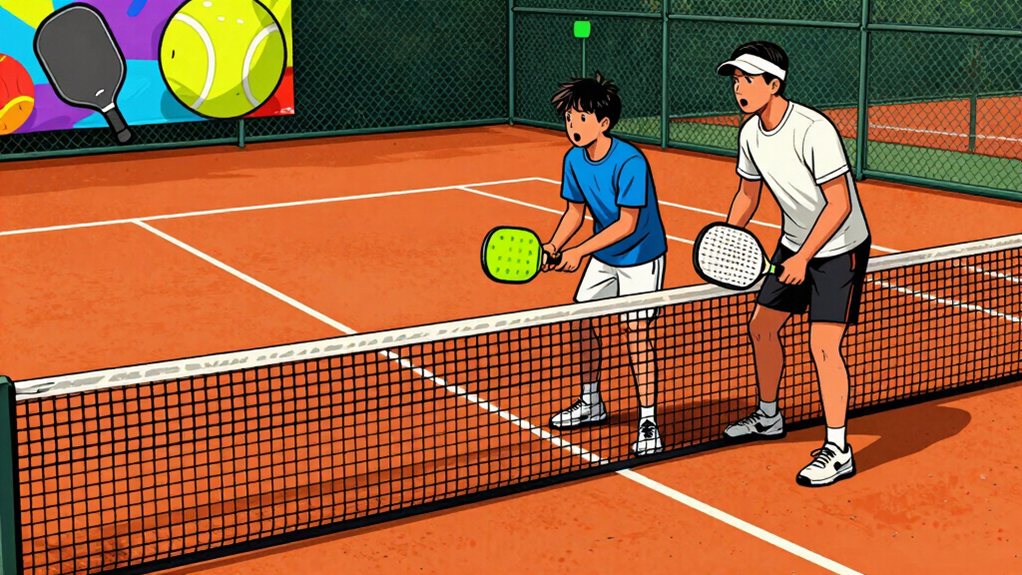
Tennis courts work well for pickleball because the dimensions align closely.
You can fit three to four pickleball courts on a single tennis court, and you lower the net from 36 inches to 34 inches.
The tennis service line measures 42 feet, which is only 1 foot short of the 44-foot pickleball baseline.
Court Size Compatibility
Because tennis courts provide generous dimensions, converting them for pickleball is simple and practical. You can fit three to four pickleball courts inside one standard tennis court. The standard pickleball court measures 20 feet wide by 44 feet long.
The standard pickleball court measures 20 feet wide by 44 feet long.
Tennis singles lines span 27 feet, so you mark sidelines 3.5 feet inside each line. The tennis service line sits just 1 foot short of the 44-foot pickleball baseline.
- A regulation pickleball court fits comfortably within tennis boundaries
- You use the existing tennis surface without modification
- Multiple games run simultaneously on one court
- The 27-foot tennis width accommodates the 20-foot pickleball width with room to spare
- Court markings use temporary markers that don’t damage the surface
Easy Net Adjustment
To adjust a tennis net, first make sure you have a tape measure and a 3,lb (1.4,kg) weight or a simple tension gauge. Follow these steps:
- Measure the current net height at the center. It should read 36 inches.
- Use the weight or gauge to apply downward pressure on the center strap.
- Lower the net until it reaches exactly 34 inches at the center.
- Use your tape measure to confirm the height before you play.
You can also slide the net strap to one side. This technique lowers the center without changing strap tension. It protects the net mechanism from damage.
After play, restore the strap to center position. This keeps original tension intact.
A portable pickleball net provides the correct 34,inch height automatically. It offers a quick setup option when you lack adjustment tools.
Space Efficiency
One standard tennis court provides enough space for three to four pickleball courts. This efficiency makes tennis facilities ideal for pickleball conversion. You can maximize your playing area without building new courts.
- A single tennis court fits multiple pickleball layouts
- You serve more players in the same footprint
- Facility managers accommodate increased demand easily
- You reduce costs by using existing infrastructure
- Groups schedule games without conflicts
The tennis service line sits 42 feet from the net. Pickleball requires 44 feet. You simply use the existing baseline with a one-foot adjustment.
This minor difference doesn’t affect gameplay. Your players enjoy full-court action immediately. You transform one space into several functional courts.
Frequently Asked Questions
How Much Does It Cost to Convert a Tennis Court for Pickleball?
Converting your tennis court costs $500-$2,500. Basic conversion using portable nets and removable tape runs $500-$800, while permanent line painting adds $1,000-$2,000. Most players opt for affordable temporary markers to avoid damaging court surfaces.
Do I Need Permission From the Court Owner to Mark Lines?
Absolutely, you must get explicit permission before using chalk, paint, or tape on any court surface! Temporary markers like cones or rubber strips work without approval, but permanent markings absolutely demand the owner’s green light.
Can I Use Tennis Balls Instead of Pickleball Balls?
No, you cannot use tennis balls instead of pickleball balls. Tennis balls bounce higher and travel faster, creating unsafe gameplay. Pickleball balls have specific bounce properties and holes designed for the sport, thereby ensuring proper gameplay and safety.
How Many Pickleball Courts Can Fit on One Tennis Court?
Picture yourself stepping onto a tennis court, you can fit three to four pickleball courts within that space. Mark your sidelines 3.5 feet inside the singles lines, and you’ll maximize your playing area efficiently today.
Will Playing Pickleball Damage the Tennis Court Surface?
Playing pickleball causes minimal damage to a tennis court surface, especially when you use temporary markers like rubber strips instead of tape or paint. Portable pickleball nets don’t damage surfaces either. You simply remove all equipment after play to leave the court untouched.
Final Thoughts
Converting a tennis court to pickleball requires three main adjustments. First, lower the net to 34 inches at center. Second, mark the court lines with temporary tape or paint. Third, establish the non-volley zone 7 feet from the net on both sides. These changes create a playable pickleball space. Follow these steps, and you will enjoy the game immediately. We make sure the court’s functionality through precise modifications.