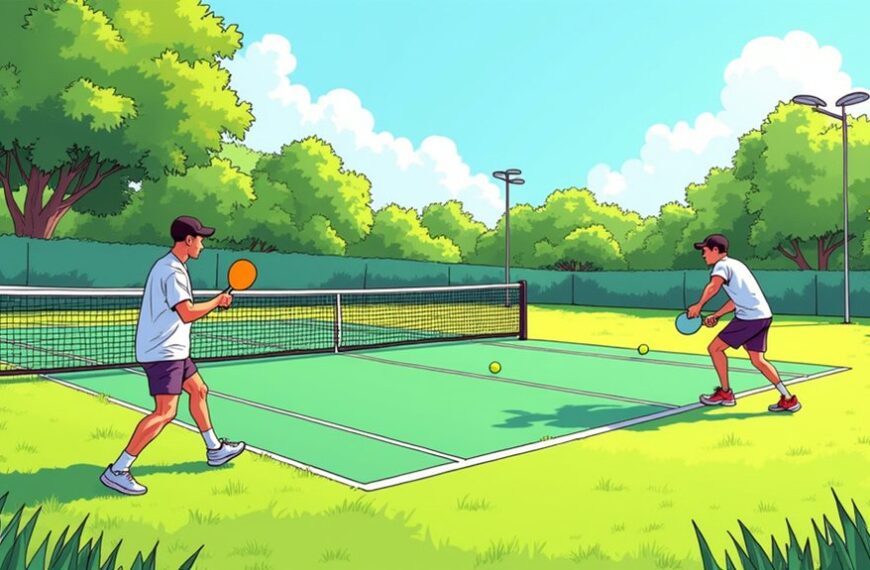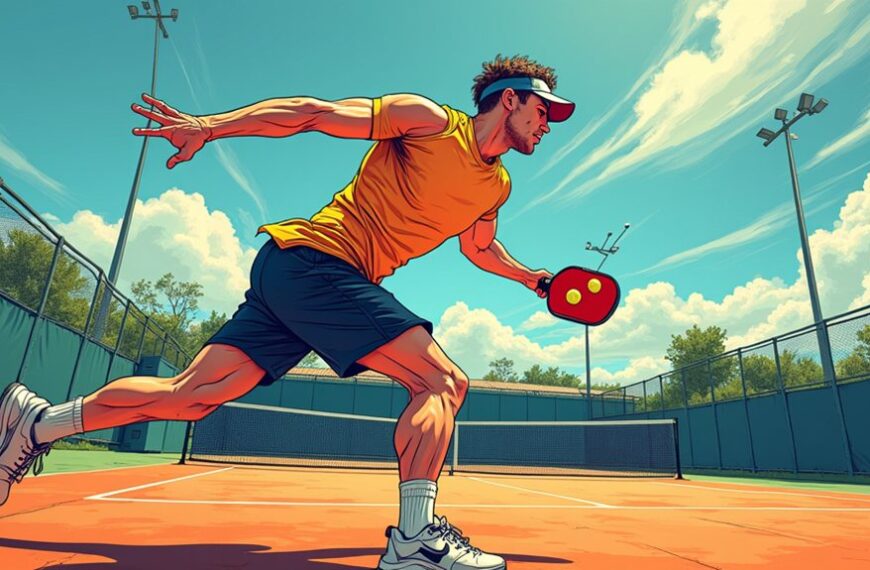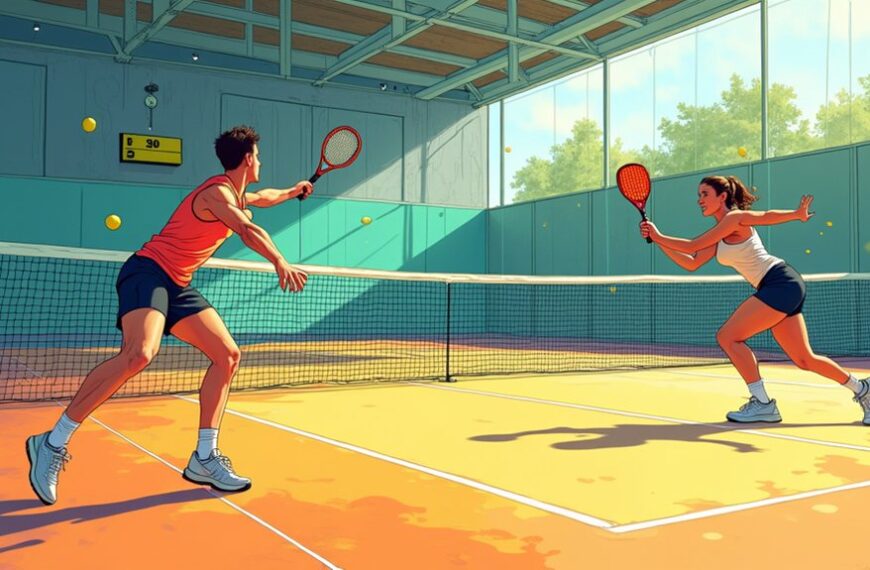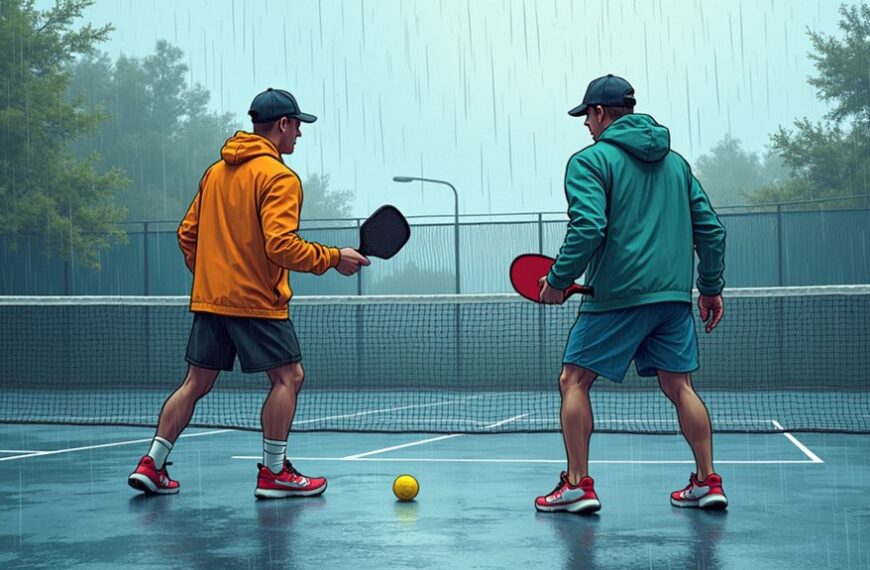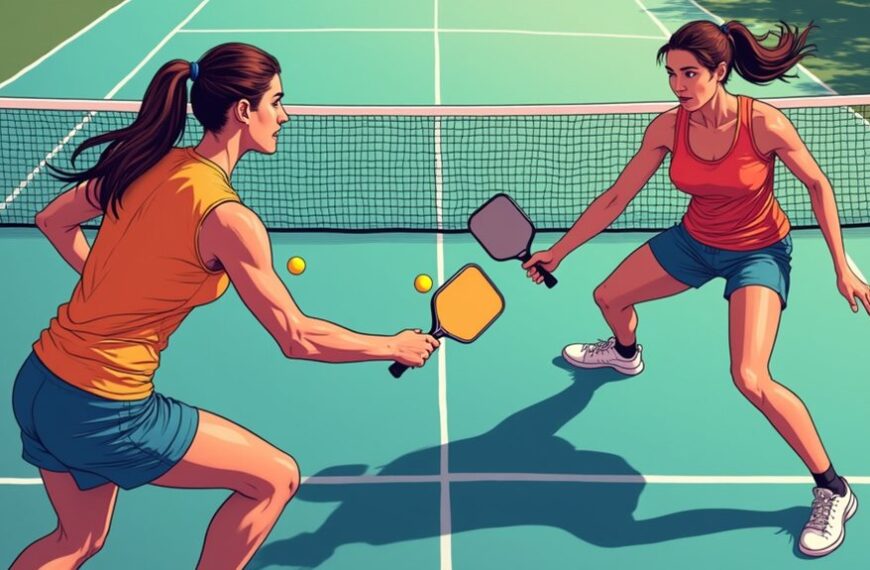
Get low immediately when a lob heads your way. Bend your knees deeply, keeping weight balanced between both feet. Shift your weight onto the pivot foot and turn ninety degrees to the net. Plant the pivot foot firmly and slide your other foot sideways to create a wide, stable base.
Keep your feet shoulder-width apart and stay on the balls of your feet. Place your paddle under the ball’s trajectory. Point paddle face toward the sky at a slight angle. Track the ball continuously.
Lift through the ball using your legs and core, not your arms. Contact the ball at its bottom arc point. Use steady, vertical follow-through. For midcourt lobs at shoulder height or lower, attack in the air.
Let deep lobs bounce first when they rise above your paddle’s reach. Pick your return: overhead, drop shot, or lob back. After your shot, reset quickly, moving laterally toward the center rather than retreating. There’s more to learn about mastering this defensive skill.
Get Low and Open Your Stance First
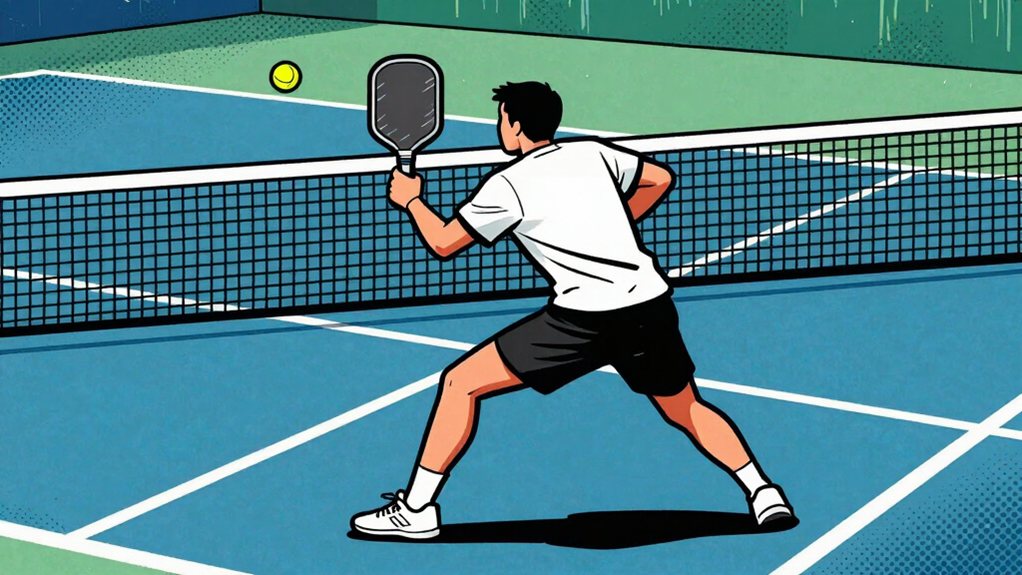
When a lob comes your way, you must get low and open your stance immediately. In defensive lob pickleball, lowering your center of gravity is the first survival step. Here’s how to do it:
When a lob heads your way, get low, open your stance, and lower your center of gravity – first defensive move.
- Bend your knees deeply, as if sitting in a chair
- Spread your feet shoulder-width apart
- Turn your toes slightly outward
- Keep your weight balanced between both feet
- Hold your paddle up and ready in front of your body
- Look directly at the ball and track its path
- Stay on the balls of your feet, not your heels
- Prepare to shuffle in any direction
This low, open stance gives you the mobility needed for effective defensive play. The pickleball lob technique starts with this position.
You must stay low throughout the entire return. Avoid standing up straight as the ball descends.
When you master how to lob in pickleball, you buy yourself time to reset and recover.

Comfort & Efficiency: The patented hexagonal design expands the contact surface between hand and handle, increasing grip efficiency by up to 14%. It allows a secure hold with less effort and tension, helping players maintain control and comfort during every shot.

Premium Performance: The leading maker of performance pickleball paddles, balls, and pickleball accessories, ONIX provides players, including national tournament competitors, with the best possible pickleball racquets and balls for their game
Set Your Feet Before Paddle Contact
Before you make contact with the ball, set your feet in the proper position. This establishes your defensive foundation. Shift your weight onto your pivot foot. Turn your body ninety degrees to the net.
Your shoulders should square toward your opponent.
- Plant your pivot foot firmly on the ground.
- Slide your other foot sideways to create a wide base.
- Bend your knees slightly for stability.
- Keep your feet shoulder-width apart.
This foot position enables quick lateral movement. It prepares your body for the upward lifting motion. Your legs generate the power for the lob.
You maintain balance throughout the shot. The set position allows controlled weight transfer from your legs to your paddle. Proper footwork prevents rushed decisions.
You can then execute the defensive lob with confidence and precision.
Get Your Paddle Under the Ball’s Arc
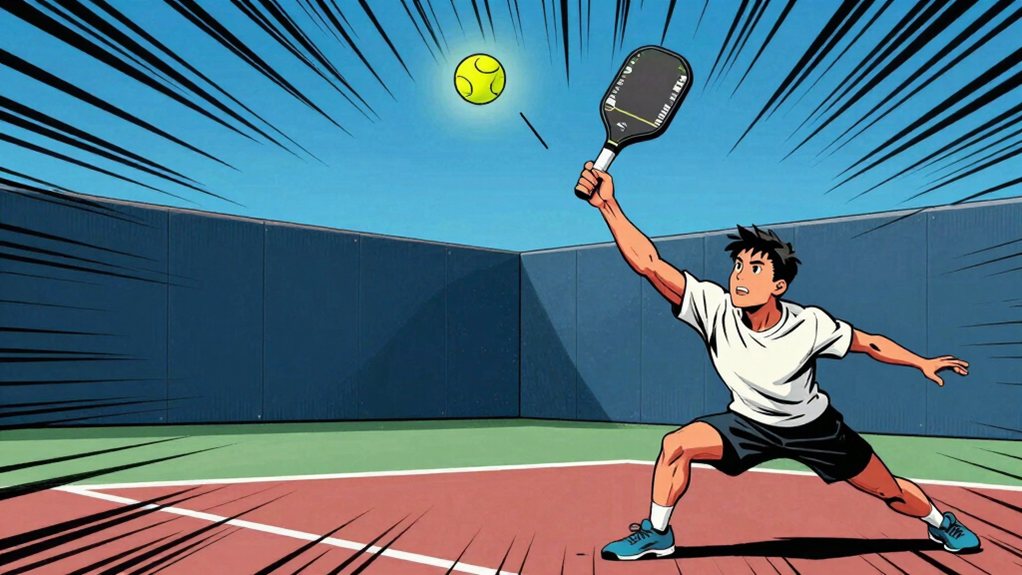
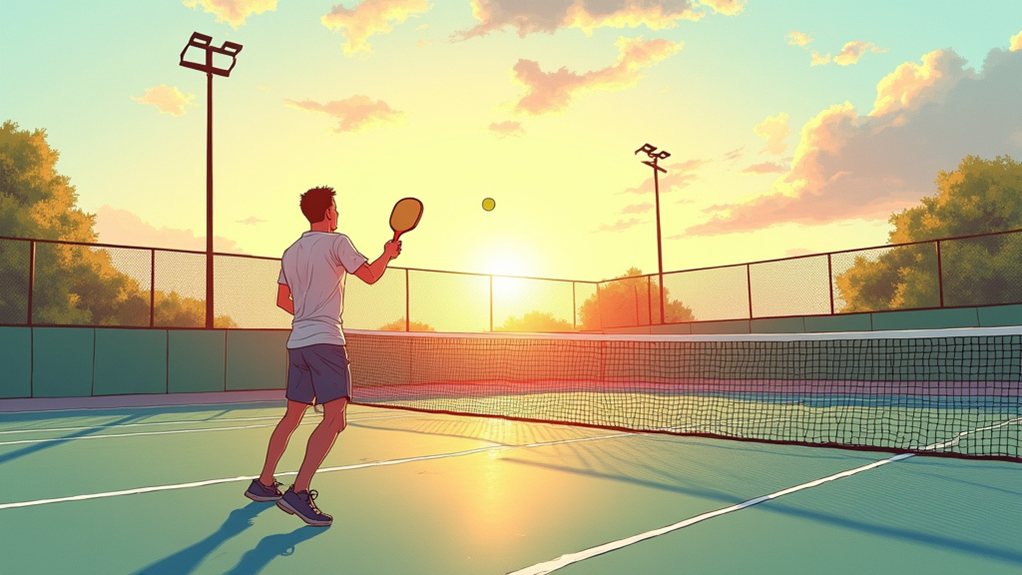
As the ball arcs overhead, you must get your paddle beneath its trajectory to execute a defensive lob. Your paddle face points toward the sky at a slight angle. This positioning lets you lift the ball upward instead of slapping it forward. We position our non-dominant foot to support lateral movement.
The paddle awaits beneath the ball’s descending path. We keep our eyes on the ball throughout its arc. Our wrist stays relaxed but controlled. The paddle remains below the contact point until the ball arrives.
Body rotation creates a stable base for paddle positioning. Weight shifts onto the pivot foot for balance. Knees bend slightly to enable quick reaction. The open paddle face points skyward. We prepare early rather than rushing at contact.
Lift Up Through the Ball With Controlled Motion
Lift through the ball using your legs and core rather than your arm. This creates controlled lift without overpowering the ball. Your knees stay bent as you rise. You transfer weight onto your dominant leg during the upward motion.
- Keep your paddle face slightly open at contact.
- Contact the ball at its bottom arc point.
- Use a steady, vertical follow-through.
- Avoid wrist flicking or arm-only swings.
Your legs generate the power. Your core directs the lift. The result is a high, floating lob that keeps you safe in defense.
Practice this lift motion until it becomes automatic. You’ll feel balanced and in control with each defensive recovery.
When to Attack Midcourt Lobs in the Air?
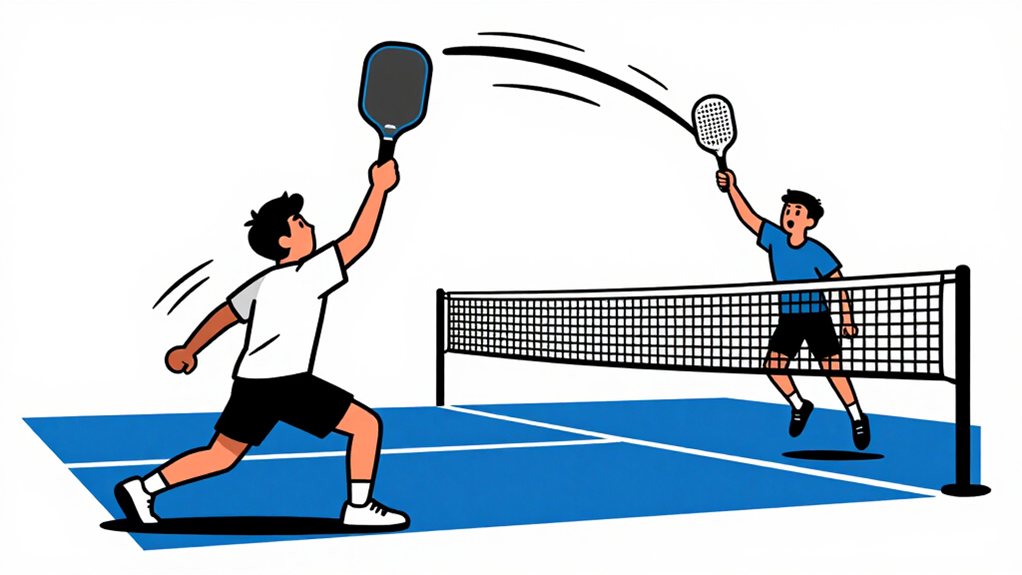
You can attack midcourt lobs in the air when the ball sits at shoulder height or lower and lands short of the back line. This gives you the best chance to hit a controlled winner or set up your next shot. Your paddle face stays open as you brush up and through the ball.
| Ball Position | Attack Option |
|---|---|
| Shoulder | Overhead smash |
| Chest | Punch volley |
| Waist | High volley |
| Below | Defensive reset |
You want to hit down into the court. You aim for your opponent’s feet or the middle. Your body rotates through the shot. You follow through toward your target.
This approach limits their options and creates openings for your next play. You keep your eyes on the ball throughout the entire swing.
When to Let Deep Lobs Bounce First?
A deep lob forces you to make a decision. You let the ball bounce when the lob lands deep in your court and rises above your paddle reach.
Use these cues to decide:
- Height check: if the ball passes your shoulder height before it starts to descend, you can’t attack it.
- Depth check: if the ball lands past the non-volley zone line and you must move more than two steps back, a bounce is safer.
- Timing check: if you’ve got to rush and lose your balance, wait for the bounce.
When you let it bounce, open your stance, shift weight to your pivot foot, and prepare a return. This gives you time to reset and avoid being caught out of position.

【Say Goodbye to a Heavy Paddle Head】Designed for pickleball paddle end caps, these weights shift the balance point toward your hand, neutralizing head-heavy paddles for faster, more responsive swings with precise control.

2.8g Precision Tuning Weights (6 Pack)-Each clip weighs exactly 2.8g for balanced power and control. 6-pack delivers 16.8g total adjustable weight. Add to the head for more pop, throat for better control, or corners to expand your sweet spot.

【Pickleball Weights kit for Custom Tuning】This pickleball paddle weights kit includes 10 pcs 3g tungsten tape for pickleball paddles and 6g/9g/12g 27mm weighted end cap coins. Tungsten tape balance kit give players a complete paddle weight system to adjust balance, control, power, and stability.
Pick Your Return: Overhead, Drop, or Lob Back
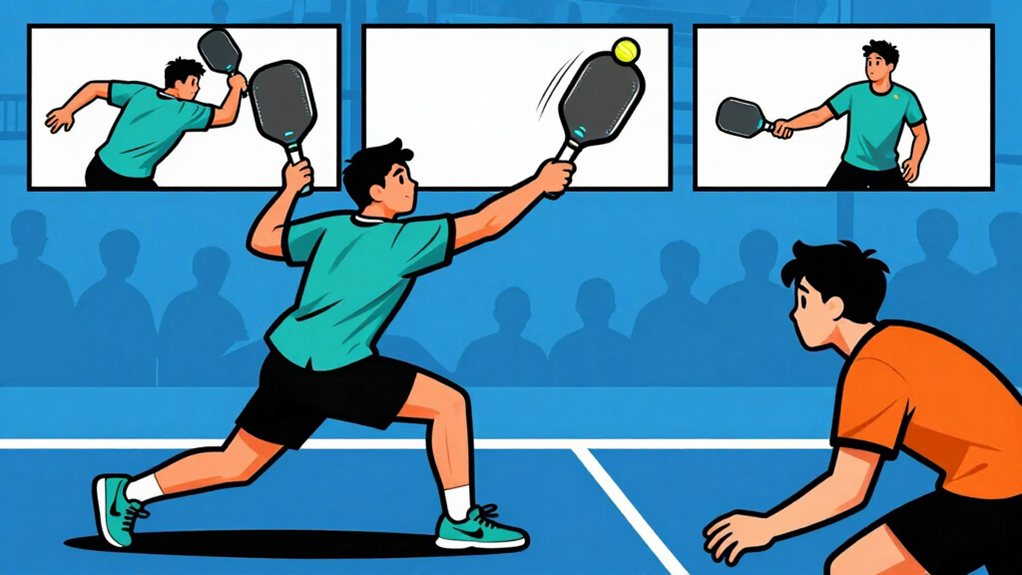
After you read the lob, choose your return.
We’ve three main options: overhead, drop shot, or lob back.
Select the one that matches the ball’s depth and your position. Just as a low latency wifi mesh router ensures seamless performance across every corner of your network, selecting the right return ensures you stay connected to the rally without gaps in your coverage.
Overhead Decision
Overhead Decision
When facing a high lob near the baseline, you must quickly decide between three return options. The overhead offers the highest reward when executed properly.
You should attempt an overhead return when the ball meets these conditions: it lands inside the court, it sits above net height, and you have clear recovery space behind you.
An overhead hit well and inside the court nearly always wins the point or forces a weak response.
Your execution checklist:
- Rotate your body 90 degrees to the net
- Position your paddle beneath the ball with an open face
- Contact the ball at its bottom
- Transfer weight onto your pivot foot
- Follow through vertically upward
Commit fully to the shot.
Hesitation creates floating returns that opponents exploit.
A clean overhead eliminates the opponent’s attacking opportunity and shifts defensive momentum to your side.
Drop Or Lob
If the overhead isn’t available, you must choose between a drop shot or a lob return to stay in the point. Your decision depends on where the ball lands and how much time you have to move.
- Hit a drop shot when you’re close to the net. Aim for the kitchen line. The ball bounces twice before reaching the nvz. This shot pulls opponents forward.
- Hit a lob return when you’re deep in court. The ball travels high and lands near the baseline. It gives you time to recover. This shot pushes opponents back.
We choose based on spacing. We pick the shot that minimizes damage. We select the return that keeps us in the rally.
Reset Your Position After the Defensive Shot
Once you’ve completed the defensive lob, resetting your position becomes your next priority. After executing your defensive shot, you must move quickly to recover your defensive stance. The goal is to get back to a balanced position that prepares you for the next shot your opponent makes.
Your immediate focus should center on three key actions:
- Get your feet set and establish a wide, stable base
- Return your paddle to a ready position in front of your body
- Read your opponent’s body language and anticipate their next move
Move laterally toward the center of the court rather than retreating backward. This positioning keeps you ready to respond to either a drop shot or an attack. Your weight should settle onto your pivot foot as you await the incoming ball.
Drills to Make Lob Defense Feel Natural
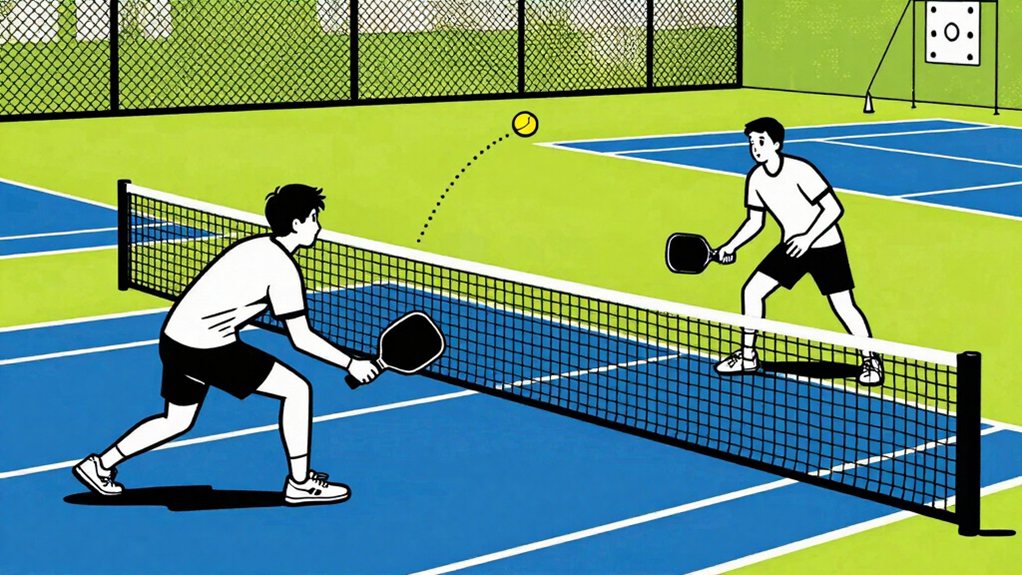
Start with drill setup basics: 1. Place three cones along the baseline, 2. Stand six feet behind the first cone, 3. Take a ready stance. Then practice pivot movement drills: 1. Pivot on your non‑dominant foot, 2. Shuffle laterally to the next cone, 3. Repeat ten times on each side. Use these two drills to make lob defense feel natural.
Drill Setup Basics
Effective lob defense drills build muscle memory through repetitive, game-situation practice.
You need a partner who can consistently hit high lobs to your backhand and forehand sides. Set up cones at the non-volley zone line to mark your target recovery position.
Start with your partner feeding ten lobs to each side while you practice the ready position. Focus on getting your paddle up early and tracking the ball with your eyes.
Gradually increase the speed and depth of lobs as your reaction time improves. Record your sessions to identify patterns in your footwork and positioning.
Setup requirements:
- Use regulation balls for realistic bounce and speed
- Mark a target zone three feet inside the baseline
- Practice for fifteen minutes per side before switching roles
Pivot Movement Drills
Building on the drill setup basics, you’ll now practice pivot movement drills that make lob defense feel natural. These drills develop muscle memory for the pivot footwork crucial to defensive lob survival.
Perform each drill in sets of ten repetitions.
Drill 1: Shadow Pivot****
- Stand in ready position at the baseline.
- Imagine a lob approaches your backhand side.
- Shift weight onto your non-dominant foot.
- Pivot 90 degrees, rotating your shoulders away from the net.
- Land with your dominant leg swung back.
- Hold the stance for two seconds.
- Return to ready position.
- Repeat on the opposite side.
Drill 2: Lateral Shuffle to Pivot****
- Start in the center of the court.
- Shuffle three steps to your right.
- Transfer weight onto your pivot foot.
- Pivot and square your shoulders to the net.
- Step forward into your defensive stance.
- Repeat moving left, alternating directions.
Focus on fluid weight transfer and complete rotation with each repetition.
Frequently Asked Questions
What Grip Should I Use for a Defensive Lob Return?
Use a continental grip or an eastern backhand grip for your defensive lob return. These grips give you the control you need to lift the ball and keep it in play effectively.
How Can I Improve My Reaction Time When Defending Lobs?
One anecdote: Imagine a goalie reading a soccer ball’s spin, that’s your paddle reading a lob’s arc. You improve reaction time by drilling shadow swings, tracking tennis balls tossed at you, and anticipating the bounce pattern.
What Mental Strategies Help Me Stay Calm During Lob Rallies?
Focus on breathing steadily, you control your responses, not the ball. Trust your positioning and paddle preparation. Acknowledge each rally as practice, not threat. Stay present and anticipate calmly. You’ve trained for this moment.
Are There Specific Shoes That Help With Quick Lateral Movement for Lob Defense?
Specific supportive shoes stabilize your side slides. Seek sturdy sole grip, flexible forefoot zones, and reinforced ankle support. Court-specific footwear optimizes quick directional shifts during defensive play.
Can I Practice Defensive Lob Techniques Solo, and if So, How?
Yes, you can practice defensive lobs solo. Set up a ball machine or toss balls high yourself. Practice opening your body, getting beneath the ball, and lifting it with upward follow-through while tracking the trajectory.
Final Thoughts
Use your defensive lob to buy time and force opponents back. You open your stance, get low, and place your paddle under the ball. You lift up with a controlled motion, driving the ball deep into the court.
Practice these five steps until they feel natural. Will you transform every hard-driven attack into a strategic opportunity? Keep your feet set, stay patient, reset your position after every lob, and successfully dominate the baseline with confidence.

SILENT SERVE: These quiet foam pickleballs are designed for premium performance without the noise, so players can keep the game going wherever and whenever they play

WEIGHTED HEAVIER – Flies straighter in extreme outdoor conditions with True Flight️ Technology

【Reaction Training for Fast Hands】React Mini Pickleball Balls are designed to boost hand speed, paddle control, and focus. Ideal for pre-game warm-ups, partner drills, and solo wall training to sharpen reflexes and reaction time on court.