

DUPR (Dynamic Universal Pickleball Rating) is a rating system from 2.000 to 8.000 that measures your skill level. Your rating updates after each recorded match based on how you perform against expectations.
Beating lower-rated players lowers your rating if you don’t win decisively. Losing to higher-rated players can raise your rating if you exceed expectations. The algorithm uses your last 30 singles matches or 60 doubles matches.
You can track your rating through the DUPR app or website. Keeping playing will help you understand how to improve your rating.
What Is DUPR and Why It Matters for Pickleball
DUPR stands for Dynamic Universal Pickleball Rating, and it’s the most accurate rating system in pickleball today.
The system was created in 2021 by Steve Kuhn, the founder of Major League Pickleball. It operates as a private technology company.
You can access your rating through their website or mobile app.
Major organizations use DUPR as their official rating system, including:
- Professional Pickleball Association (PPA Tour)
- Major League Pickleball
All players receive ratings on the same scale. This scale ranges from 2.000 to 8.000.
All players receive ratings on the same scale, ranging from 2.000 to 8.000.
Age, gender, and location don’t matter. Beginners start near 2.000. Professional players reach nearly 8.000.
Ben Johns, the top-ranked player, holds a 7.131 rating.
The system gives you a clear picture of your skill level. It helps tournament directors place you in the correct division. It helps clubs match you with similar players.
You can trust the rating because it uses data from every match you play.
Most pickleball camps use your DUPR rating to determine camp placement and skill grouping before you register.
How Does the DUPR Rating Algorithm Work?
Now that you know what DUPR is, let’s look at how the system calculates your rating.
- After each recorded match, the algorithm updates your rating in real time.
- It compares the actual match score to the expected score based on the combined team ratings.
- Your rating moves up if you outperform the expected score, or down if you underperform.
- Club and tournament results carry more weight than recreational games.
- The system looks at your last 30 singles matches or 60 doubles matches to determine the rating.
- Recent matches have greater influence than older ones, and more matches create a stable rating.
- The algorithm uses a modified Elo system, adjusting your rating by 0.001 increments after each match.
- View your rating easily in the DUPR app.
What Do the DUPR Rating Numbers Mean?
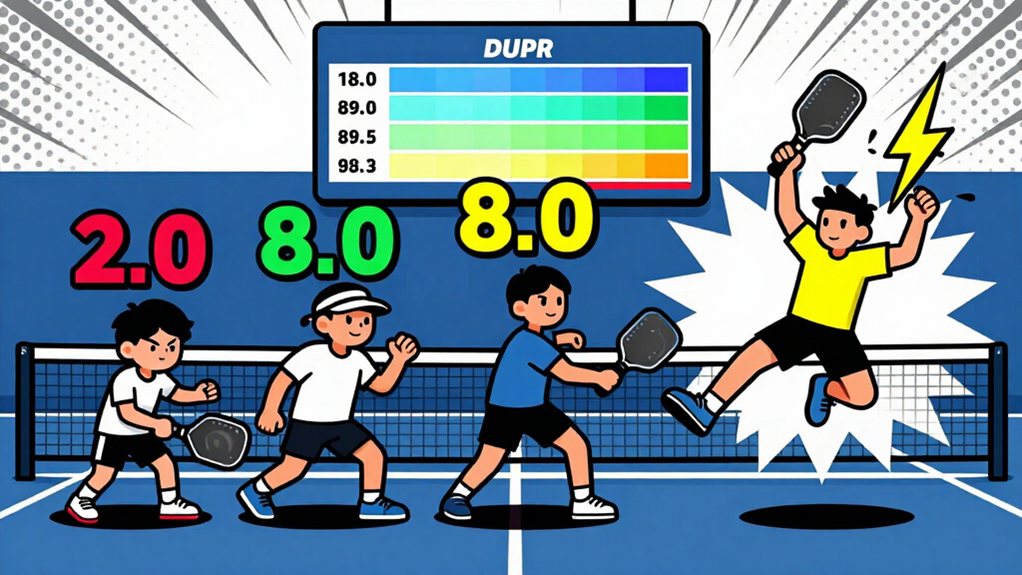
The DUPR rating scale runs from 2.000 to 8.000, with 2.000 representing beginners and 8.000 representing professional-level play.
You receive a rating after your first match, and the system updates it in real time as you play more games.
Ben Johns, the current No. 1 player, holds a rating of 7.131, which shows you where professional players fall on the scale.
Rating Scale Explained
On the DUPR scale, ratings span from 2.000 to 8.000, giving you a clear picture of where you stand as a player.
- The rating runs in 0.001 increments, so you’ll see small changes after each match.
- You receive one rating for singles play and another for doubles play; each reflects the last 30 singles or 60 doubles matches.
- The system counts only your most recent eligible results; older matches drop off after the limit is reached.
- Tournament and league results carry more weight than self-reported rec games.
- Your rating can move up or down after a single match if you exceed or fall below expected performance.
- A rating can be assigned by a DUPR Coach if you have no matches, letting you join events.
Skill Level Meaning
Your DUPR rating places you on a clear skill hierarchy from 2.000 (beginner) to 8.000 (professional). A low number shows you’re still learning the game, while a high number shows you can compete at the professional level. Your rating updates after every recorded match, reflecting how you perform against opponents of different skill levels.
Use the list below to quickly understand what each numeric range tells you about your game.
- 2.0–3.0: You’re new, focus on basic serves and dinks.
- 3.0–4.0: You play recreationally, can keep rallies but lack power.
- 4.0–5.0: You compete in local events, use strategy and placement.
- 5.0–6.0: You win tournaments, possess strong shots and stamina.
- 6.0–8.0: You match professional players, compete on national tours.
Review your rating often for growth.
Numeric Range Breakdown
Understanding your DUPR number tells you exactly where you stand in the pickleball world. The scale runs from 2.000 to 8.000. Every player uses the same range regardless of age or gender.
Here is the numeric breakdown:
- 2.000–2.999: You’re a beginner. You’re learning the basics. You struggle with consistent serves and returns.
- 3.000–3.999: You’re a recreational player. You understand basic rules. You can maintain short rallies.
- 4.000–4.999: You’re an intermediate player. You have developed strategy. You can hit with some power.
- 5.000–5.999: You’re an advanced player. You compete in local tournaments. You handle speed reasonably well.
- 6.000–6.999: You’re an elite amateur. You play in regional competitions. You possess strong technical skills.
- 7.000–8.000: You’re a professional-level player. Ben Johns currently holds the top rating at 7.131.
The DUPR system calculates ratings in 0.001 increments for precision. Your rating updates after each match.
The algorithm considers opponent skill and match outcome to determine your new number.
Which Matches Count Toward Your DUPR Rating?
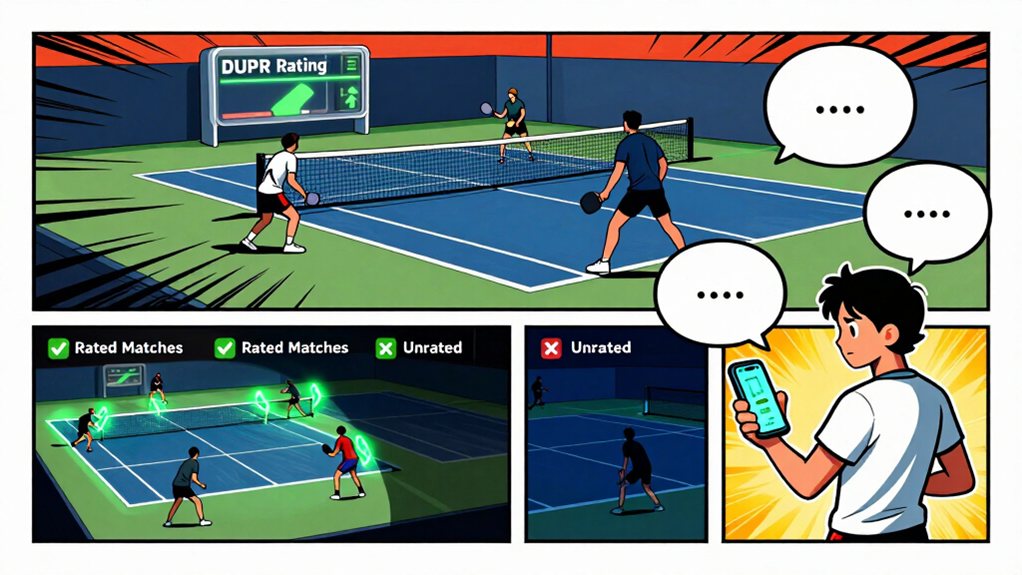
You might wonder which matches count toward your DUPR rating. We include self-reported rec play, league matches, and tournament results from both sanctioned and unsanctioned events.
Club and tournament matches carry more weight than recreational games when we calculate your rating.
Eligible Match Types
When determining your DUPR rating, the system analyzes match results from multiple play environments. You can log matches from five main sources:
- Self-reported recreational play
- League matches
- Unsanctioned tournaments
- Sanctioned tournament play
- Club sessions
Each match you record contributes to your rating calculation. The system uses your last 30 singles matches or 60 doubles matches to determine your current rating.
You only need one match result to receive an initial DUPR rating. If your playing partner has an established rating, your matches connect and generate a rating for you retroactively. Verified play from sanctioned events creates the most accurate rating snapshot.
You can self-report results through the DUPR app or website at any time.
Match Weight Factors
Now that you know which matches count as eligible, it’s important to understand that not all matches carry the same weight in your DUPR calculation.
Your rating uses three key weight factors:
- Match type, Tournament and league matches influence your rating more than self-posted recreational games. Verified results from sanctioned events carry the highest weight.
- Match recency: Your most recent 30 singles or 60 doubles matches affect your rating most. Older matches gradually lose impact.
- Performance vs. expectations: The algorithm predicts your expected result based on opponent ratings. Outperforming expectations always raises your rating. Underperforming always lowers it.
Beating a higher-rated opponent helps more. Losing to a lower-rated opponent hurts more.
Your rating adjusts in real time after each eligible match.
Valid Match Sources
Understanding which matches count toward your DUPR rating is essential for tracking your progress accurately. DUPR accepts results from five approved sources.
- Sanctioned tournament matches
- League matches organized by clubs or associations
- Club match sessions recorded by directors
- Self-reported recreational games
- Matches verified through the DUPR app
Only results from these sources affect your rating; other games are ignored. You’ve gotta report each result through the DUPR app or your club director. Your rating updates after each recorded match.
The algorithm looks at your last 30 singles or 60 doubles matches. Tournament and league matches carry more weight than self-reported games. Verified results provide the most stable snapshot.
You can track all eligible matches in the DUPR app. Report matches promptly for accurate rating.
Why Can My DUPR Rating Change After a Win or Loss?
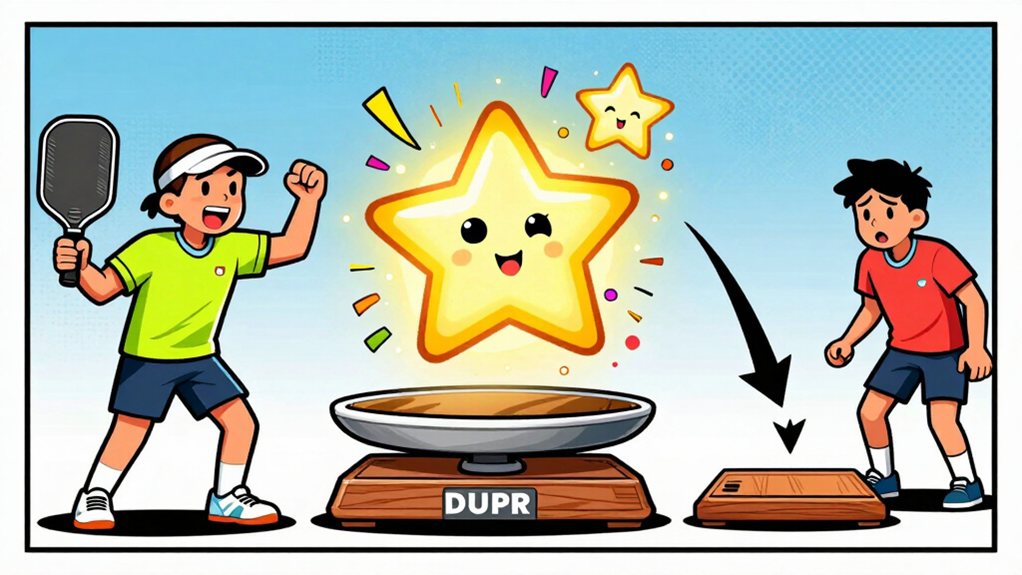
Your DUPR rating can change even after a win or loss because the system measures how you perform against expectations, not solely whether you win or lose.
The algorithm calculates an expected score based on your rating and your opponent’s rating. If you beat a lower-rated player, the system expects a dominant win. A close match means you underperform expectations.
Your rating drops even though you won. Conversely, you can lose to a higher-rated player and gain points. The system sees you performed above expectations.
Key factors affecting your rating:
- Expected score vs actual score determines direction
- Result type assigns weight: tournament matches carry more influence than rec play
- Recent matches have greater influence on adjustments
- More matches played increase rating stability
- In doubles, both partners move directionally together
Your rating can increase with a loss if you outperform expectations. Your rating can decrease with a win if you underperform.
How Do I Get Started With DUPR and Track My Rating?
Getting started with DUPR is simple and free. Visit mydupr.com or download the iOS or Android app to create your free account.
You can log matches manually or connect with clubs and tournaments that submit results automatically. Your rating updates after each recorded match based on the algorithm we explained earlier.
The system tracks your last 30 singles or 60 doubles matches to determine your current rating.
- Create your free account at mydupr.com or download the app
- Self-report your recreational matches or connect with verified venues
- Play in club sessions, leagues, or tournaments for stronger ratings
- Check your rating after each match to see how it changes
- Use the app to find players at your similar skill level for competitive play
Frequently Asked Questions
Can I Have Separate Ratings for Singles and Doubles?
Yes, DUPR generates separate ratings for singles and doubles based on your match history. Track your results independently in each format to establish different ratings. Play matches in both to build your ratings.
How Do I Dispute or Adjust an Inaccurate DUPR Rating?
Play more matches to help the algorithm adjust your rating naturally. The system weighs recent performance heavily, so consistent strong play will gradually correct any inaccuracies. Contact DUPR support through the app for specific dispute assistance.
Does DUPR Rating Affect Tournament Seeding or Entry?
Absolutely, your DUPR rating can determine your tournament fate! Many events use it for seeding, division placement, and entry requirements. Higher ratings open elite flights, while accurate ratings make certain you’re competing against equally skilled opponents.
Are DUPR Ratings Required to Play in Official Tournaments?
Most sanctioned tournaments require you to have a DUPR rating for seeding purposes, though some allow you to play without one initially. You’ll need to establish your rating before competing in rated divisions officially.
Do Pro Players Have Their DUPR Rating Visible to the Public?
Yes, pro players’ DUPR ratings are publicly visible on the DUPR app and website. Professional players like Ben Johns display their ratings, which are consistently updated after each verified tournament match throughout the entire season.
Final Thoughts
Now you understand DUPR, the dynamic rating system tracking your pickleball performance. Your rating typically falls between 2.0 and 8.0. Most recreational players land between 3.0 and 5.5. Higher numbers mean greater skill. Your rating updates after each match. Check your DUPR weekly. Play consistently to establish an accurate rating. Use your rating to find fair games. Measure your improvement over time. Your DUPR is a compass, pointing you toward your true skill level.