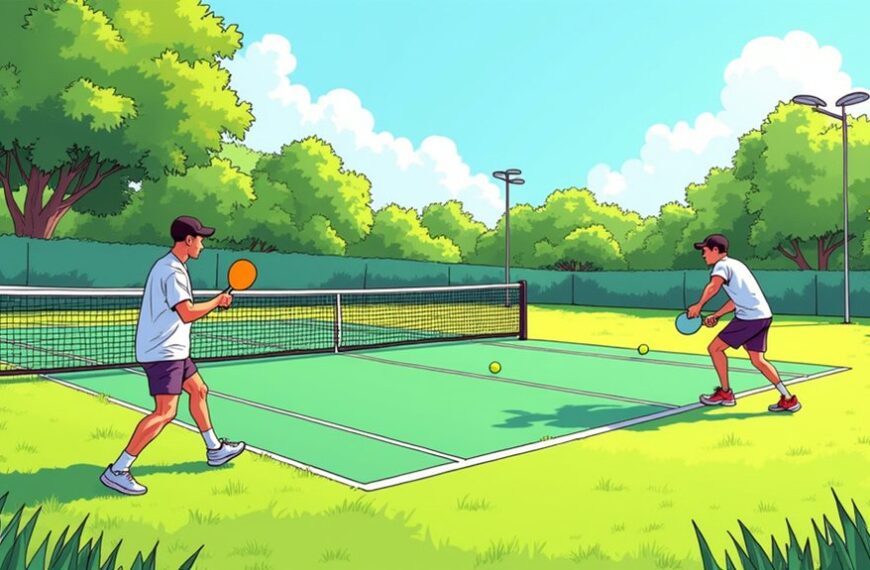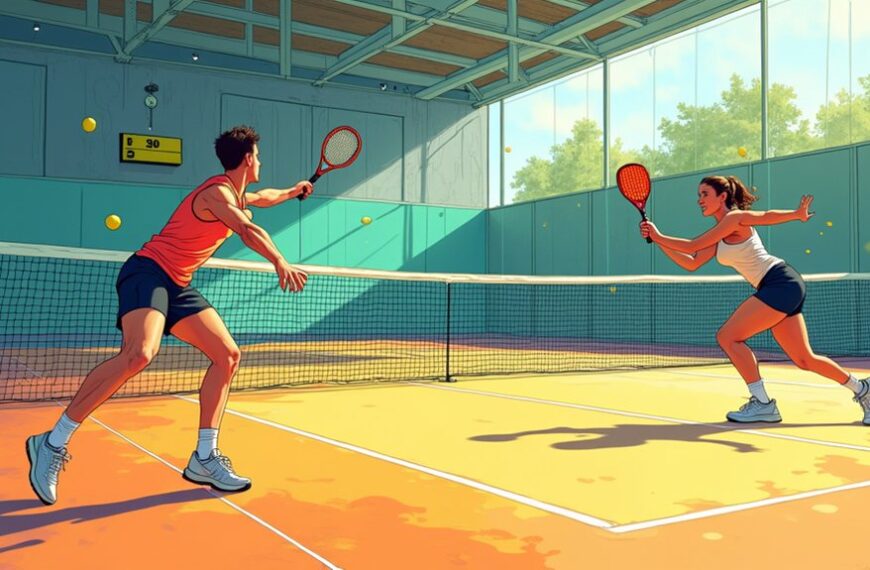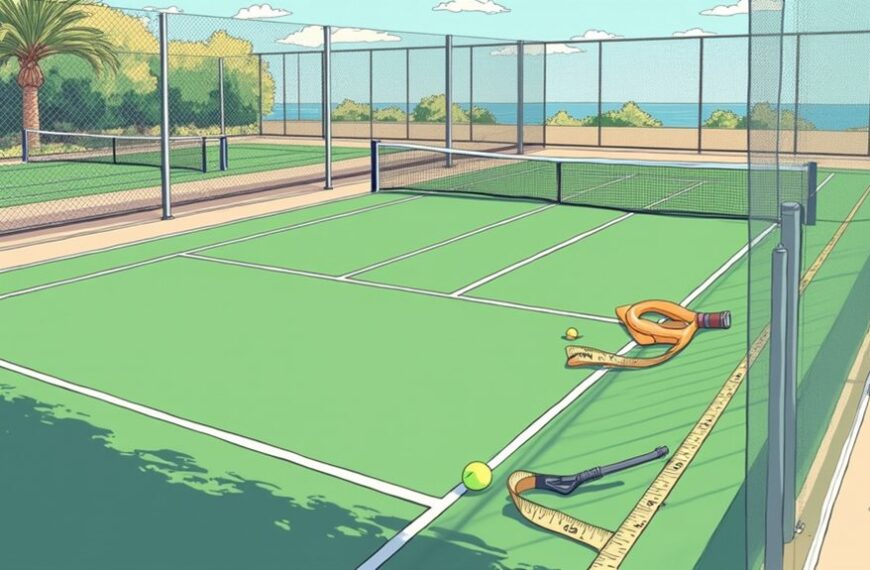
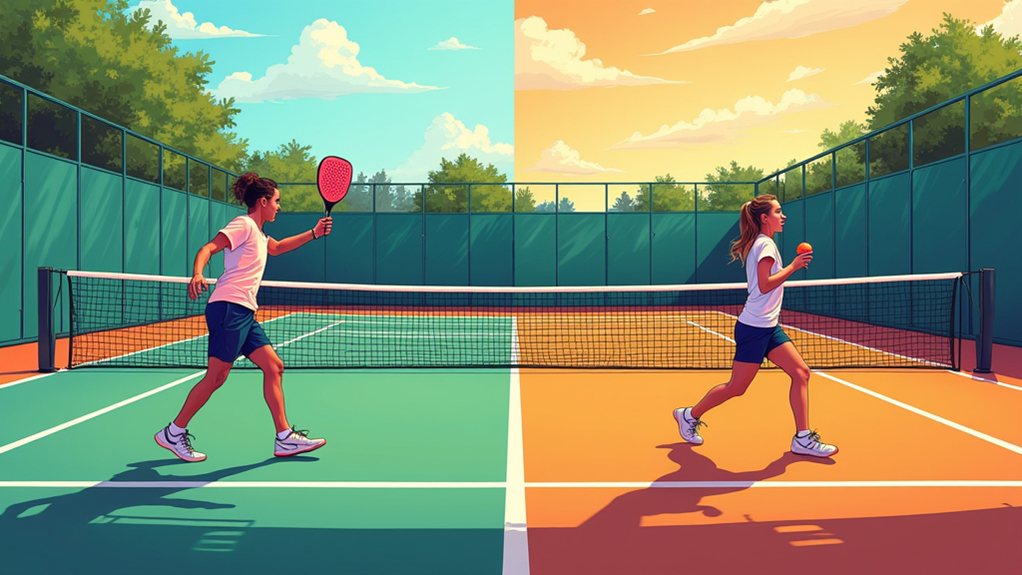
Court sizes differ significantly between the two sports. Padel courts measure 20 × 10 m (200 m²) with glass walls, while Pickleball courts measure 13.4 × 6.1 m (82 m²). Net heights are also slightly different, with Padel sitting at 88 cm at the centre and 92 cm at the posts, compared to Pickleball’s 86.36 cm centre and 91.44 cm posts.
Both sports use an underhand serve, though Padel serves into a service box while Pickleball serves beyond the non-volley zone. Scoring systems differ as well: Padel uses tennis points (15-30-40, deuce) in a best-of-three format, whereas Pickleball plays to 11 points, win by two. As for gear, Padel bats are stringless with perforations, while Pickleball paddles are solid polymer.
Choose the sport that fits your space and style; you’ll get more details.
Court Size Comparison: Padel’s 200 M² Vs Pickleball’s 82 M²
Compare the playing surfaces of padel and pickleball, and you’ll immediately notice a dramatic size difference. Padel courts measure 20 meters long by 10 meters wide. This gives you 200 square meters of playing space.
Pickleball courts measure 13.4 meters long by 6.1 meters wide. This gives you 82 square meters of space.
- Size comparison:
- Padel: 20m × 10m (65.6 ft × 32.8 ft)
- Pickleball: 13.4m × 6.1m (44 ft × 20 ft)
- Area difference:
- Padel: 200 m² (2,150 sq ft)
- Pickleball: 82 m² (880 sq ft)
- A padel court is more than twice as large
- Relative sizes:
- Padel equals roughly one-third of a tennis court
- Pickleball matches badminton doubles dimensions
The larger padel surface gives you more ground to cover. You’ll find longer running distances and bigger reaches required during play.
The smaller pickleball court creates faster exchanges and keeps you closer to the action at all times. In fact, the pickleball court’s compact dimensions mean it fits entirely within a standard tennis court footprint, with multiple pickleball courts often marked inside a single tennis court using overlaid lines.
Why Padel’s Glass Walls Change Everything
When you step onto a padel court, the glass walls immediately set this sport apart from most racket games. The walls aren’t decorations, they change how you play.
Balls bounce off the glass after your shot, keeping the ball in play. This creates longer rallies than in open courts.
Glass walls bounce the ball back, keeping play alive and stretching rallies longer than on open courts.
You must anticipate wall rebounds, rather than simply your opponent’s hits. The walls also contain the ball, so you never chase errant shots far from the playing area.
This makes gameplay faster and more continuous.
- Walls extend your rallies
- You account for rebound angles
- No lost balls or long run-outs
- Strategy shifts to wall usage
Net Heights: Padel’s 88 Cm Vs Pickleball’s 86 Cm
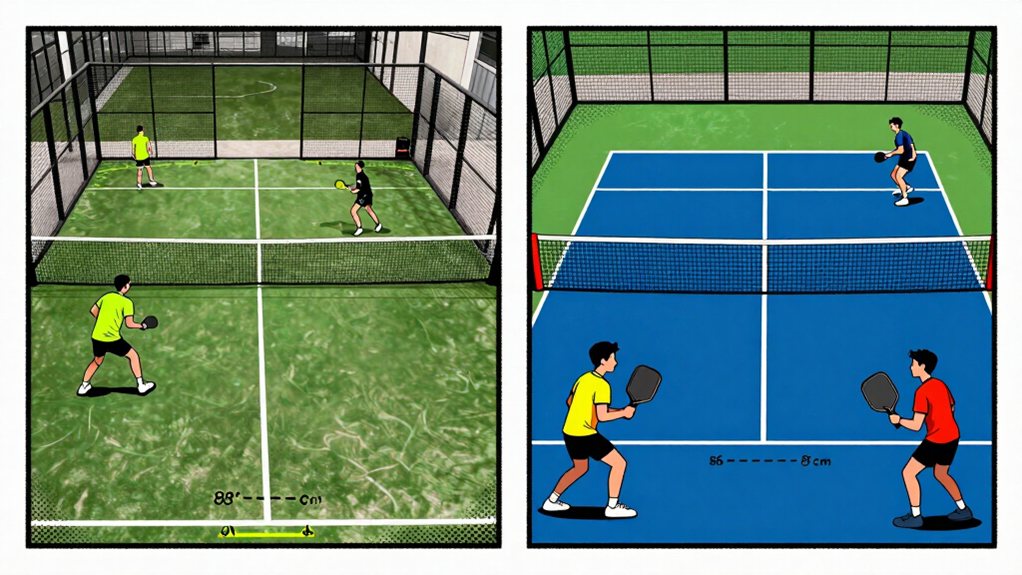
Standing at the net, you’ll notice padel sits slightly higher than pickleball. The center height difference is minimal but affects gameplay. Here’s what you need to know:
- Padel net height:
- Center: 88 cm (2.9 ft / 35 inches)
- Posts: 92 cm (3 ft / 36 inches)
- Pickleball net height:
- Center: 86.36 cm (2.83 ft / 34 inches)
- Posts: 91.44 cm (3 ft / 36 inches)
The 1.64 cm difference may seem small.
Yet it influences ball trajectory and shot placement.
Both sports maintain 36 inches at the posts. This helps guarantee consistent net tension across the width.
Your footwork adjusts accordingly when switching between sports.
Serving Rules: Underhand but Not Identical
Now let’s look at how you serve in each sport. Both padel and pickleball use underhand serves, but the rules differ in important ways.
Both padel and pickleball use underhand serves, but the rules differ—impact level, court placement, and serve attempts vary significantly.
In padel:
- You serve below waist level
- The ball must land diagonally in the opponent’s service box
- You alternate sides after each point, starting from the right side
- You receive two attempts per serve
In pickleball:
- You serve with an upward motion
- Impact must occur below your waist
- Both feet stay behind the baseline at all times
- The ball must land beyond the non-volley zone, which stretches 7 feet from the net
- You receive only one attempt per serve
These differences affect how you approach your serve strategy in each sport.
Scoring Systems: Tennis Points vs. 11-Point Games
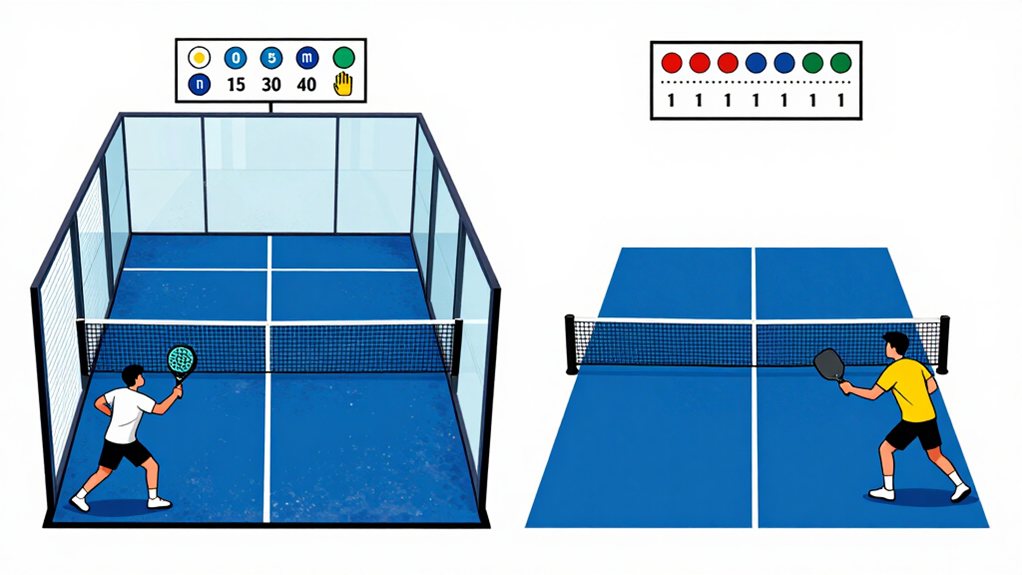
1) You’ll see that padel uses the traditional tennis point system (15, 30, 40, deuce), while pickleball plays to 11 points.
2) We’ll note that padel requires a two, point advantage to win a set, and you need a two, point lead to win a game in pickleball.
3) You’ll remember that in padel only the serving side can score, but in pickleball the receiving side may also score after a side, out.
Point System Differences
When you step onto the court, the scoring system you follow depends entirely on which sport you play. In padel, you earn points in the traditional tennis sequence. You start at zero, advance to 15, then 30, then 40. When you win four points, you win a game.
In pickleball, you score in simple increments. You begin at one, then two, then three, until you reach 11. The mechanics differ completely.
- Padel uses 15-30-40 counting with deuce and advantage when both players reach 40-40.
- Pickleball uses 1-2-3 counting up to 11 points per game.
- Padel allows both sides to score, while pickleball uses side-out scoring where only the serving side earns points.
Winning Condition Contrast
Understanding how each sport determines a winner helps you prepare for competition. In padel, you win a match by securing the majority of sets.
Most padel matches use a best-of-three format where you need two set victories to claim the win.
Each set requires at least six game wins, and you must win by two games.
If both players reach six games, a tiebreaker determines the set winner.
Pickleball follows a different winning condition.
You play to 11 points, but you must win by two points.
When the score reaches 10-10, play continues until one side achieves a two-point lead.
Only the serving side can score in pickleball, which changes your strategic approach completely.
This means you must hold your serve to accumulate points.
Scoring Structure Comparison
Because padel and pickleball use different scoring systems, you must learn both approaches to compete effectively. Padel uses traditional tennis scoring: 15, 30, 40, deuce, and advantage.
You win games by reaching 40 and holding your serve. You win sets by winning six games, and you win matches by winning best of three sets.
Some padel tournaments apply golden point at deuce to end sets faster. Pickleball operates differently. You play to 11 points, and you must win by 2 points.
Only the serving team scores points, which is called side-out scoring.
- Padel scoring mirrors tennis with 15-30-40-advantage points.
- Pickleball uses 11-point games with mandatory 2-point margin.
- In padel, both teams score; in pickleball, only the server scores.
Equipment: Balls, Paddles, and Racket Design
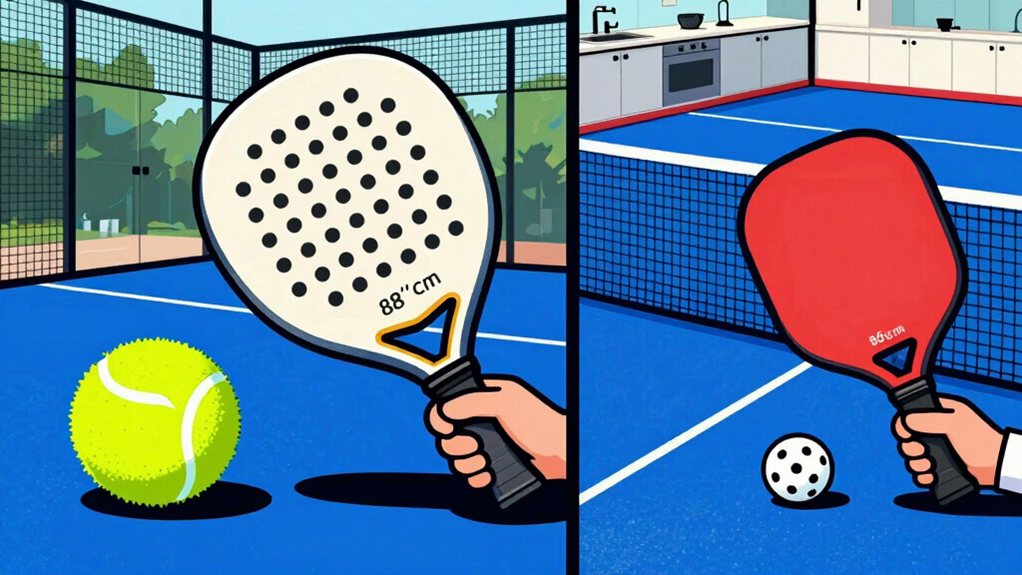
You need to account for these points, and we’ll examine:
1) ball types and design, 2) paddle materials and construction, 3) racket features and technology.
Padel uses low-pressure tennis balls (~0.7 bar) that bounce off walls.
Pickleball uses solid plastic balls with 26-40 holes for a softer hit.
Padel rackets are solid, perforated rubber bats (~350 g) without strings.
Pickleball paddles are lightweight polymer (~150-230 g) often with a honeycomb core.
Ball Types And Design
When comparing equipment, padel and pickleball use distinctly different balls and racket designs suited to their respective games. You’ll notice immediately that padel balls resemble tennis balls but operate at lower pressure.
This reduced pressure creates a softer feel and slower pace, which helps the ball bounce predictably off walls.
Pickleball balls differ, they’re solid plastic discs with holes throughout the surface. These perforated balls generate unique spin and flight characteristics that you must adjust to when playing.
- Padel balls maintain 2-3 PSI below standard tennis ball pressure, extending their lifespan during wall play.
- Pickleball balls feature 26-40 holes depending on the manufacturer, affecting wind resistance and bounce.
- Outdoor pickleball balls use thicker plastic to withstand weather, while indoor versions allow faster gameplay.
Paddle Materials And Construction
Although both sports use paddle-like implements, the materials and construction of padel bats and pickleball paddles differ significantly to match the demands of each game.
Padel bats feature:
- Solid rubber faces with small perforations
- Fiberglass or carbon fiber frames
- Foam or rubber cores for shock absorption
- Maximum length of 45.5 cm
Pickleball paddles use:
- Graphite, composite, or aluminum faces
- Polymer or nomex honeycomb cores
- Maximum length of 17 inches
- Solid construction without holes
Paddle weight affects your game. Heavier padel bats give you more power and stability. Lighter options improve maneuverability and reduce fatigue. Pickleball paddles typically weigh 7-8.5 ounces.
The weight provides control and quick reaction time.
Material choice shapes your experience. You notice the difference in feel and durability.
We use these tools to match our playing style and court conditions.
Racket Features And Technology
Building on paddle construction details, let’s examine the balls and racket design features that define each sport. Padel rackets lack strings. They feature a solid, perforated surface made of carbon fiber or fiberglass composite. The hitting area contains small holes that reduce air resistance.
Pickleball paddles use solid polymer faces without perforations. These paddles weigh between 7 and 8.5 ounces.
Ball composition differs in a major way. Padel balls resemble tennis balls with lower pressure. They maintain bounce off glass walls during rallies. Pickleball balls are solid plastic with holes. These balls travel slower and generate less spin.
- Padel rackets use stringless designs with perforations, allowing controlled rebounds off court walls.
- Pickleball paddles employ non-rough polymer surfaces, generating minimal spin during play.
- Padel balls retain tennis-ball characteristics with lower pressure, while pickleball balls use solid plastic construction with distinctive hole patterns.
Frequently Asked Questions
Which Sport Is Easier for Beginners to Learn?
Pickleball is easier for beginners. You’ll find its smaller court lets you cover ground quickly, and you can master basic serves and shots in a few sessions. Simpler rules help you build confidence.
How Does the Physical Intensity Compare Between Padel and Pickleball?
Padel demands more physical exertion, you cover a larger court, chase wall rebounds, and play longer rallies. Pickleball offers lower-impact movement with shorter distances, making it easier for beginners seeking a lighter workout.
Are Padel Courts More Widely Available Than Pickleball Courts?
Think of padel courts as rare gems in certain regions, while you’ll find pickleball courts sprouting across neighborhoods. Availability depends on your location, pickleball leads in the US, padel dominates in Europe.
What Are the Typical Costs to Play Padel Versus Pickleball?
You’ll typically pay $20-50 per hour for padel court time, while pickleball costs $5-20 per session. Padel requires specialized equipment and its unique racket style, adding to initial costs compared to pickleball’s more affordable paddles and balls.
Which Sport Offers More Opportunities for Competitive Tournaments?
You’ll find more competitive tournament opportunities in pickleball due to its explosive growth, organized ranking systems, and widespread recreational play across communities, despite padel’s strong regional presence in Europe and Latin America.
Final Thoughts
Finally, both padel and pickleball provide distinct racquet experiences. You choose padel for larger courts and glass walls. You choose pickleball for compact play and quick games. Remember these key differences: padel courts measure 200 m² with 88 cm nets; pickleball courts span 82 m² with 86 cm nets. Padel uses tennis scoring; pickleball uses 11-point games. Consider your space, speed, and style preferences when selecting your sport.