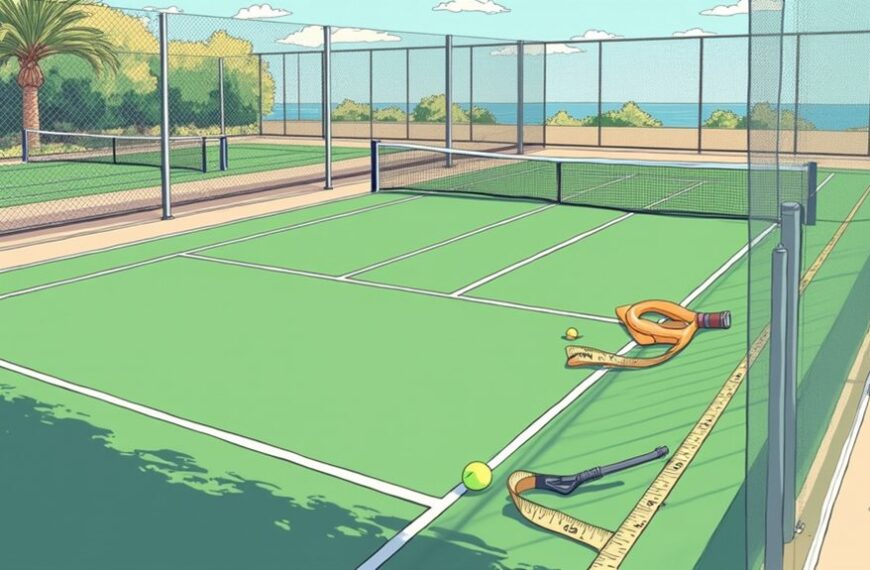
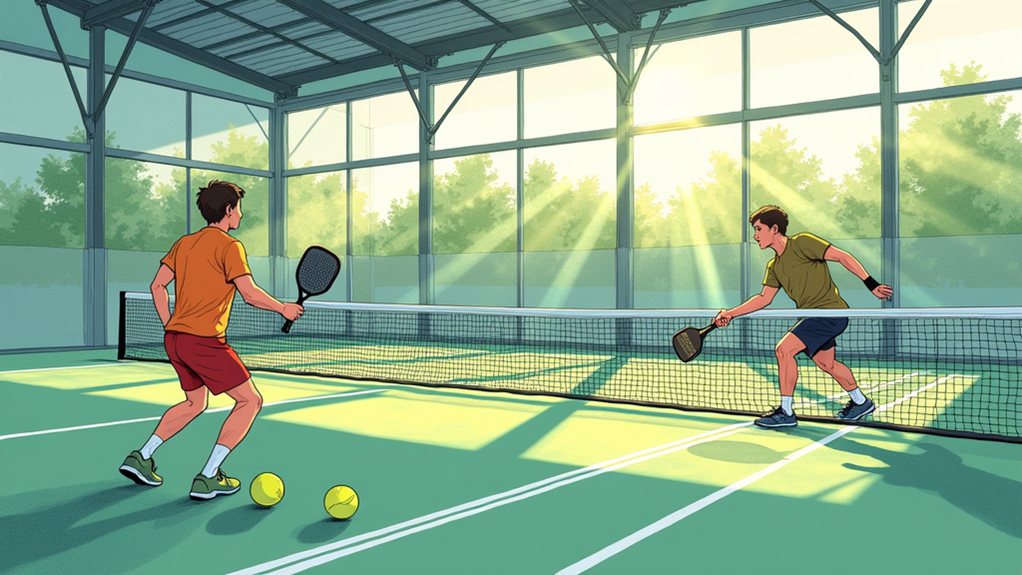
No, you can’t play pickleball on a padel court. Pickleball forbids ball contact with walls; padel needs rebounds. Size: padel 20 m × 10 m, pickleball 20 ft × 44 ft. Net height: padel 88 cm, pickleball 86.4 cm. Equipment: padel uses tennis balls, pickleball uses plastic balls.
If you need a place, try centers, gyms, or portable kit on 30 ft × 60 ft surface. For more detail, see our guide.
Can You Play Pickleball on a Padel Court? The Short Answer
The short answer is no, you can’t legally play pickleball on a padel court. Here is why:
No, pickleball can’t be played on padel courts—different walls, dimensions, net height, balls, and rules.
- Padel courts have walls. Pickleball rules forbid ball contact with walls.
- Padel courts measure 20m x 10m. Pickleball courts measure 20ft x 44ft.
- The net heights differ. Padel nets sit at 88cm center. Pickleball nets sit at 86.4cm center.
- Padel uses tennis-style balls. Pickleball uses perforated plastic balls.
- Wall rebounds are mandatory in padel but illegal in pickleball.
Official organizations classify these sports as distinct.
The International Pickleball Teaching Association specifies court dimensions that exclude walled environments.
No governing body permits pickleball on standard enclosed padel courts under official rules.
Pickleball also enforces a non-volley zone extending 7 feet from the net on both sides, a rule that would be further complicated by the presence of surrounding padel walls.
Where to Play Pickleball If You Only Have a Padel Court
If you only have access to a padel court and want to play pickleball, you’ll need to find alternative venues.
You can look for community centers, indoor sports facilities, or mobile court rental services in your area.
These options provide proper pickleball courts that meet official dimensions and allow you to play without the wall restrictions that padel courts impose.
Community Centers
Community centers often provide dedicated pickleball courts when padel facilities are unavailable in your area. These venues typically convert basketball courts or multipurpose gym spaces into pickleball courts using temporary nets and tape markings.
You should check your local community center’s schedule online or call ahead. Most centers offer open play sessions during weekday mornings and evenings. Membership requirements vary; some centers allow non-members to play for a small daily fee.
Court availability is first-come, first-served at many locations. Some community centers host organized pickleball leagues.
Equipment rentals are often available if you don’t own a paddle and balls.
Indoor Sports Facilities
Although padel courts have walls that make them unsuitable for official pickleball play, you can find indoor pickleball options at several types of facilities.
Indoor sports complexes offer dedicated pickleball courts with proper markings and nets.
Recreation centers convert gymnasiums into temporary pickleball courts during open hours.
Health clubs include pickleball classes in their schedules.
Multi-sport arenas set up portable nets for open play.
Many facilities offer leagues, clinics, and tournaments for all skill levels.
You can find indoor pickleball at:
- Large sports complexes with multiple courts and flexible scheduling
- Community recreation centers with gym space and night leagues
- Health and fitness clubs with court facilities and group classes
- Indoor sports arenas with portable net setups and open play times
Mobile Court Rentals
Mobile court rentals offer a practical solution when you want to play pickleball but only have access to a padel facility. You can bring a portable pickleball court to any location.
- Search online for “portable pickleball court rental” in your area.
- Compare prices; daily rentals cost $150-$300.
- Confirm the kit includes nets, boundary lines, and paddles.
- Reserve at least one week ahead for weekend play.
- Make sure you have a flat surface of 30 feet by 60 feet.
Benefits include quick setup in 20 minutes and removal after play.
You control the environment without permanent court construction.
Many companies deliver and install the equipment for you.
Court Dimensions: Why Size Differences Matter
Contrast dimensions in two steps: 1) Measure padel court, 20 m × 10 m (≈200 m²); 2) Measure pickleball court, 20 ft × 44 ft (≈88 m²).
The padel court covers about twice the area of the pickleball court, giving you more running space, but it’ll also introduce wall rebounds.
Therefore, when we play pickleball on a padel court, the game’s dynamics change due to these size differences.
Size Comparison Overview
Since padel courts measure 20 meters wide by 10 meters long, they’re significantly larger than pickleball courts. This difference affects how you play both games.
Padel courts cover 200 square meters while pickleball courts cover only 88 square feet.
You need more running space in padel. The walls in padel create rebound opportunities that pickleball doesn’t use. Pickleball courts fit in smaller spaces. You can set up pickleball in gyms or driveways easily.
Consider these size facts:
- Padel courts are about 2.3 times bigger than pickleball courts.
- The extra space in padel changes player positioning and strategy.
- Walls in padel extend the playing area beyond the baseline.
- Pickleball’s smaller size makes it more accessible for casual play.
Area Impact
Area Impact
The size difference between padel and pickleball courts directly affects how you play each sport. A padel court measures 20 meters by 10 meters, covering 200 square meters. A pickleball court measures 20 feet by 44 feet, covering about 88 square meters. This means padel exceeds pickleball by roughly 112 square meters.
You will find padel courts offer more room. You must adjust your footwork for the larger area. The walls in padel add playable territory. Pickleball has no walls. This size gap creates distinct gameplay experiences.
You cannot simply transfer pickleball layouts onto padel surfaces. The larger padel area changes serving distances. It changes rally lengths. It changes strategy entirely.
| Court Type | Dimensions | Surface Area |
|---|---|---|
| Padel | 20m x 10m | 200 sq m |
| Pickleball | 20ft x 44ft | 88 sq m |
| Singles Pickleball | 17ft x 44ft | 68 sq m |
| Size Difference | , | 112 sq m larger |
| Practical Impact | More ground to cover | Adjusted footwork needed |
The Wall Problem: Why Padel’s Enclosed Space Doesn’t Work
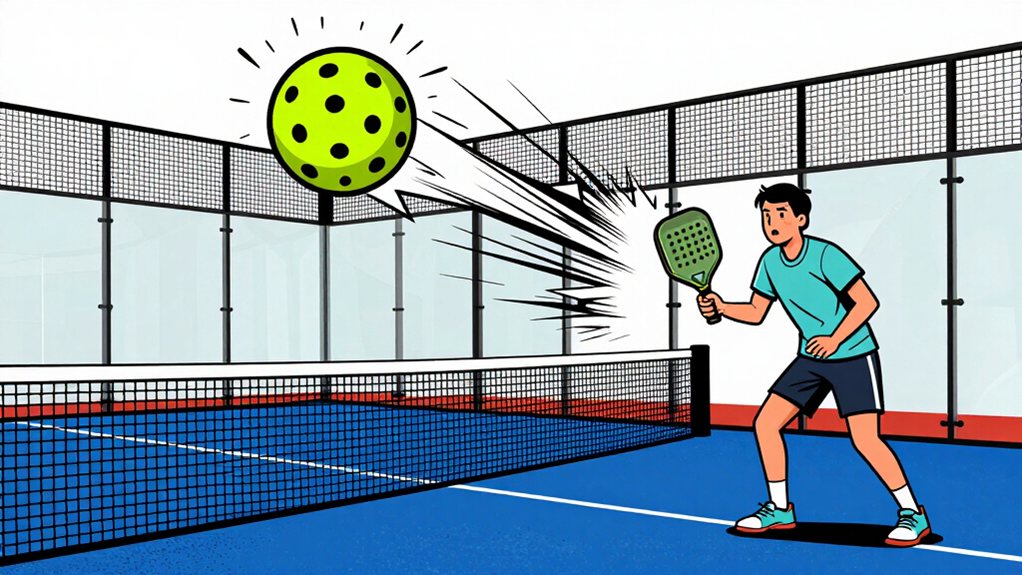
When you step onto a padel court, the walls immediately change how the game works. The enclosed space forces every ball to interact with solid surfaces. You can’t ignore the walls. They become part of every point.
Padel courts use walls as strategic tools:
- The 3-meter tall walls create rebound opportunities that pickleball never uses.
- Balls bounce off walls and back into play, requiring constant awareness.
- Pickleball rules forbid any wall contact, making enclosed play impossible.
- The glass and mesh barriers transform every shot into a multi-dimensional calculation you never trained for.
The wall problem goes beyond rules. Your muscle memory expects open boundaries.
Your positioning assumes no rebounds.
The enclosed space creates a fundamental mismatch between what you know and what the game demands.
Net Height and Court Markings: Technical Barriers
Consider how net height differences create immediate problems for cross-court play.
The padel net stands 88 centimeters at center, while the pickleball net reaches 86.4 centimeters at center and 91.4 centimeters at the posts.
You notice the 1.6-centimeter difference immediately during serves.
The variance affects ball trajectory and shot placement.
Court markings create additional barriers.
Padel courts lack the 7-foot Non-Volley Zone line that defines pickleball play.
Service boxes don’t align between the two sports.
You can’t simply paint new lines over existing padel markings without confusion.
These technical differences mean you can’t convert a padel court for official pickleball matches.
The net height and marking discrepancies violate standard play rules.
Rule Conflicts: The Kitchen vs. Wall Rebounds
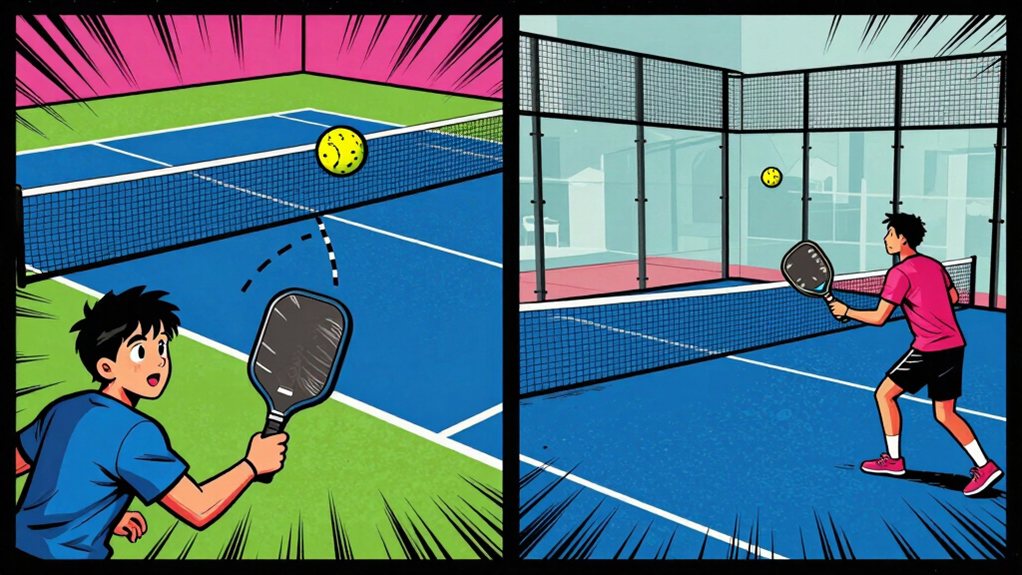
Unlike padel, pickleball restricts player movement near the net with a 7-foot Non-Volley Zone, commonly called the Kitchen. You can’t volley the ball inside this zone.
Padel players use walls constantly. They bounce shots off the glass and hit returns directly. Pickleball forbids all wall contact. These opposing rules make the two sports incompatible. You face these conflicts:
- Kitchen placement on a padel court has no official positioning, so players can’t enforce the 7-foot rule.
- Wall rebounds in padel create fast returns that would violate pickleball’s volley restrictions instantly.
- Padel allows you to hit the ball after one bounce; pickleball requires two bounces before volleys begin.
- The fundamental gameplay philosophies contradict each other completely.
Equipment Safety: Pickleball Paddles and Padel Balls
Using the wrong equipment creates dangerous safety hazards. Pickleball paddles lack the reinforced fibreglass construction of padel rackets. Padel balls travel faster and bounce harder than pickleball balls. You risk injuring your wrist, elbow, or shoulder when you use a pickleball paddle with padel balls.
The lighter pickleball paddle can’t absorb the higher impact forces. Padel rackets are specifically engineered for their balls. The solid composite face absorbs shock differently than pickleball paddle surfaces. Your safety depends on using sport-specific equipment.
Never substitute pickleball paddles when playing padel. Never use padel balls on a pickleball court. Equipment mismatch causes unnecessary injury risk. Choose the correct gear for your chosen sport. Protect your body by matching equipment to game requirements.
Official Rules: What the Federations Say
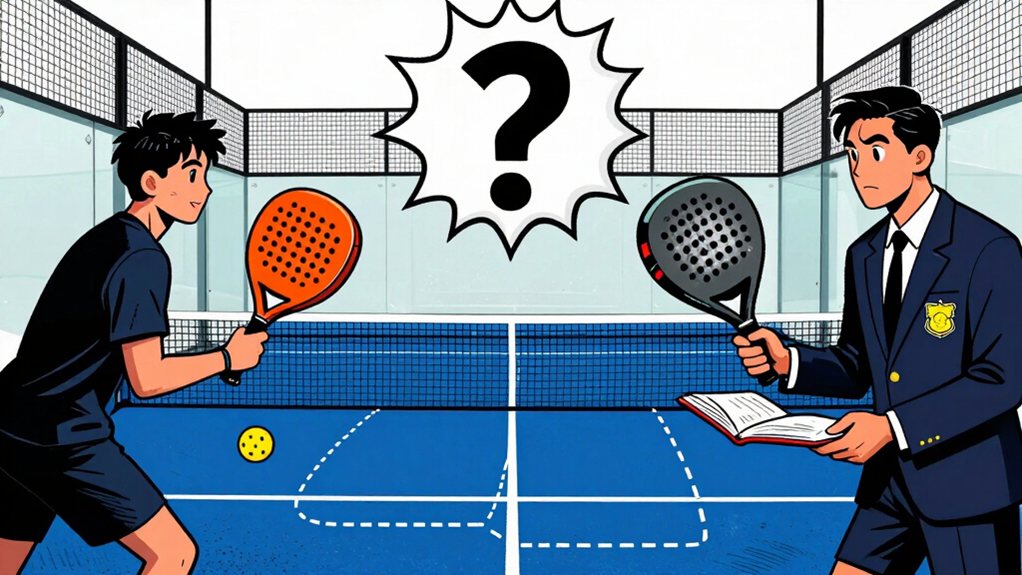
Because the governing bodies classify padel and pickleball as distinct sports with incompatible requirements, you can’t play pickleball on a padel court under official rules.
The International Padel Federation mandates that wall rebounds are a core element of play. The International Pickleball Teaching Association specifies court dimensions that exclude walled environments.
Both organizations enforce different net heights, boundary lines, and scoring systems. You must follow these official stances to guarantee compliant gameplay.
- The International Padel Federation (IPF) requires wall rebounds as an vital part of every rally
- The International Pickleball Teaching Association (IPTA) forbids ball contact with walls during play
- The IPF sets padel courts at 20m x 10m with 3m high perimeter walls
- The IPTA standards call for open courts measuring 20ft x 44ft with no walls
These regulations guarantee player safety and fair competition across both sports.
Why Padel and Pickleball Courts Have Different Designs?
The different court designs reflect the fundamental gameplay differences between the two sports. Padel courts measure 20m x 10m and use walls you bounce balls off during play. Pickleball courts measure 20ft x 44ft and have no walls for ball rebounds. You cannot play pickleball on a padel court because the walls interfere with pickleball rules.
Padel requires high-impact walls that enable strategic ball rebounds during rallies. The enclosed design allows dynamic gameplay with players using walls. Pickleball requires an open playing surface without wall interactions.
The padel net sits at 88cm, slightly higher than pickleball’s 86cm. Pickleball courts include a specific 7-foot non-volley zone you must respect. These fundamental design differences make the courts incompatible for cross-play. Each sport’s unique playing characteristics determine its specific court requirements.
| Feature | Padel Court | Pickleball Court |
|---|---|---|
| Dimensions | 20m x 10m | 20ft x 44ft |
| Walls | Required | Prohibited |
| Net Height | 88cm center | 86cm center |
Frequently Asked Questions
How Much Does It Cost to Convert a Padel Court for Pickleball?
You’re looking at $15,000-$30,000 for basic conversion, but complete wall removal, structural modifications, and new markings can cost $50,000-$75,000. Most facilities find building a new pickleball court more practical.
Can a Padel Court Be Used for Both Padel and Pickleball Sessions?
Like forcing a round peg through a square frame, you cannot use a padel court for pickleball. The walls, dimensions, and net height create an impossible mismatch, you must keep them separate.
Will Playing Pickleball on a Padel Court Damage the Glass Walls?
You can play pickleball on a padel court without damaging the glass walls, since the light plastic balls won’t impact them. However, your paddles might accidentally hit the walls during play, which could cause scratches or damage over time.
Do I Need Special Shoes to Play Pickleball on a Concrete Padel Surface?
Picture yourself stepping onto that concrete padel court, you’ll want court shoes with proper grip. Regular tennis shoes work, but pickleball-specific soles give you better traction and help prevent slips on the *slightly slicker* surface.
Can I Use a Portable Pickleball Net on a Padel Court?
You can physically place a portable pickleball net on a padel court’s concrete surface, but official pickleball rules require a properly regulation net height of 34 inches at center and 36 inches at the sidelines.
Final Thoughts
We recommend that you do not try to play pickleball on a padel court. The courts differ in size, surface, walls, and net height. A padel court measures 20m x 10m while a pickleball court is 13.41m x 6.10m. Padel walls interfere with ball movement, and the net sits 3cm higher. Follow these steps if you must adapt:
- Remove all players from the court
- Mark new boundary lines with tape
- Adjust the net height to 91.4cm at the center
- Use only pickleball paddles and balls
Trying to combine these sports is like fitting a square peg in a round hole—you will encounter constant problems.