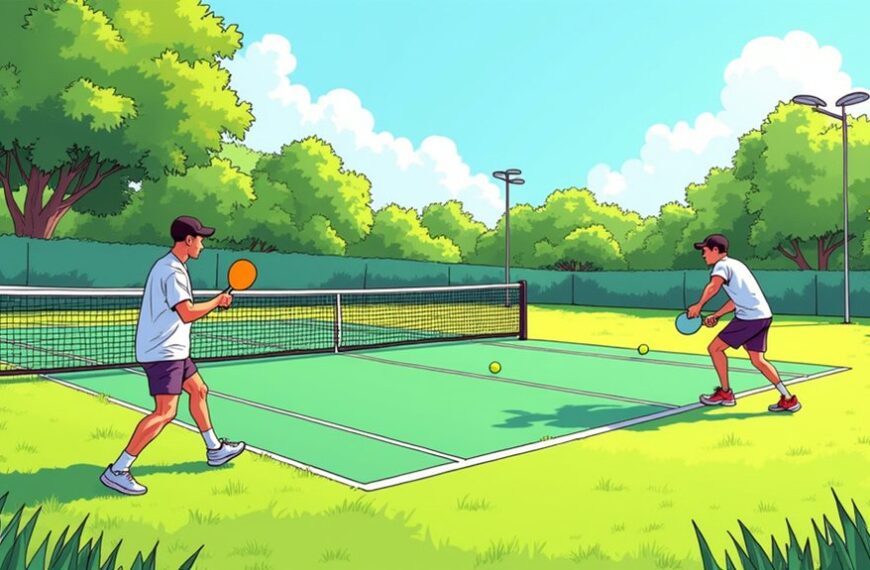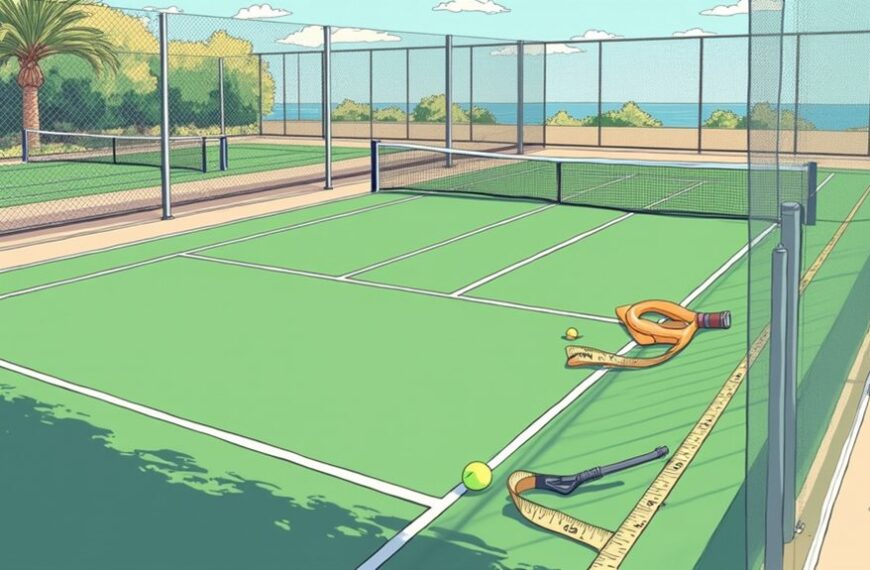
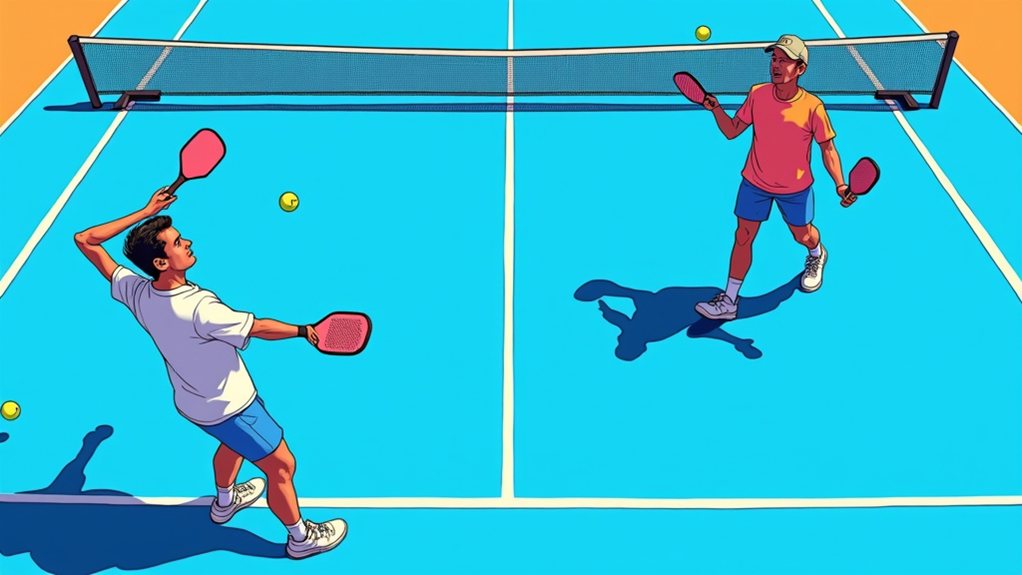
The court measures 20 feet wide by 44 feet long. Lines are 2 inches wide, and any line counts as in. Serve from behind the baseline and hit diagonally crosscourt. The ball must bounce once on each side before volleying (two-bounce rule).
You cannot volley inside the 7-foot non-volley zone (kitchen). Games go to 11 points with a 2-point margin, and only the serving team scores. For more on specific rules, keep exploring.
Pickleball Court Dimensions: How Big Is the Court?
The standard pickleball court measures 20 feet wide by 44 feet long for both singles and doubles play. When you step onto the court, you’ll notice the playing area is smaller than a tennis court. These measurements are taken to the outside of the perimeter and non-volley zone lines.
- The court is 20 feet wide.
- The court is 44 feet long.
- The minimum playing surface you need is 30 feet by 60 feet.
- You should provide 40 feet by 64 feet of surrounding margin for adequate space.
- All boundary lines must be 2 inches wide and the same color.
- The line color must contrast with the playing surface.
On each side of the net, the non-volley zone extends 7 feet from the net, creating a restricted area where players cannot volley the ball unless it has bounced first.

[Oversized 44x20 Feet Template] Complete pickleball court marking template perfect for backyards, schools, and clubs. Easily create accurate, professional-grade courts for family fun, school sports, or club play, enhancing every pickleball experience with precise and durable court lines.

[Oversized 44x20 ft Full-Court Template] Transform any concrete or asphalt surface into a regulation-size pickleball court. This complete marking template is perfect for backyards, schools, and clubs, making it easy to create accurate, professional-grade courts in minutes.
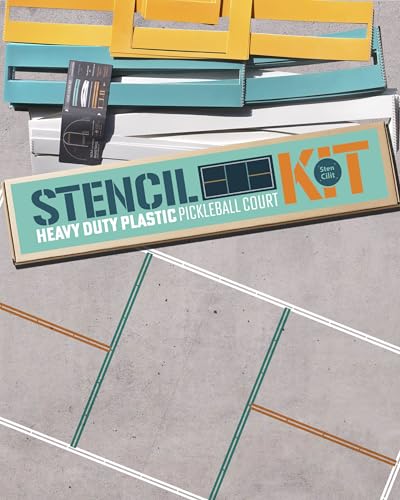
1mm PPE Plastic for Long-Term Reuse: Constructed from 1mm thick, heavy-duty PPE plastic, this stencil kit is weatherproof and designed for multiple applications. The rigid material resists warping and paint buildup, ensuring consistent line thickness across concrete, asphalt, and sports court surfaces.
Court Lines and Boundaries: What’s In and Out?
When you step onto the court, you’ll notice three main boundary lines that determine whether a ball is in or out.
The baseline runs parallel to the net at each end. The sidelines run perpendicular to the net along both sides. All boundary lines are 2 inches wide and considered part of the court surface.
A ball landing on any line counts as in.
- Baseline: the back boundary at each end of the court
- Sideline: the side boundary running the full length of the court
- Centerline: divides the court into right and left service courts
- Non-volley zone line: marks the 7-foot kitchen area where volleying is prohibited
Understanding these lines helps you make accurate in/out calls during play.
The ball must land completely within these boundaries to be considered good. When the ball touches any line, the call goes in your favor.
How to Serve in Pickleball: Rules and Foot Positioning
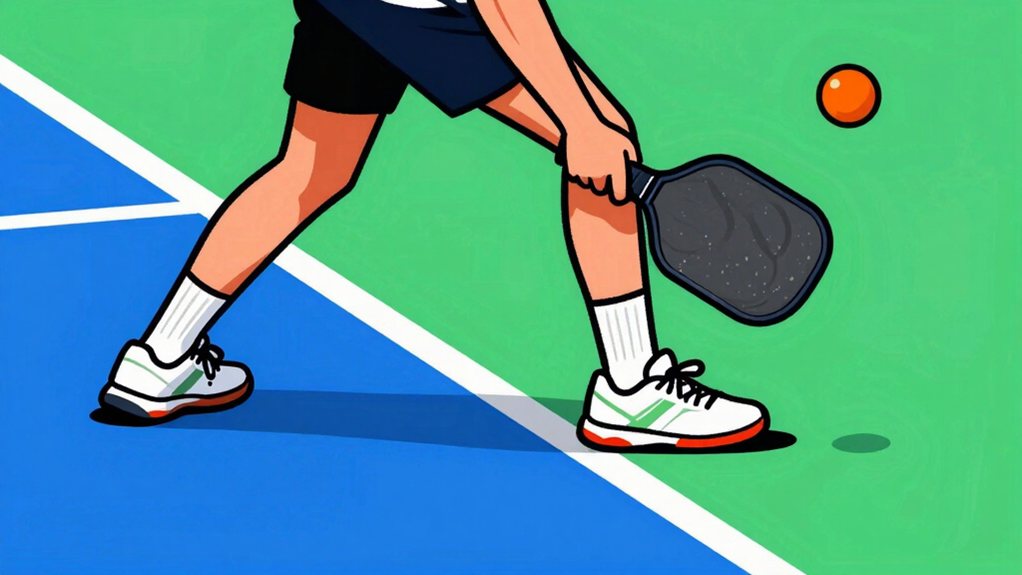
When you serve in pickleball, you must keep both feet behind the baseline and not touch the court surface when you strike the ball.
At least one foot must remain on the ground behind the baseline until after you make contact with the ball.
Your serve must travel diagonally crosscourt into the opposite service court.
Feet Placement Rules
Where must your feet be positioned when you serve in pickleball? Your feet must follow specific rules to make certain a legal serve:
- Keep at least one foot behind the baseline when you strike the ball
- Keep both feet outside the court boundaries until you make contact
- Ensure your feet don’t touch the court surface at the moment of contact
- Position your feet on the ground or the playing surface behind the baseline
These requirements make certain your serve is valid and prevents foot faults during the rally.
Diagonal Service Requirement
Since the serve must travel diagonally crosscourt, you must aim for the opposite service court. The ball must land within the bounds of that diagonal service area.
Key diagonal serve rules:
- Serve from the right/even court when your score is even
- Serve from the left/odd court when your score is odd
- The ball must land in the opposite service court
- The court divides into right and left by the centerline
- The ball must land beyond the non-volley zone
- The server stands behind the baseline
You must serve diagonally because the court splits into two diagonal service areas.
The centerline separates the even and odd service courts.
When your score is zero, two, four, six, eight, or ten, you serve from the right side.
When your score is one, three, five, seven, nine, or eleven, you serve from the left side.
The ball crosses the net at a diagonal angle and lands in the opposite service court.
The baseline and sidelines form the boundary for the service area.
Rally Play and the Two-Bounce Rule Explained
Once you understand the serve, you move into rally play where the real game begins.
The two-bounce rule requires the receiving team to let the serve bounce once, then the serving team must let it bounce once before either side can volley.
After these two bounces complete, you and your opponent can choose to volley the ball in the air or let it bounce and play it off the ground.
Rally Play Basics
Although the serve begins each rally, the two-bounce rule determines how play develops after the ball lands. A rally continues until a fault occurs. You score points only when your team serves. When your team faults, the serve passes to your opponents. We call this side-out scoring.
After the serve and required bounces, you enter full rally mode. During rallies, you must avoid hitting the ball into the net. You can’t let the ball bounce twice on your side. You must keep the ball within the opponent’s court boundaries.
Key rally faults include:
- Hitting the ball out of bounds
- Failing to return the ball before it bounces twice
- Volleying the ball while standing in the non-volley zone
- Touching the net with your paddle or body
You win rallies by forcing your opponents to commit errors. Your team keeps serving as long as you win points. When you fault, the other team gains the chance to serve.
Two‑Bounce Rule
The two-bounce rule governs what happens immediately after each serve lands in your court. After the ball bounces once in your court, you must let it bounce before you hit it. Then the serving team must let it bounce once on their side. Only after both bounces occur can either team volley the ball.
This rule applies on every rally that begins with a serve.
Here are the steps:
- The serve lands in your service court.
- You let the ball bounce one time.
- The serving team lets the ball bounce one time.
- Both teams may now hit the ball in the air.
The two bounces must be complete before volleying begins. If you hit the ball before two bounces occur, you lose the rally. This rule keeps the game fair for all skill levels.
Volley After Bounces
After both required bounces occur, you may then move toward the net and volley the ball in the air. The two-bounce rule protects your opportunity to return serves fairly. Once the ball bounces twice, you gain an advantage.
You can move forward and strike before it lands again.
- You may volley in the air once both bounces happen
- You can’t volley before the second bounce completes
- You can play the ball off the bounce if you prefer
- Both teams gain equal volley rights after two bounces
Your position near the net gives you control.
You must wait for the ball to settle before attacking.
The rule keeps rallies active.
The Non-Volley Zone: Kitchen Rules You Need to Know
When you step onto a pickleball court, you’ll notice the non-volley zone, commonly called the kitchen, runs parallel to the net on both sides.
- The kitchen is 7 feet deep from the net to the non-volley line.
- You can’t volley while your body or paddle is inside the kitchen or on line.
- You may step into the kitchen after the ball bounces, then you can strike it.
- If you volley while in the kitchen, your opponent earns a point.
- The non-volley line is part of the kitchen; touching it counts as being in the zone.
- Stay behind the line when you volley.
- Wait for the ball to bounce before you enter.
- Keep your feet clear of the kitchen until after you hit the ball.

Crafted from a unique 40 singles tri-blend fabric, offering a lightweight, ultra-soft feel

Clear court layout artwork showing baseline, sideline, service courts, centerline, net, kitchen zone, and recommended playing area.

Pickleball Scoring: Points, Games, and Winning
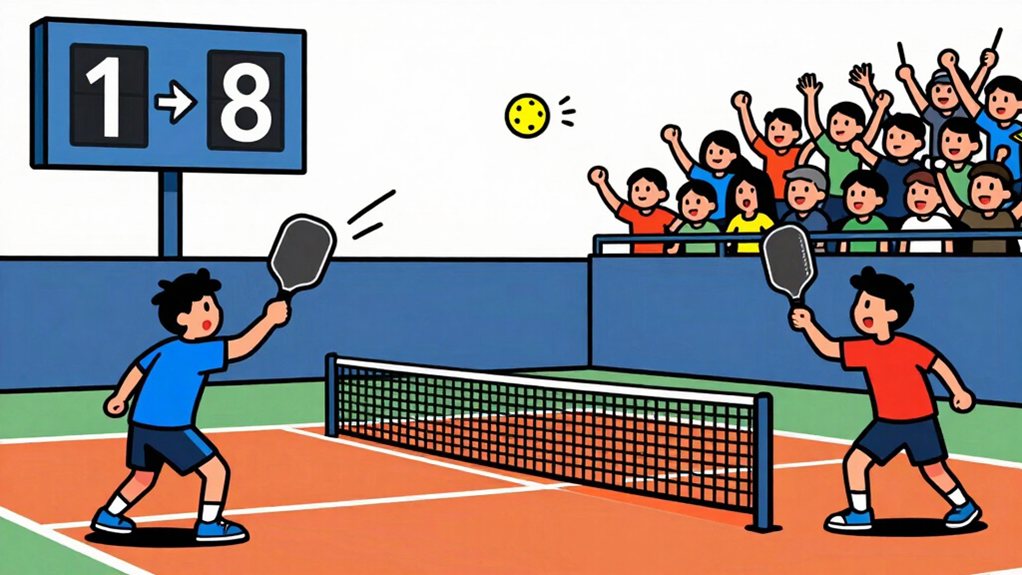
Now that you understand the non-volley zone rules, let’s cover how points are earned and games are won. In pickleball, only the serving team can score a point during a rally. When the receiving team wins a rally, they don’t get a point, they gain the serve instead. This is called side-out scoring.
Games are typically played to 11 points, but you must win by 2 points. Some tournaments use 15 or 21 points instead.
- Points are awarded only to the serving team
- A game is won when a team reaches 11 points with a 2-point margin
- The receiving team gains serve if they win a rally (no point awarded)
- Tournament matches may use 15 or 21-point games
Frequently Asked Questions
Can the Ball Bounce More Than Once During a Rally?
No, the ball cannot bounce more than once in your rally. The two-bounce rule requires each team to let the serve bounce once before volleying begins. After two bounces, you may hit the ball either in the air or after it bounces.
What Is the Maximum Paddle Size Allowed in Official Play?
You can use a paddle measuring no more than 8 inches wide by 16 inches long in official play. These specific dimensions represent the maximum size permitted by the USAPA for tournament and recreational competition.
Are There Any Restrictions on Player Conduct or Unsportsmanlike Behavior?
Over 90% of tournaments report handling at least one unsportsmanlike conduct case yearly. You must avoid profanity, equipment abuse, or delaying play. Repeated violations result in point penalties or immediate disqualification from the match.
How Is a Let Served Ball Handled in Pickleball?
If the ball hits the net during your serve but lands in the correct service court, you play continues, there’s no let rule in pickleball. The ball remains in play and the rally proceeds normally.
Can a Player Step on the Non‑Volley Zone Line While Hitting a Volley?
Approximately 46% of all faults in competitive play involve non-volley zone violations. You can’t step on the non-volley zone line while hitting a volley, your feet must remain outside the kitchen at any point during play.
Final Thoughts
Follow these rules and we’ll play official pickleball.
- Serve diagonally, keep the ball in bounds, and follow the two,bounce rule.
- Stay out of non,volley zone (the kitchen) during volleys, you.
- Score points only when you serve; win games at 11 points, by two.
- The court measures 20 ft by 44 ft; the net is 36 in at the ends, 34 in at center.
Practice these steps and you’ll improve your game.

WORRY-FREE SET: Our team is committed to creating high-quality pickleball court marking kits, so we have carefully prepared a 3-piece pickleball court set to help you get a pickleball court quickly.
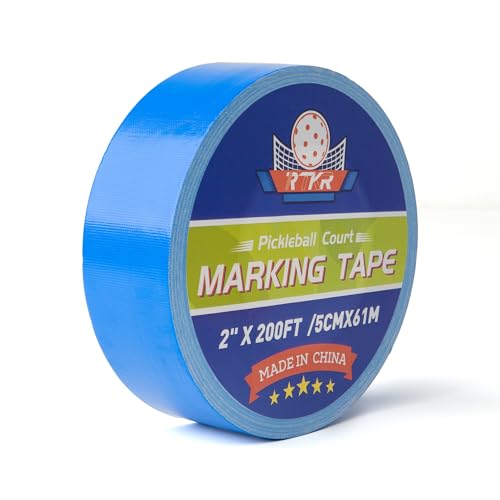
Zero-Residue Removal & Clean Surfaces: Peel away effortlessly leaving absolutely no sticky residue behind. Perfect for protecting gym floors, driveways, and outdoor courts, ensuring a pristine surface every time. (2 inches wide)

[Ultra-durable] Define any space quickly and easily with this floor marking vinyl tape. Our pickleball court tape is tough enough to adhere to any floor or hard surface and remain in place. It can withstand high foot traffic and equipment, so you can depend on this floor tape to keep your areas spaced and marked.